

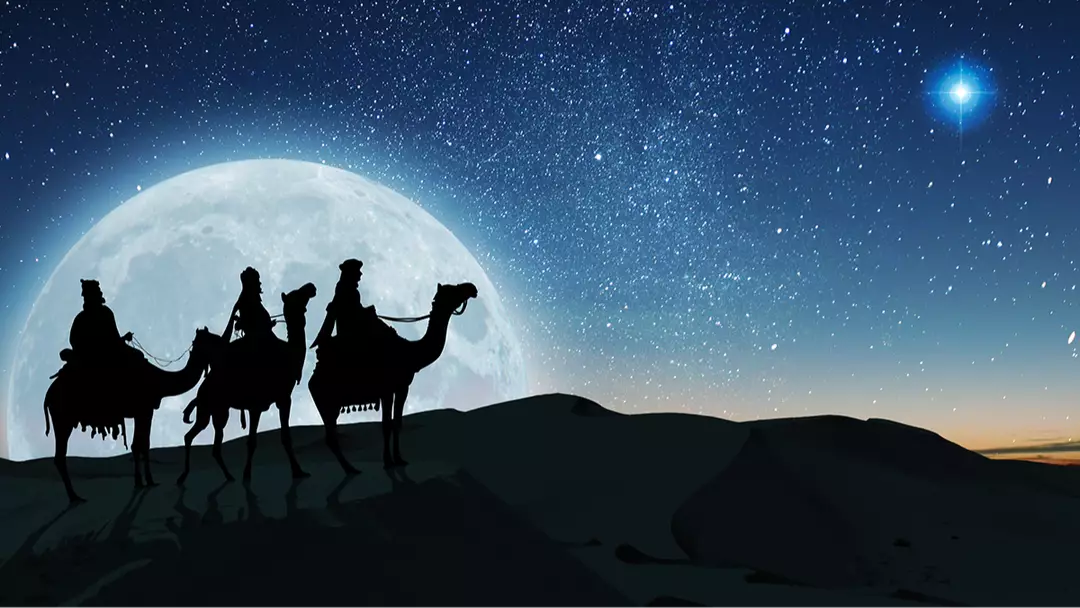
A NASA scientist believes he can unravel the mystery of the Star of Bethlehem mentioned in the nativity story.
As Christmas approaches, many are eager to enjoy quality time with family and the excitement of new gifts. Meanwhile, others take this time to reflect on the Christian nativity story. According to the Bible, when Jesus was born, three wise men followed a celestial sign to his location, bringing gifts to celebrate his birth. This is a cherished story among Christians during this festive period.
The narrative is found in the Gospel of Matthew, detailing how the star led the wise men to Bethlehem, marking the birthplace of Jesus.
This story has puzzled historians, theologians, and astronomers, as there seems to be no known ‘star of Bethlehem’ in the cosmos.
However, a NASA planetary scientist, Dr. Mark Matney, has proposed a potential explanation that aligns with the biblical account. He suggests the ‘star’ was possibly a comet, based on a paper he published in the Journal of the British Astronomical Association. Matney notes that an object observed by the Chinese in 5BC, which was visible for 70 days, could be the star mentioned. The birth of Jesus is often dated between 6BC and 5BC.
Matney’s analysis of ancient Chinese records led him to identify possible orbital paths for the object. One reconstruction indicates it could have been visible on a morning in June 5BC.
In his research, Matney stated: “This is the first astronomical candidate for the Star ever identified that could have had apparent motion corresponding to the description in Matthew, where the Star ‘went before’ the Magi [Wise men] on their journey to Bethlehem until it ‘stood over’ where the child Jesus was.”

Matney added that the comet might have come exceptionally close to Earth, possibly making it visible during the day and appearing extremely bright. It could have looked like a star-like object against the daylight, seeming to pause for several hours.
Despite Matney’s findings, not everyone agrees. An astrophysicist from Friedrich Schiller University Jena in Germany has expressed skepticism about Matney’s conclusions.
According to a report from Metro, Dr. Ralph Neuhäuser, an expert in historical astronomy, argues that the Chinese records might not be entirely reliable. He stated: “The older the record, in general, the less information is left. There have been at least 400 scholarly attempts to explain the truth of the Star of Bethlehem – including supernovas and planetary conjunctions.”