

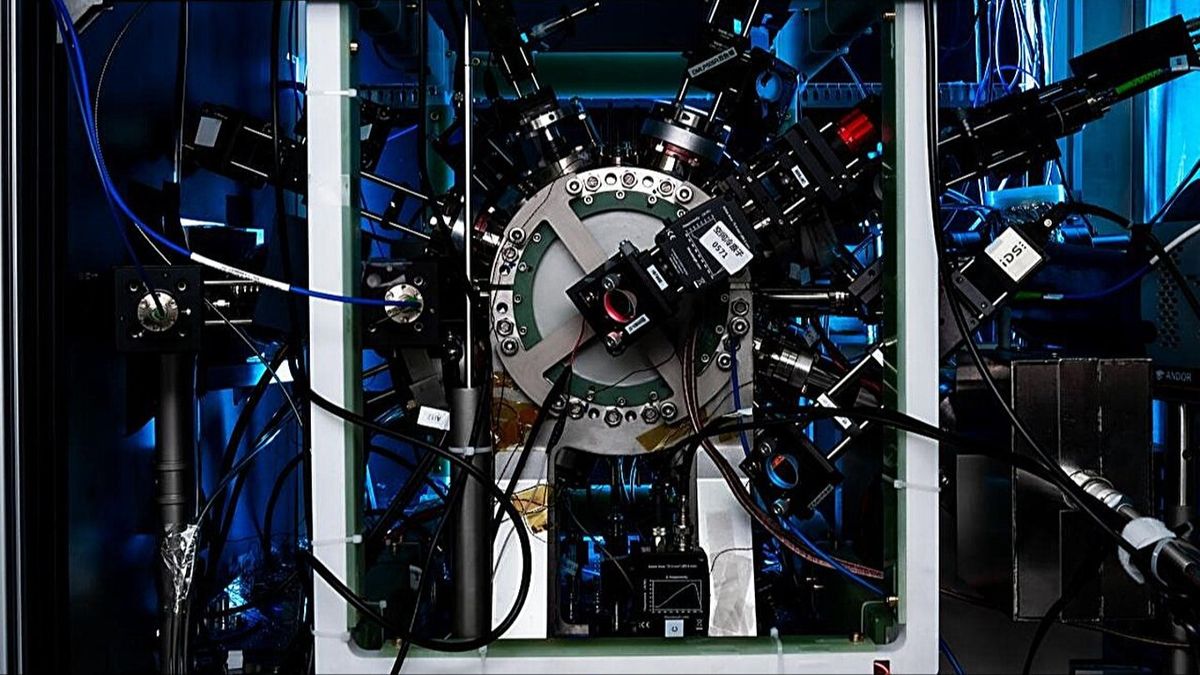
Researchers have developed a clock they say is so accurate it could force a rethink of what a second actually is.
A group of scientists in China has been pushing the limits of precision timekeeping, producing what’s being described as one of the most exact clocks ever built.
The device is called a strontium optical lattice clock, and it’s designed to keep time with extraordinary stability.
According to the researchers, it can resolve a single second out to 19 decimal places.
To put that into perspective: even if it kept running for 30 billion years — more than double the age of the universe — it would drift by only about one second.
That level of accuracy probably won’t affect everyday life, but in the world of measurement science it’s a major step, made possible by rapid progress in optical clock techniques and related technologies.
The clock could also move scientists closer to redefining the second — something that may be on the table within the next decade.
Before that can happen, several requirements still need to be satisfied. One key condition is that at least three optical clocks using the same kind of measurable “tick,” and demonstrating the necessary precision and long-term stability, must be operating at separate institutions.
Writing in the journal Metrologia, the research team said their clock ‘achieves accuracy at the level required for the roadmap of the redefinition of the second’.
The team added that the benefits wouldn’t stop at timekeeping: clocks this sensitive could support efforts to detect dark matter and improve measurements of Earth’s gravitational field.
Time standards have shifted significantly over history. At one point, a second was simply defined as 1/86,400 of a day — dividing a 24-hour day into equal parts.

But because Earth’s rotation doesn’t stay perfectly constant, that approach isn’t reliable enough for high-precision science.
Atomic clocks changed that by allowing the second to be tied to stable properties of nature rather than planetary motion. Since 1967, the International System of Units (SI) has defined one second as exactly 9,192,631,770 oscillations associated with the cesium-133 atom.
It’s a neat fact — and a reminder that even our most familiar measurements are built on ongoing scientific refinement.
Even with today’s cesium-based standard, researchers believe there’s still room to improve, and advances like optical lattice clocks show how quickly that next leap may arrive.