

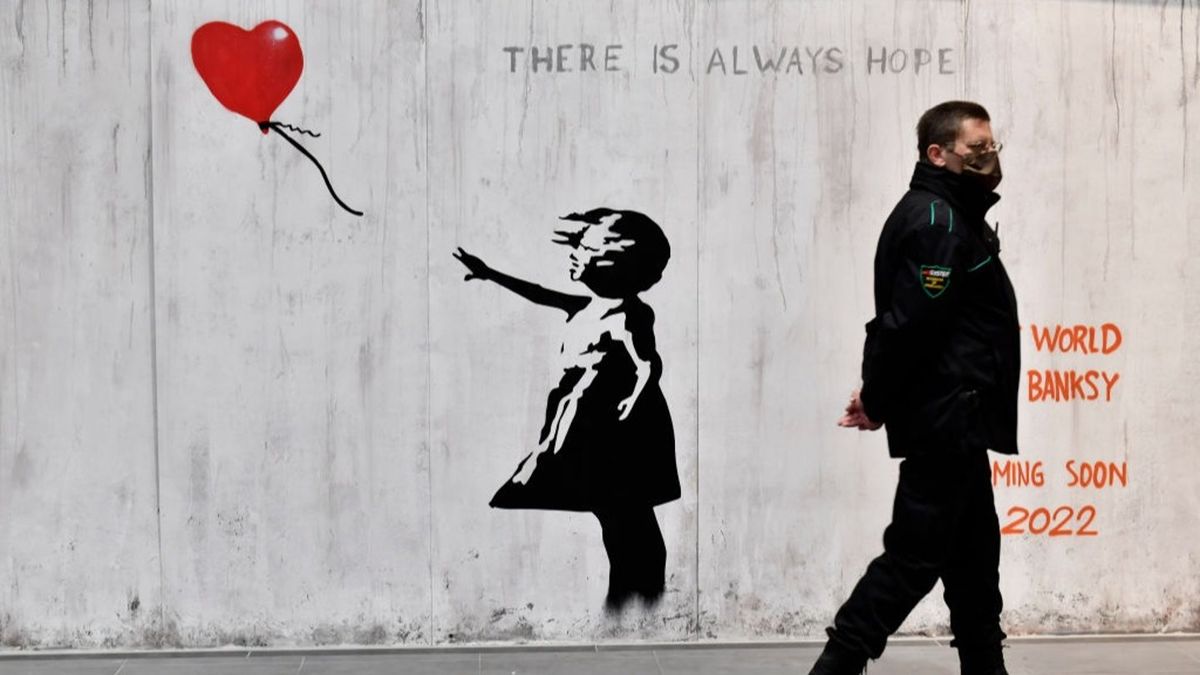
With fresh claims that Banksy’s real name has been identified, many are revisiting some of the artist’s most debated and provocative pieces.
The anonymous street artist has been active since the 1990s, becoming globally recognised for images such as Girl with Balloon. Other widely known works include Flower Thrower, Choose Your Weapon, Laugh Now, and Kissing Coppers.
Fans, critics, and investigators have tried for years to pin down who Banksy really is. Now, the outlet investigation has renewed speculation, suggesting the elusive artist may finally have been identified.
Reports said that Banksy is Robin Gunningham, pointing to US police records in which a person with that name was arrested in September 2000 after allegedly defacing a billboard on top of a building at 675 Hudson Street in New York City.
The report also suggests that Gunningham may have adopted a different name in later years, indicating he may have been using David Jones by 2008.
“In 2017, for example, there were about 6,000 men named David Jones in the UK, according to data analyzed by GBG, an identity-data intelligence company. David Jones also is the given name of David Bowie, whose Ziggy Stardust alter ego inspired a Banksy portrait of Queen Elizabeth,” the outlet writes.
Separate to the identity claims, HUNGER magazine looked back in 2023 at a selection of Banksy’s most controversial creations.
Here are some of the works that continue to spark the most discussion.
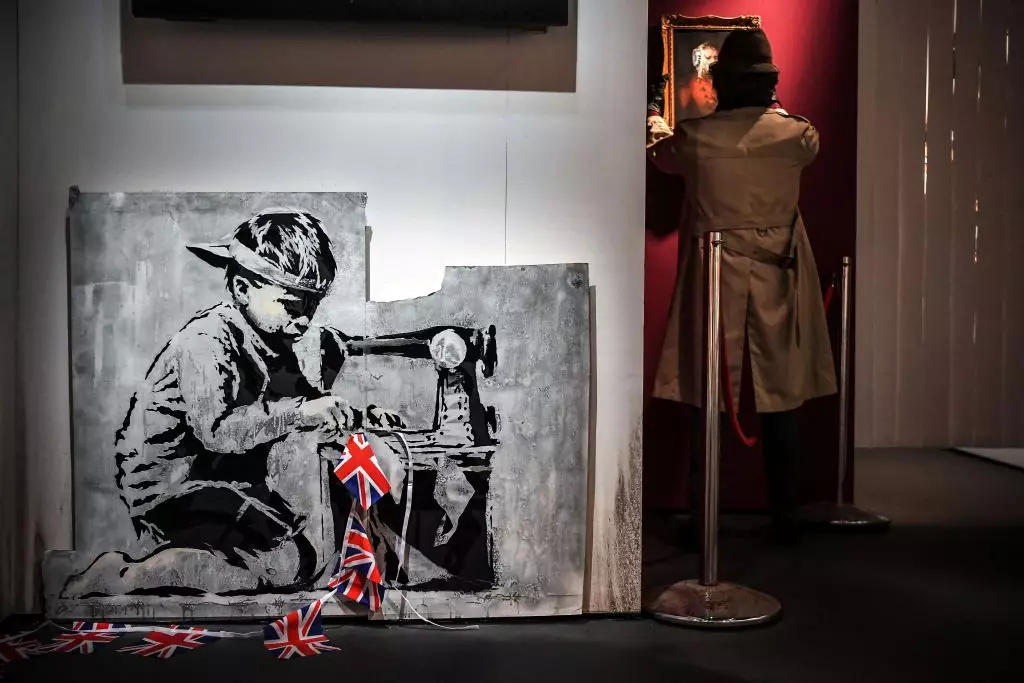
In the lead-up to the London 2012 Olympics, Banksy painted Slave Labour on the wall of a Poundland store in Wood Green, north London.
The piece targeted consumerism and exploitation, depicting a child sewing Union Jack bunting associated with both the Olympic celebrations and the Queen’s Diamond Jubilee, which took place the same year.
In 2010, Banksy turned his attention to Detroit, using a mural to comment on the city’s long-term decline and transformation.
The artwork showed a young boy holding a brush and paint can beside the phrase “I remember when all this was trees,” painted in red. It appeared near the abandoned Packard Plant, a stark symbol of Detroit’s industrial past.
In 2015, Carl Goines and Monte Martinez—directors of Detroit’s 555 Nonprofit Gallery and Studios—shared their reactions to the piece while speaking to Rust Belt Magazine.
“There used to be a whole infrastructure of people working there, and they’re all gone. So are the trees people? Or are the trees trees?” Martinez told Rust Belt Magazine.
“You could plant this anywhere in Detroit,” Goines added.
“The city’s been rebuilt, reshaped, rivers buried. It’s nothing like it ever was.”
Perhaps the most infamous moment tied to Banksy’s work came in 2018, when Girl with Balloon was sold at auction for more than £1 million ($1.3 million)—and then partially shredded moments later.
The sale took place at Sotheby’s in London. Immediately after the hammer fell, the framed piece began running through a shredder that had been secretly installed inside the frame.
Quoting Picasso on his Instagram, Banksy wrote afterwards: “The urge to destroy is also a creative urge – Picasso.”
“It appears we just got Banksy-ed,” said Alex Branczik, Sotheby’s senior director and head of contemporary art in Europe, at the time.
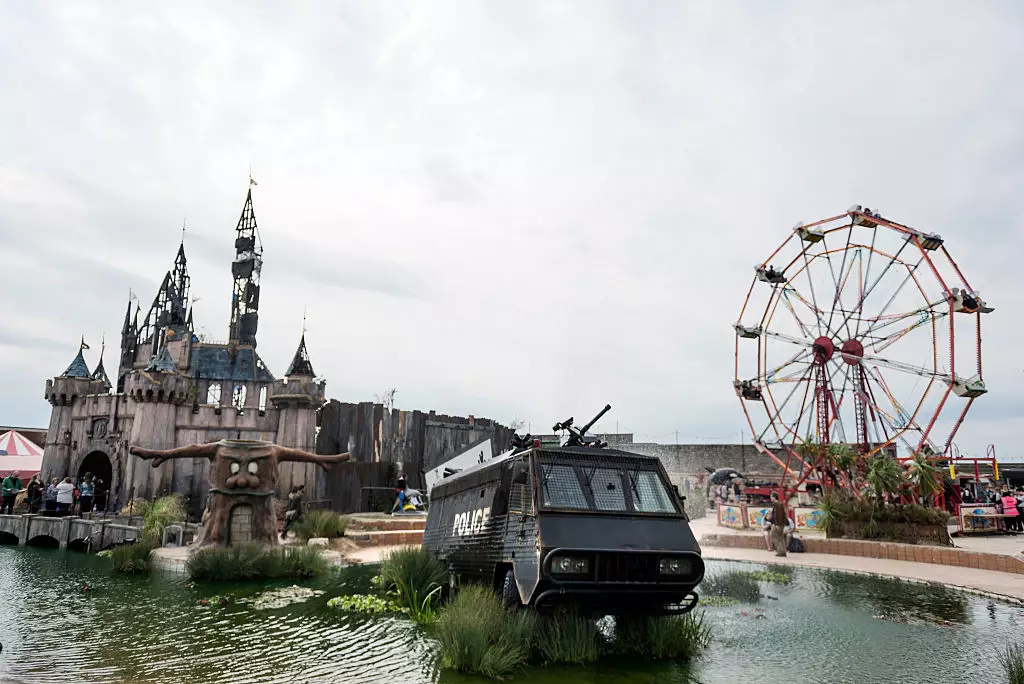
In 2015, Banksy also created Dismaland, a temporary “bemusement park” in Somerset, charging visitors £3 to enter.
Designed as a bleak parody of classic theme parks, it offered a grim reflection on modern life, contrasting glossy fantasy worlds with real-world crises.
Among its installations were a crumbling Cinderella castle featuring a staged carriage crash, along with a boat attraction referencing the refugee crisis.
Banksy said Dismaland was ‘a place where you can get your counterculture easily available over the counter. A theme park for the disenfranchised, with franchises available’.
For Cardinal Sin, Banksy presented a defaced sculpture of a priest at Liverpool’s Walker Art Gallery.
The altered statue was widely understood as a reference to the Catholic Church child abuse scandal, using vandalism as a deliberate statement rather than random damage.
“The sculpture very clearly contains a message,” said Reyahn King, director of art galleries at National Museums Liverpool.
“When you look at it and see the tiles that have been applied to the sawn-off face, you immediately get the impression of those pixelated images of suspected criminals you see on screen or in a newspaper photograph.
“What interests me is that when a visitor sees that, they then perhaps will look at the other paintings in the gallery and look for the less obvious messages that all artists tend to have within their work.”
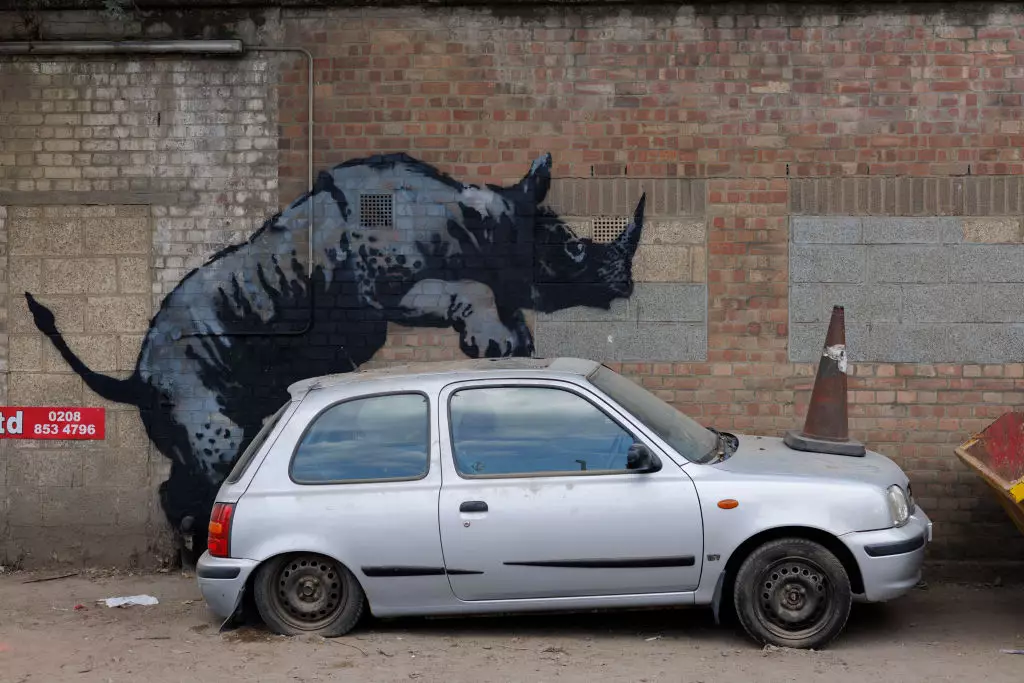
More recently, in 2024, a burst of Banksy activity appeared across London over nine days, with a series of animal-themed works turning up in different locations.
The run included images such as a goat balancing on a narrow ledge, two elephants leaning out of a window, three monkeys hanging from a bridge, and a pelican perched above a fish and chip shop.
Charlotte Stewart, managing director at MyArtBroker, shared her view on what the animal series might be suggesting.
“It’s been suggested it’s ‘just for fun’ to brighten up the world, but nothing with Banksy is just for fun,” Charlotte Stewart, managing director at MyArtBroker said.
“Street works by Banksy are intended for the public, and as such are for everyone to interpret personally.
“For me, personally, they represent the gradual building of an Ark, as the Bible story of Noah does when the world needed to start over again. Representing a mass exodus.
“Equally, Banksy has been notorious for his works that involve animal welfare, such works as ‘Barcode’ and ‘Laugh Now’ show themes of animal activism.
“It is a subject he hasn’t dealt with in recent years, but it seems an incongruous focus with the state of the world right now, its wars, and current politics.”