

A new poll has offered a stark snapshot of how many Americans view the direction their country is heading.
Not so long ago, talk of the future often came with a sense that society and technology were pushing life in a better direction.
However, fresh YouGov polling focused on Donald Trump’s second term to date suggests that confidence has been replaced, for a significant number of people, by anxiety about what the years ahead could bring.
With “once in a generation” crises seeming to arrive with increasing frequency, the shift in mood may not be surprising.
From climate-related disruption and ongoing conflicts to economic fears and unease about rapidly advancing tech, plenty of issues are leaving people worried.
YouGov’s latest survey takes a closer look at expectations for the next decade as the midterms draw nearer, and several of the findings are grim.
One of the standout results: almost half of respondents said they fear a “total economic collapse” in the United States within the next 10 years — though that wasn’t the only alarming prediction.
The poll also found that 25 percent of Americans — including 36 percent of Democrats and 9 percent of Republicans — believe the US will have a dictator at some point in their lifetime. A larger share, 56 percent, said they do not expect that to happen.
Most respondents said a dictatorship would be harmful, but two percent of those surveyed said they believed a dictator would be a good thing.
On the economic front, 42 percent said they think the country will see “total economic collapse” within the next decade.
Other projections were similarly severe. Around 36 percent predicted a civil war within that timeframe, 35 percent thought the US would add new territory, and 31 percent said they expect the US will no longer be a democracy.
So how are voters judging Trump’s second term so far?
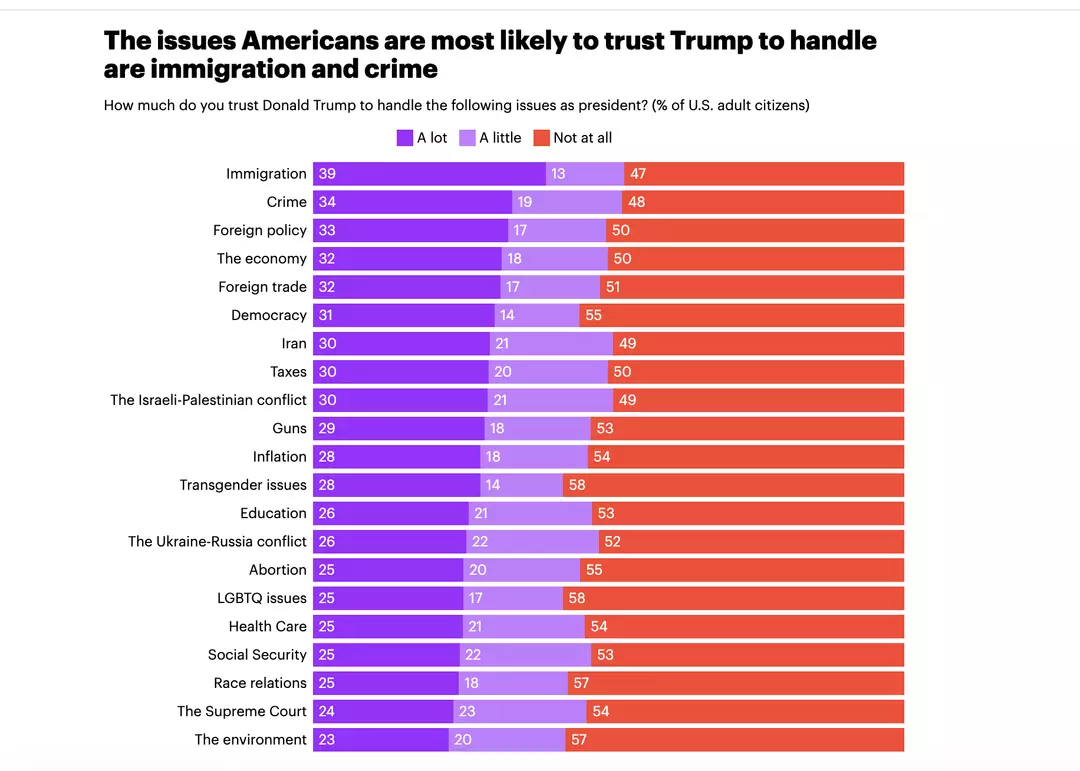
Immigration has typically been one of Trump’s stronger issues in polling. In March 2025, 47 percent of respondents said they felt he could be trusted on immigration.
A year later, that number has dropped to 39 percent — yet it remains the area where he performs best in the survey.
His second term has also been marked by large-scale federal actions, including reports that two US citizens were shot and killed by ICE agents in Minnesota.
Participants were also asked how strongly various words described Donald Trump.
The three terms most commonly chosen as applying “a lot” were “arrogant” (65 percent), “opportunistic” (57 percent), and “reckless” (56 percent).
Further down the list were descriptors such as “dishonest,” “corrupt,” “hypocritical,” and “ineffective.” It was not until 12th place that a more favorable label appeared: “a strong leader,” which 38 percent agreed with.

That “strong leader” rating may still sit relatively high among the options tested, but recent months have also coincided with heightened international tension following US military action in Venezuela and then Iran.
Trump has since also issued threats directed at the US’ southern neighbour.
In particular, the US and Israeli strikes on Iran were followed by a jump in oil prices after Iran blocked oil tankers from traveling through the Strait of Hormuz — a key chokepoint through which roughly 20 percent of global oil supply passes.
Davis Ingle said in a statement: “What matters most to the American people is having a Commander-in-Chief who takes decisive action to eliminate threats and keep them safe, which is exactly what President Trump is doing with the ongoing successful Operation Epic Fury.
“President Trump campaigned proudly on his promise to deny the Iranian regime the ability to develop a nuclear weapon, which is what this noble operation is seeking to accomplish.
“The President does not make these incredibly important national security decisions based on fluid opinion polls, but on the best interest of the American people.”