

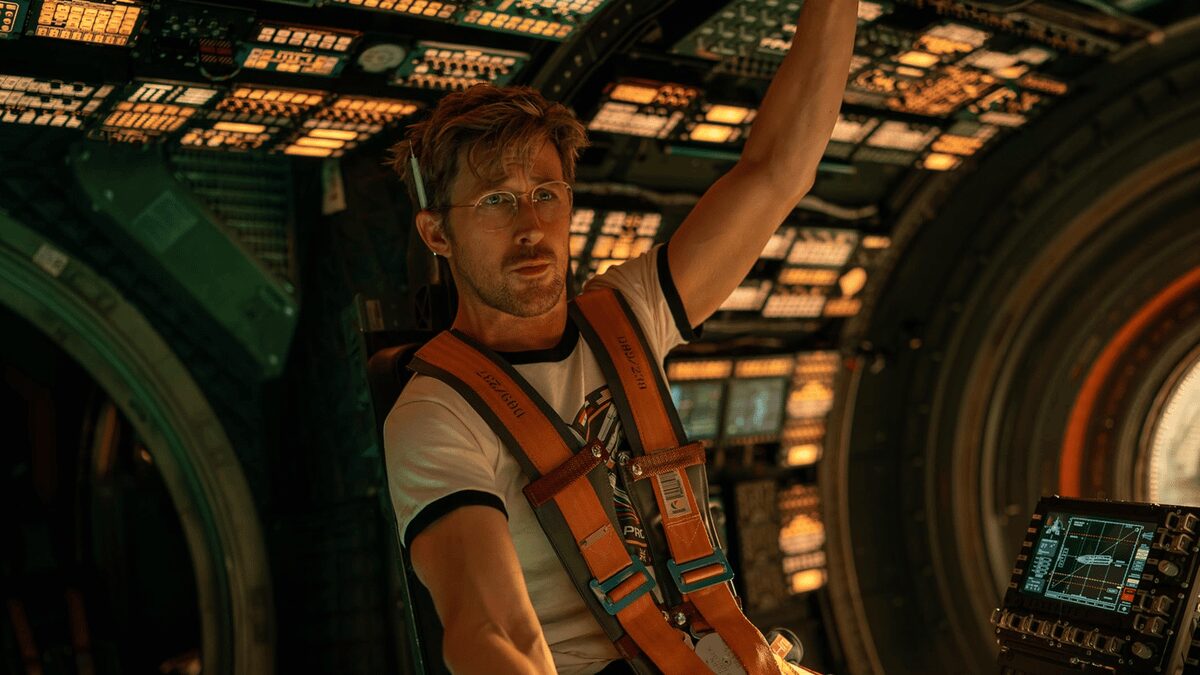
Ryan Gosling’s latest sci-fi outing, Project Hail Mary, is pulling in serious attention — but a scientist says that while the movie gets some scientific touches right, several of its headline concepts about space and biology don’t stand up to scrutiny.
Adapted from Andy Weir’s bestselling novel, the film centres on Ryland Grace, a onetime teacher who ends up recruited for an emergency mission when the sun begins to fade.
Far from Earth, Grace encounters an alien he calls Rocky. The two form an uneasy partnership and work together in a race to prevent catastrophe back home.
It’s a high-stakes setup, and Dr Jacqueline McCleary, an observational cosmologist at Northeastern University, says the story is science-adjacent in a way that can still be entertaining — even if it requires some substantial suspension of disbelief.
“This story in particular falls on the line of close enough to be enjoyable and, more importantly, self-consistent. It’s a grammar unto itself, but it’s legible,” McCleary told Northeastern Global News.
The biggest sticking point, McCleary argues, is the film’s core menace: astrophage. In the story, these microscopic organisms absorb solar energy at a scale large enough to noticeably reduce the sun’s output. It’s an inventive idea — but she says it falls apart once you consider the energy accounting.
“There’s orders of magnitude mismatch between what a microbe could store… and what the sun actually puts out in terms of energy,” she explained.
Given how staggeringly much energy the sun emits every second, the film’s energy-draining mechanism would need to operate on an extreme (and unlikely) scale. There’s also the question of survivability: anything living in the sun’s atmosphere would be dealing with temperatures that can reach roughly 2.7 million degrees Celsius.
The movie also takes liberties with human biology during interstellar travel. Grace is kept in an induced coma for years while travelling nearly 12 light-years to Tau Ceti, and he wakes up disoriented and missing memories. McCleary says the real-world consequences would almost certainly be far more severe.

“You’d have brain damage,” she added.
Even so, McCleary doesn’t dismiss the film’s approach entirely. She points to the spacecraft as one of the movie’s more grounded elements.
Rather than relying on pure hand-waving, Grace’s ship uses a recognisable propulsion concept and includes a rotating section intended to generate artificial gravity. While no one has built that exact setup for a crewed mission yet, the basics align with established physics.
According to McCleary, the principle behind that spinning structure is based on ‘totally conventional, well-accepted physics’.
And the praise doesn’t stop with engineering. McCleary also highlights Rocky — the alien character — as unexpectedly plausible in one important respect.
She notes that the film leans into the idea that life might not just look different elsewhere, but could be built on entirely unfamiliar foundations.
“People are now starting to talk about sentient plasmas as a potential lifeform,” McCleary said. “The notion of a completely different biology, completely different body chemistry adapted to different conditions is very clever.”