


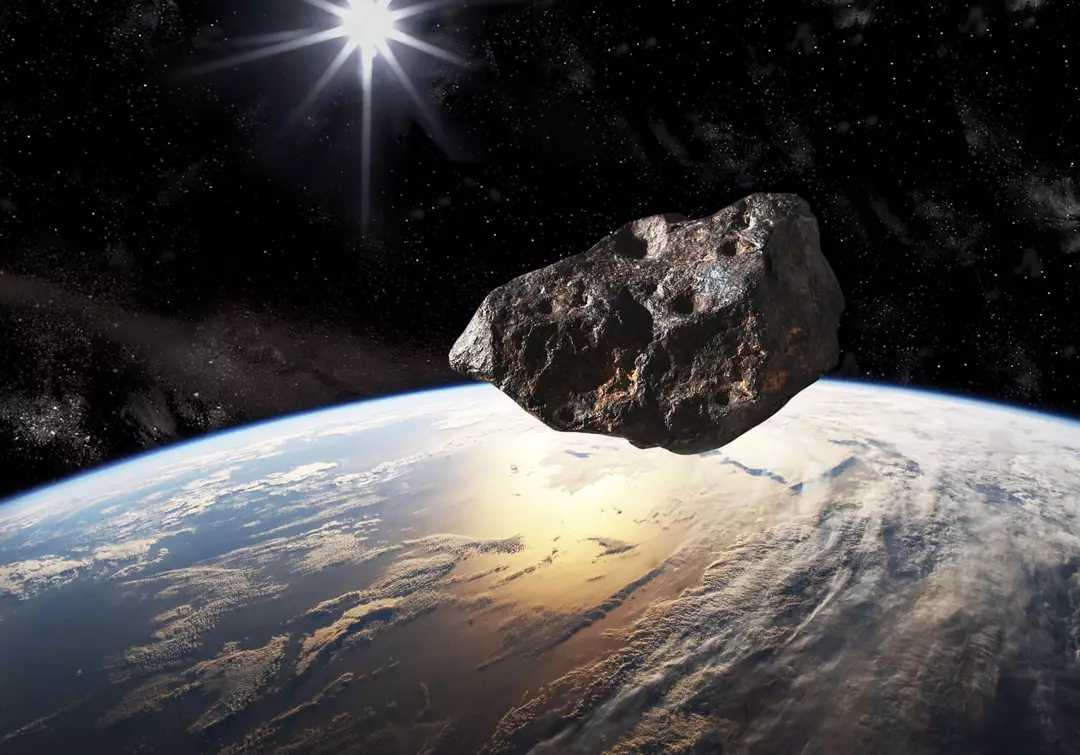
Protecting Earth from potentially catastrophic asteroid impacts could soon hinge on a new NASA collaboration with Amazon founder Jeff Bezos, involving a sophisticated “Blue Ring” concept intended to help safeguard the planet.
The possibility of a space rock striking Earth isn’t just science fiction. Every year, thousands of asteroids pass close enough to raise real concern—especially those large enough to cause major regional destruction.
Across the global astronomy community, around 40,000 Near-Earth Objects (NEO) are monitored, including the truly enormous bodies more than 1km wide. However, when it comes to smaller objects—often described as “’city killer’” asteroids—NASA can currently account for only about 60 percent of them.
NASA’s planetary defence officer Dr Kelly Fast has warned that it’s the still-untracked objects, up to 200ft across, that keep him “’up at night’”. A new effort with Blue Origin could soon help close that gap.
Blue Origin says it is developing the “’Near-Earth Objects Hunter mission’” in partnership with NASA’s Jet Propulsion Labaratory, with the aim of improving our ability to detect and respond to dangerous incoming objects.
The plan includes testing a flexible Blue Origin spacecraft designed to remain in orbit and potentially apply “’multiple asteroid-deflection techniques’” if a threatening object is found on a collision path.
In outlining the concept, the company said options could include “’ion beam deflection’”—using streams of plasma ions to gradually push an asteroid’s trajectory off course—or the more traditional “’robust direct kinetic impact’” approach.
That latter strategy echoes NASA’s 2022 Double Asteroid Redirection Test (DART), when a spacecraft slammed into an asteroid at roughly 14,000mph and measurably changed its orbit—though the smaller body Dimorphos also ended up breaking apart.
Researchers have noted that attempting such an action too close to Earth could backfire, effectively turning a single incoming threat into many pieces—like changing a sniper’s bullet into a shotgun blast—according to analysis published in the Planetary Science Journal.
Working alongside JPL/Caltech, we've developed a Near-Earth Objects (NEO) Hunter mission concept for planetary defense using Blue Ring. NEO Hunter tests multiple asteroid-deflection techniques, including ion-beam deflection and robust direct kinetic impact, helping protect Earth… pic.twitter.com/ZWsdfJAtLq
— Blue Origin (@blueorigin) March 11, 2026
With an estimated 15,000 asteroids making close passes, improving detection and response capabilities is increasingly seen as essential—especially if we want to avoid an extinction-scale outcome.
That broader concern also drives NASA’s Near-Earth Object Surveyor program, a dedicated space telescope designed specifically to find and track potentially hazardous objects heading our way.
Rather than relying primarily on reflected visible light, the telescope uses infrared detection to spot dim objects, looking for their “’glow in the infrared spectrum as they’re heated by sunlight.’”
Blue Origin has said it plans to launch the NEO Hunter mission sometime this year, although an exact date has not yet been confirmed.
Separately, SpaceX is expected to send the NEO Surveyor telescope into space aboard a Falcon 9 rocket sometime next year.