

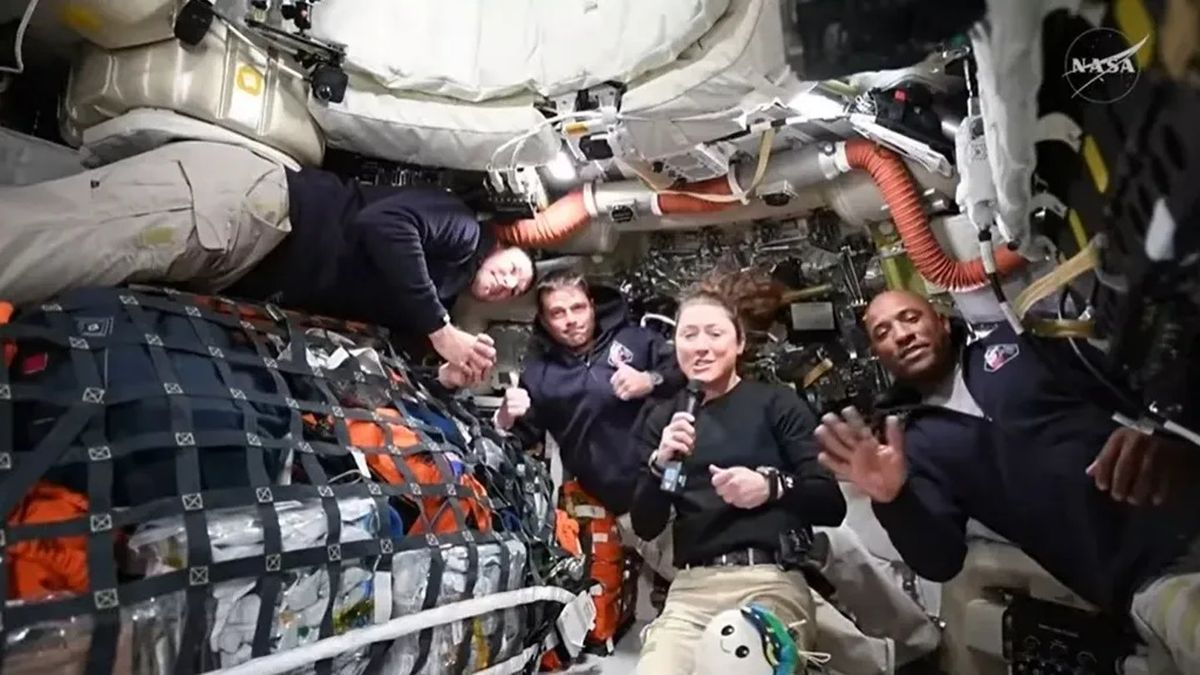
The crew of NASA’s Artemis II mission has shared the alarming alert they received after crossing the so-called “point of no return” on their way to the Moon.
Decades after the Apollo era reshaped spaceflight, NASA is once again sending humans on a lunar-bound journey.
But even with modern systems and years of preparation, the start of the mission has included some nerve-racking moments.
The Orion capsule lifted off from Cape Canaveral at 6:35 p.m. ET, beginning the crew’s trip beyond Earth orbit.
As astronauts Reid Wiseman, Christina Koch, Victor Glover and Jeremy Hansen approached a crucial phase of the flight, they carried out a translunar injection burn—an essential maneuver that pushes the spacecraft out of Earth’s orbit and onto a trajectory toward the Moon.
During that window, the crew saw a warning indicating a potential emergency: a suspected cabin leak.
“We did get a warning message for ‘cabin leak suspected’,” astronaut Hansen said in a live video with the rest of the team.
He described how quickly the situation can feel like it’s spiraling from nominal to critical as you weigh whether you can continue or must turn back.
“This grabs your attention because… you go right from doing this burn and you’re heading to the moon to thinking, ‘Are we going to have to cancel this burn, start getting into our spacesuits and figuring out how to get home in a day or less?’”
A cabin leak is not a minor fault: any loss of pressure inside the spacecraft can become life-threatening, as crews rely on a tightly controlled environment to breathe and stay safe.
Like deep-sea diving, sudden pressure changes can put the human body under severe strain, raising the risk of serious illness and oxygen deprivation.
In this case, the scare didn’t turn into a crisis.
“Houston helped us out – they confirmed they were seeing good cabin pressure and so were we on-board,” Hansen said. “We did the burn and now we’re heading to the moon and feeling good.”
NASA says the mission will push Orion to a new milestone: on day six, the crew is expected to reach the most distant point from Earth ever achieved by a human mission, surpassing Apollo 13’s record.
Artemis II is planned to travel about 6,400 miles beyond the lunar surface, with commander Reid Wiseman emphasizing how extraordinary the task really is.
“There is nothing normal about this. Sending four humans 250,000 miles away is a Herculean effort and we are now only just realizing the gravity of that.”
Since launch, the crew has also dealt with a chilly cabin and issues with the toilet system—additional reminders that spaceflight rarely goes perfectly—but they’ve continued to sound upbeat.
With the translunar injection burn complete, Orion has escaped Earth’s gravitational hold and is now committed to its lunar route.
Over the coming days, key checkpoints will include system testing, navigation milestones, and a steady stream of photography as the crew documents Earth and the Moon from deep space.
The astronauts will be checking radio communications while also capturing images from the spacecraft windows—expect dramatic views as distance from Earth grows.

Another major step arrives when Orion enters the Moon’s sphere of influence—when lunar gravity begins to dominate over Earth’s pull.
Spacesuit checks are also scheduled, ensuring the crew’s protective gear is ready for the demanding re-entry phase later in the mission.
The standout moment of the trip will come as Orion passes behind the Moon, taking the crew farther from Earth than any humans have ever been.
This region is often called the “dark side” of the Moon, though it isn’t permanently dark; it receives sunlight just like the near side. The term is tied to tidal locking, which keeps the same lunar face oriented toward Earth—meaning the far side is never visible from the ground.
The crew will spend time photographing the lunar surface, and there will be a roughly 40-minute communications blackout while Orion is behind the Moon—an expected but tense stretch for teams on the ground.
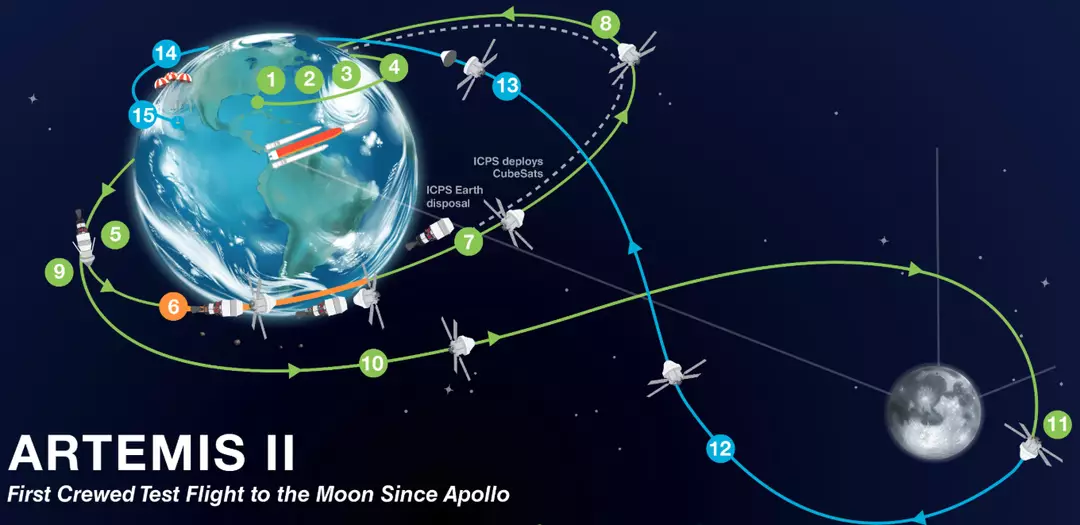
After the far-side pass, Orion will begin its route back toward Earth.
One day is scheduled as a lighter-duty day for the crew after the intense early phases of the mission—though downtime inside a compact spacecraft is limited. No Netflix, unfortunately.
Later, the astronauts are expected to rehearse building a radiation shelter to protect against solar flare conditions, test compression garments designed to reduce dizziness during re-adaptation to gravity, and practice manual piloting procedures.
The mission is set to wrap up by the weekend, with the most hazardous segment coming during re-entry, when the spacecraft must withstand temperatures up to 3,000°F.
After Orion descends through Earth’s atmosphere, parachutes will deploy for splashdown in the Pacific Ocean off San Diego, where recovery teams from NASA and the US Navy will be on hand to retrieve the crew.