

OpenAI has had a headline-making month, publishing two significant documents: one that outlines which roles are most vulnerable to AI-driven change, and another that lays out broad policy ideas — including a push to test a four-day week without cutting pay.
The first paper, The AI Jobs Transition Framework, examines where job disruption is most likely to land first and hardest. The second, Industrial Policy for the Intelligence Age: Ideas to Keep People First, proposes wide-ranging reforms, urging employers to pilot a 32-hour workweek while also expanding benefits such as pensions, healthcare, and more — all while maintaining current wages.
Below is a breakdown of what the reports say.
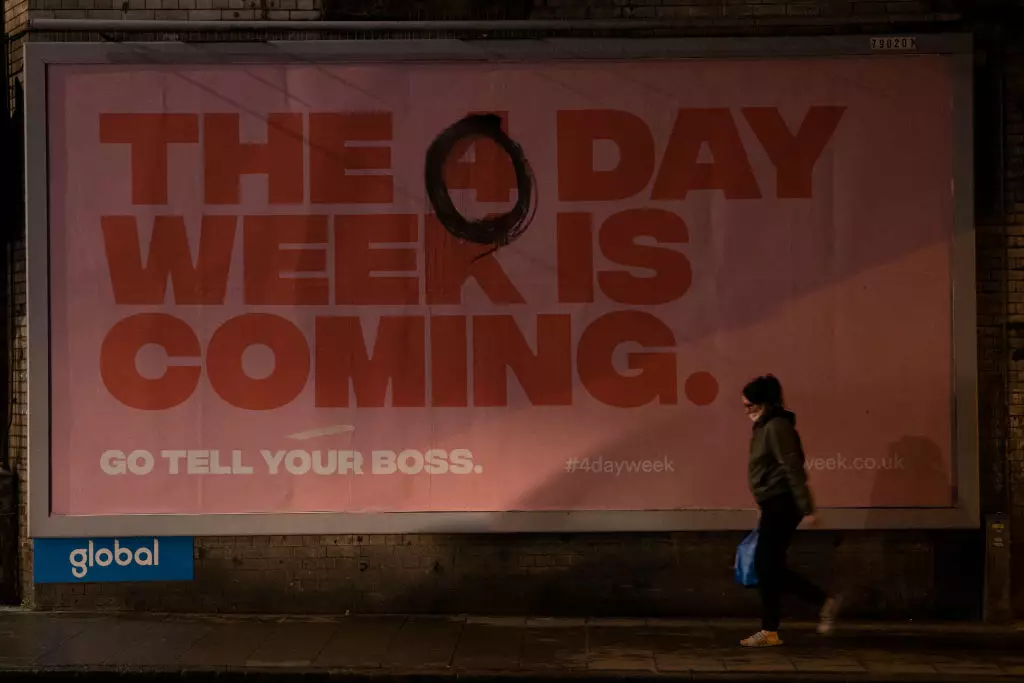
In its policy proposals, OpenAI argues governments should encourage employers and unions to run pilots for a 32-hour, four-day workweek that keeps pay the same and maintains output and service standards. The proposal also includes the possibility that any “reclaimed” time could ultimately become a permanent shorter week, converted into bankable paid time off, or some mix of both.
The underlying message is that if AI raises productivity, the rewards shouldn’t land solely with corporate margins — workers should share in those gains.
Alongside shorter-hours trials, OpenAI also points to longer-term upgrades to employee benefits as everyday workloads fall. That includes ideas such as boosting retirement contributions, having employers cover most healthcare costs, and offering childcare subsidies.
Still, there are skeptics who say the politics — and incentives — may not be so straightforward.
Speaking to the BBC, Prof Gina Neff of the University of Cambridge Minderoo Centre for Technology and Democracy said the idea of paying workers for efficiency gains from revolutionary tech is not new. But the difference now is that “OpenAI wants other companies to pay workers more while also paying them for subscriptions to their services.
“The ideas in this policy might work, but doing so will take a complete change in political headwinds.”
On the jobs side, OpenAI’s analysis — authored by Chief Economist Ronnie Chatterji — reviewed more than 900 occupations spanning 153.7 million roles, representing 99.7 percent of US employment. The goal, it says, was to build a detailed view of where AI disruption could arrive fastest and with the most force.
Being identified as “exposed,” however, doesn’t automatically mean a job is about to disappear.
Instead, OpenAI groups roles into four broad categories. It estimates 18 percent of jobs face a true automation risk. Another 24 percent may shrink in headcount even though people remain essential to core tasks. Around 12 percent could expand because of AI — with examples like software developers and physical therapists, where reduced costs and faster throughput can increase overall demand.
The biggest share, 46 percent, is expected to see relatively limited change in the near term.
One of the key visuals in the report is a chart comparing 22 major industry groupings using two lenses: how much of their work AI could theoretically perform, and how much AI is actually being used today.
The difference between those two numbers — what OpenAI calls the ‘Capability Overhang’ — is large in every sector.
In simple terms, AI is already capable of doing more across these industries than workplaces are currently applying it to.
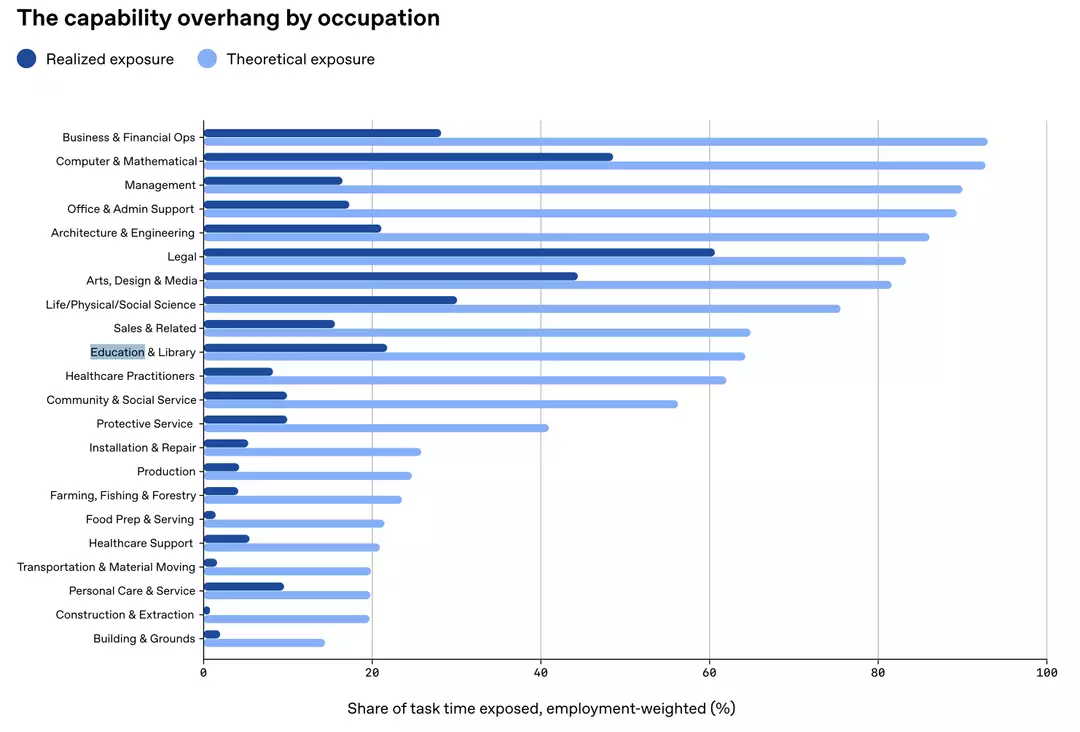
In the report’s ranking, the industries listed from highest to lowest theoretical AI exposure are:
It also highlights the sectors where AI tools are already being deployed most heavily compared with their potential:
And it points to areas where real-world usage lags furthest behind what’s technically possible — which could indicate that larger shocks may still be ahead — include:
Even so, OpenAI stresses that exposure alone doesn’t equal a pink slip.
The report states: “Exposure helps us understand where AI has technical capability.
“It cannot, on its own tell us which jobs are most likely to be automated, redesigned, or expanded in the near term.”
Finally, OpenAI cautions that without deliberate guardrails, AI could deepen inequality — amplifying advantages for people and places already positioned to benefit, while leaving under-resourced communities behind through reduced access to tools, emerging industries, and new opportunities.
Rather than presenting the papers as final answers, OpenAI frames them as a starting point — the opening move in a wider discussion that governments, businesses, civil society groups, and households will need to engage with.