

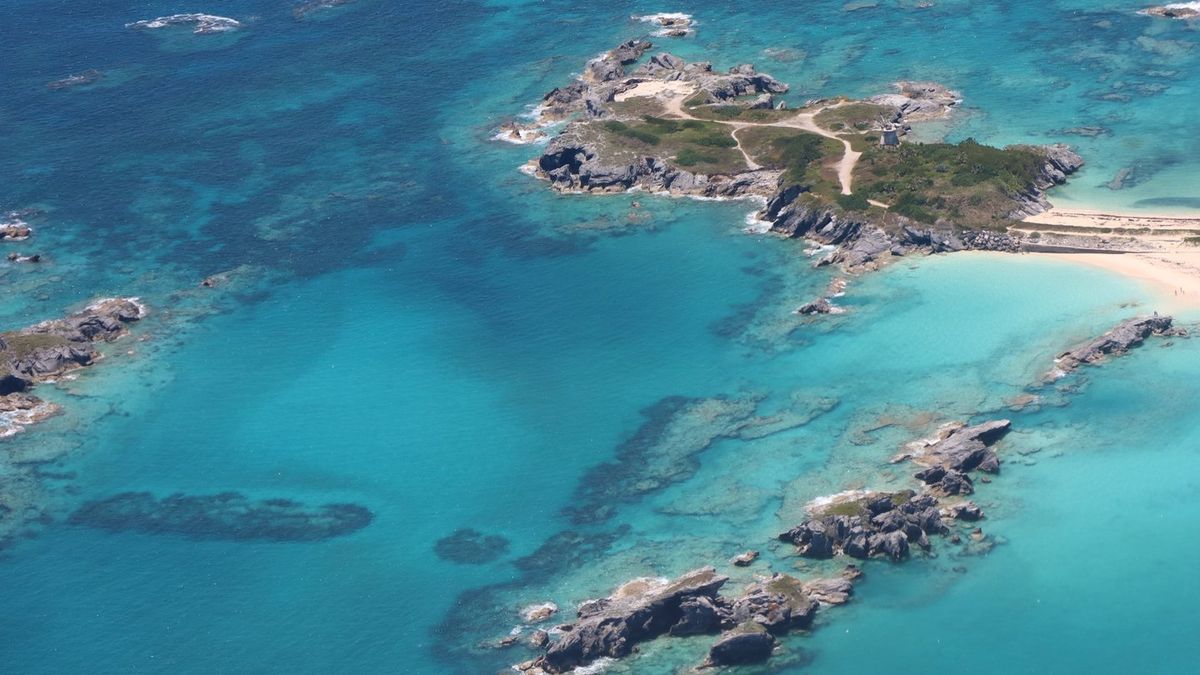
Bermuda has long been surrounded by mysteries, and scientists now think they’ve cracked one of its biggest.
A team from the Carnegie Institution for Science and Yale University set out to understand why the island sits higher above the Atlantic than expected, even though the volcanoes that created it stopped erupting millions of years ago.
In many parts of the world, volcanic islands stay above sea level because they’re continually fed by activity below (Hawaii is a well-known example). Bermuda, however, is the exposed peak of an ancient underwater volcanic system — and its volcanism shut down more than 30 million years ago.
Given that, plenty of researchers assumed the island should have gradually subsided beneath the waves over time. But Bermuda has remained above water.
Using around 20 years of earthquake recordings, researchers William Frazer and Jeffrey Park analyzed signals captured by a single seismic monitoring station on Bermuda. From that data, they reconstructed a view of what’s happening inside Earth down to roughly 20 miles beneath the island.
The pair focused on vibrations from distant earthquakes, because seismic waves travel differently depending on what they pass through — variations in rock density and composition leave clear fingerprints in the data.
Their conclusion is that Bermuda, home to more than 60,000 people, is supported by a massive layer of rock sitting just beneath the oceanic crust — effectively helping the island “float” higher than it otherwise would.
They estimate this layer is about 12 miles thick and roughly 1.5 percent less dense than the surrounding mantle, making it more buoyant than the material around it.
The slab likely formed 30 to 35 million years ago, when carbon-rich molten mantle material pushed into the base of the crust and then cooled in place — a process known as “underplating.”
Frazer and Park wrote in their study conclusion: “The deepest layer is ∼20 km thick and likely formed during or soon after the volcanism that formed Bermuda.
“We interpret this layer to be underplating that could extend 50–100 km out from the center of the swell. If this underplated layer is positively buoyant relative to the mantle, it can support the swell.”
Frazer is now exploring whether similar hidden, buoyant slabs could be propping up other islands around the world as well.
Discussing his recent discovery, Frazer said (per the Carnegie Institution): “Bermuda is an exciting place to study because a variety of its geologic features do not fit the model of a mantle plume, the classic way for deep material to be brought to the surface.
“We observe thick underplating, something that is not observed at most mantle plumes. Combined with recent geochemical observations, this suggests that there are other convective processes within Earth’s mantle that have yet to be well understood.”