

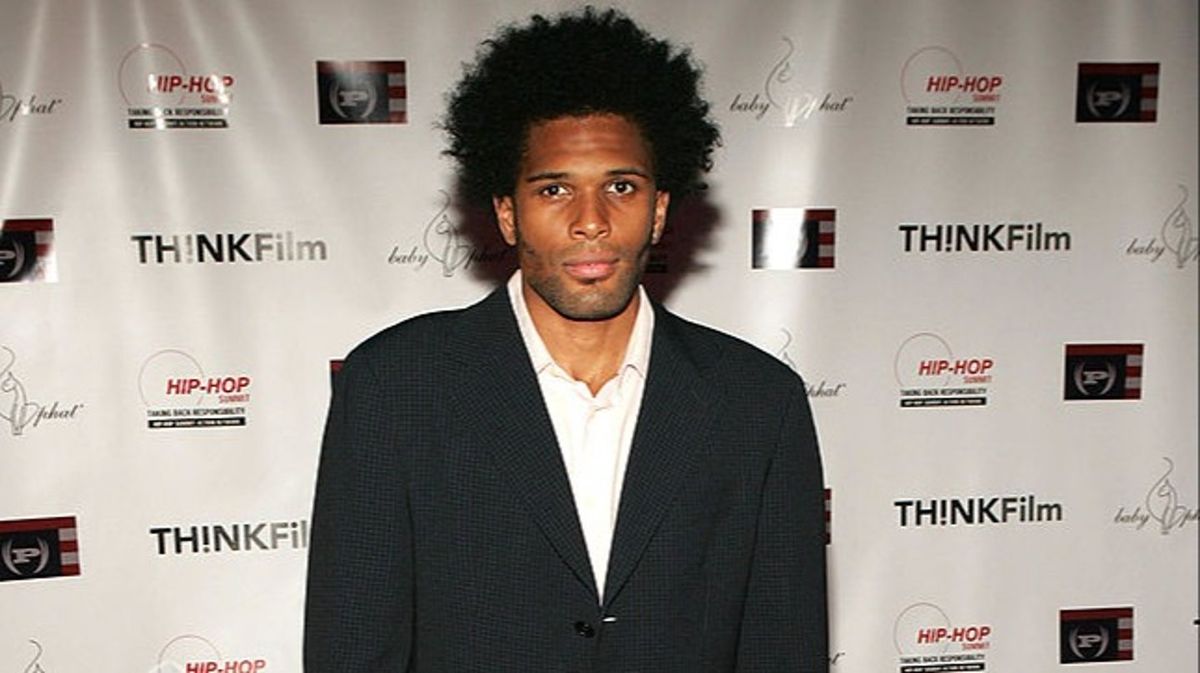
Jayson Cross stepped out to collect his dry cleaning on a Manhattan street when a stranger carrying a brick walked by — and moments later, a German tourist was almost killed.
At 39, Cross says he was in the best shape he’d ever been in.
In 2018, he was boxing four or five days a week and running a couple of miles daily. On the way to the gym with a friend, he ducked into a dry cleaner on 38th Street in Hell’s Kitchen.
Having spent two decades living in New York after growing up on Chicago’s South Side, he kept a reflex he’d learned early: check both directions before stepping out onto the sidewalk.
As he exited, he glanced left and noticed a man approaching with a large brick held in both hands — Cross estimated it was about seven inches long, four to five inches wide, and three inches thick.
He later explained on the What Was That Like podcast that his body reacted before he had time to think it through.
“When I first noticed the attacker holding the brick, my immediate thought was defense. That instinct may have come from my boxing background or simply from growing up on the South Side of Chicago.
“My first concern was not allowing him to get too close and thinking through what I would do if the situation escalated into a physical confrontation.”
Cross passed his clothes to his friend, guided him aside, and shifted into a defensive boxing stance — chin tucked, hands up, body turned — trying to minimize his target.
The brick-carrying man appeared to register it immediately and kept space between them.
He looked at Jayson and said: “Nah, I’m going to hit a white motherf**ker with this brick.” Then he kept walking.
At first, Cross assumed it might be the kind of outburst associated with someone in crisis — but he didn’t relax or turn away.
He watched the man continue up the sidewalk. When the attacker was roughly 15 feet beyond him, another pedestrian in a burnt orange hoodie approached from the opposite direction, head down with his hands in his pockets, seemingly unaware.
“He picked the brick up over his head the same way you would try to strike a nail with a hammer if you wanted to hit it with intense force,” Jayson said. “He struck him on the left side of his chin, and he went down like a ton of bricks.”
The blows didn’t stop. Cross moved toward the attacker as the brick came down again and again, blood pooling as onlookers shouted for someone to intervene — but no one stepped in.
“I thought distinctly to myself: if someone, i.e. Me, doesn’t stop this, this guy is going to die right in front of my eyes,” Jayson said.
On the final strike, the brick snapped in two. The attacker dropped it and bolted. Cross grabbed the smaller piece — he later described the pickup as instinctive, like a shortstop fielding a ball — and sprinted after him.
For a split second he considered throwing the broken brick at the fleeing man, then decided against it and kept running, tracking him through traffic.
They went past a mounted police officer Cross had noticed earlier outside the cleaners, still seated on the horse as nearby bystanders offered it nuts.
Cross yelled for help. The officer called for backup over the radio but stayed mounted — later, Cross said he was told that turning a police horse loose in the Times Square area could have created an even more dangerous scene. In the moment, Cross recalled feeling furious.
About half a block later, the attacker abruptly dropped to the pavement, face up with his arms and legs spread wide. As police closed in from behind, he looked at Cross and spoke.
He looked up at Jayson and said: “You witnessing, bro?”
Cross later described a rush of thoughts — that a man had just been brutalized in public, and that the attacker seemed to be probing whether others would side with him or excuse what he’d done.
The attacker then said he couldn’t breathe and claimed he hadn’t taken his medication, echoing the words associated with Eric Garner’s death years earlier. Cross believed it was a calculated attempt to invoke that tragedy. The man was handcuffed and transported to Bellevue psychiatric hospital.
Back near the ambulance, Cross located the victim — a German tourist — sitting with something held to his face to slow the bleeding. Cross believed he’d been struck three, four, perhaps five times.
Cross apologized for not reaching him sooner. The tourist looked at him, confused, and asked what he had to apologize for.
Months later, prosecutors contacted Cross to discuss charges. He recounted what the attacker had said on the street — including the explicit racial motive.
As a result, the case was elevated to attempted murder with a hate crime enhancement, which can carry a sentence of 25 years to life under New York law.
The attacker ultimately accepted a plea deal for 10 years. He later appealed while representing himself and ended up with 14 years total. His release is currently listed for March 2030.
Some people close to Cross urged him to avoid testifying. He chose not to listen.
He said: “At the end of the day, I always intended to testify. I knew the attacker would remain a danger to others if he stayed on the street.”
Cross had learned German as a child at a language academy. Sitting by the ambulance after the attack, he heard the victim’s accent and asked: “Sind Sie Deutsch?” (are you German?) The man said yes — and the two have remained friends.
Jayson said: “The victim and I have become friends since the incident. Since then, we have stayed in touch. Every year, on the anniversary of the attack, we check in with one another. We also search online to make sure the attacker is still in custody.”
In 2026, one of those routine searches surfaced news that stunned them both.
“This year, in 2026, we discovered that he had been accused of another murder in Minnesota,” Jayson said.
“The news hit both of us hard. We were overwhelmed by a mix of shock, stress, and disbelief.
“It was disturbing to realize that the person who had nearly taken a life years ago was once again being connected to such a violent crime.”

According to Cross, DNA taken after the arrest and run through the national database later linked the attacker to the stabbing death of a woman in Minnesota sometime around 2013 or 2014. He could potentially be transferred directly from New York custody to face that case.
Cross said the development didn’t completely blindside him.
“During the attack, I saw what I would describe as a bloodlust in his eyes. Growing up, I had seen that look before, the look of someone who seems to derive satisfaction from hurting another person.
“It wasn’t anger alone; it felt like something darker. That impression stayed with me long after the attack ended.”
In the years since, Cross has tried to process the experience by turning parts of it into stand-up — a difficult balance, he admits, given that it begins with a racial slur and nearly ended with a man dying on a New York sidewalk.
He points to Richard Pryor as proof that comedy can come from dark places, noting that Pryor’s most memorable work included telling the story of setting himself on fire — and if that could be transformed into a bit, Cross believes his story can be, too.