

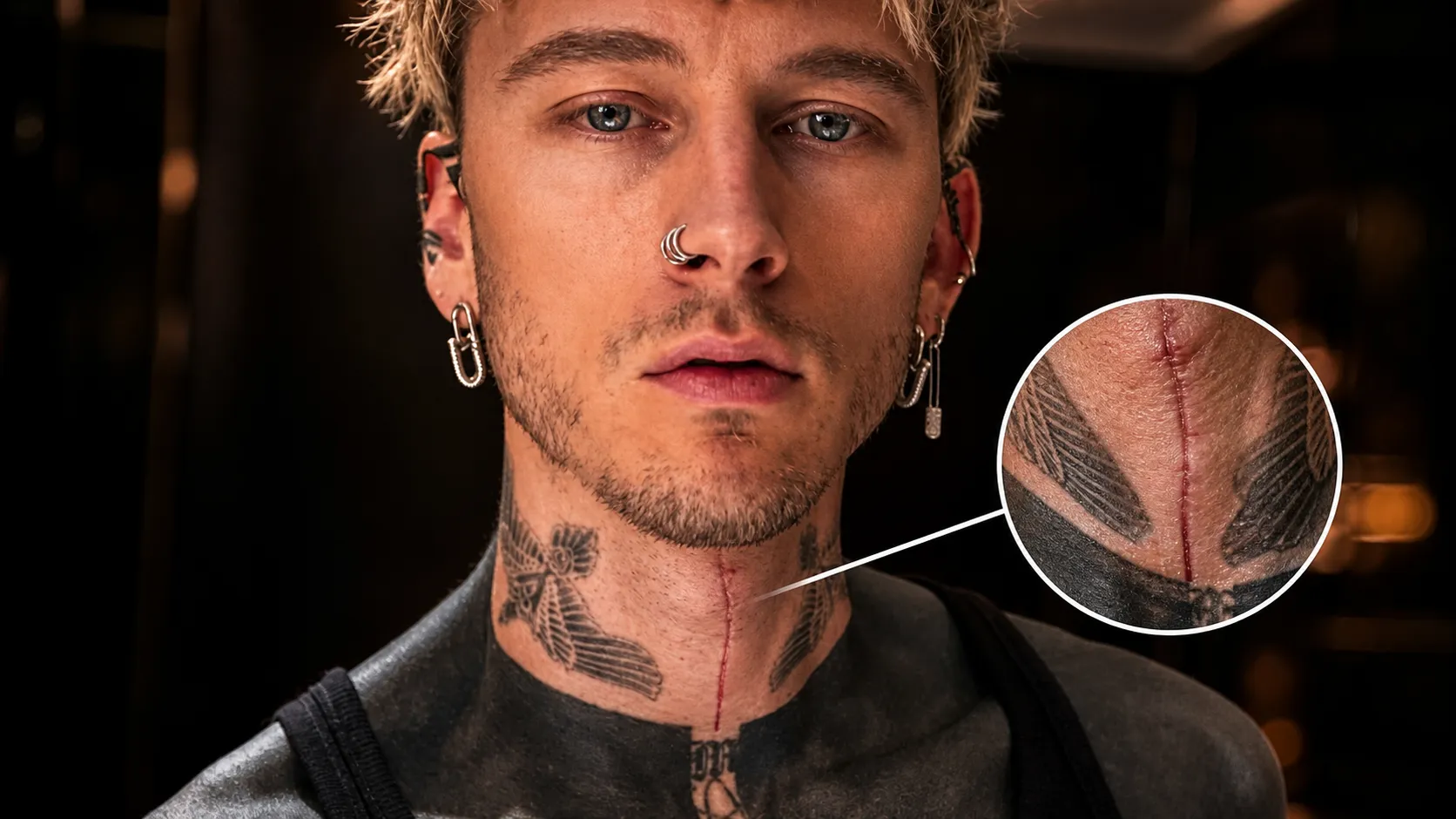
Medical experts have raised concerns over blackout tattoos after Machine Gun Kelly spoke about what happened when he underwent the heavy-ink style himself.
Tattoos are often used as both body art and personal expression. In most cases, a design is inked onto the skin while leaving much of the natural skin tone visible around it.
Blackout tattoos work differently. Instead of using the skin as the main background, this approach covers large areas with dark ink, sometimes leaving negative space behind to create a pattern or image.
Some people also choose blackout work to completely cover parts of the body, including the arms, shoulders, or chest. That means a far greater portion of skin is tattooed than with a more conventional design.
The look has become more visible online in recent years, with celebrities and tattoo artists helping to push the style into the mainstream. It can also carry a deeper purpose. In some cases, people who have self-harm scars choose blackout tattoos as a way to reduce their visibility.
Others use the style to cover older tattoos they no longer want, although experts warn that a blackout piece should not be treated as a quick fix. The sheer scale of the work can mean long sessions, intense healing, a higher chance of swelling, and a much more complicated removal process if someone later changes their mind.

One physician has cautioned that the tattooing method may come with additional health concerns.
Will Kirby, M.D. serves as medical director at a New York City clinic focused on tattoo removal.
He said the concern is not simply how much ink is used, but what may be inside that ink.
“It’s not only the quantity of ink but the constituents of the ink injected,” he told Women’s Health. “These days artists frequently mix ink together, and an all-black tattoo, which clinically appears to be composed of just carbon-based ink, may actually be an amalgamation of different inks.”
He went on to explain that designs requiring very large amounts of ink could increase those concerns, and blackout tattoos generally use more than any other style.

“While these ingredients in any amount are worrisome, there is a valid argument for problems being dose dependent—meaning the higher volume of ink you have in your body, the more likely you are to suffer negative consequences from it,” he said.
General tattoo risks can include infection, allergic reactions, scarring, keloids, granulomas, swelling, burning, and reactions that may appear days, months, or even years after the tattoo is done. With blackout tattoos, the same risks apply across a much larger area of wounded skin.
The US Food and Drug Administration has also continued to flag tattoo ink safety as an issue. In October 2024, the agency issued final guidance to tattoo ink manufacturers and distributors on preventing microbial contamination, after reports of illnesses linked to contaminated inks and multiple voluntary recalls between 2003 and 2024.
A 2024 study involving FDA researchers tested 75 tattoo and permanent makeup inks and found that 26 samples, or 35 percent, were contaminated with bacteria. That does not mean every tattoo ink is unsafe, but it underlines why sterile equipment, reputable studios, proper aftercare, and traceable ink batches matter.
Another concern is what happens after the ink is placed in the skin. Research has shown that some tattoo pigment can move from the skin to nearby lymph nodes, which are part of the body’s immune system. That is one reason doctors may ask about tattoos before scans or medical procedures.
Dermatologists also warn that very dark, solid ink can make it harder to spot changes in moles or other marks on the skin. The American Academy of Dermatology advises people to avoid tattooing over moles or suspicious spots because changes in size, shape, or color can be important warning signs of skin cancer.
Machine Gun Kelly is one of the celebrities who has embraced the blackout style, and he has described the physical reaction he experienced after getting it done.
According to the artist, he became unwell after large sections of his torso, shoulders, and arms were covered in black ink.
MGK, whose real name is Colson Baker and who now stylises his stage name as mgk, debuted the dramatic blackout look in 2024. In a June 2026 interview with Billboard Canada, he said tattoo artist ROXX had originally warned him that completing such a large piece should take far longer than he wanted.
“After the first week, we hit my lymph nodes around my armpits and shoulders, and I got really sick,” he said. “My skin was turning yellow. I wasn’t able to sleep. I stopped being able to move certain parts of my upper body.”
He said ROXX had warned him about the scale of the project, adding: “She warned me that it was going to be near impossible, even from a pain tolerance standpoint.”
But he said he wanted the transformation finished in two months rather than over a much longer period, recalling: “I said, ‘Yeah, we got two months.’”
The musician said the blackout tattoo was part of a personal reset, explaining: “I was looking for a change that wasn’t just a sound wave. It had to be something physical.”
He also said the design covered older tattoos that reminded him of different periods of his life, adding: “I saw death and drugs in all these patterns that I was literally writing on my body. There were happy tattoos, sad tattoos, holy tattoos, hellish tattoos. It was like my bipolarity was screaming off my skin.”
While MGK has framed the tattoo as meaningful to him, his symptoms are the kind experts say should not be ignored. Yellowing of the skin or eyes can be associated with jaundice and may point to problems involving the liver, gallbladder, blood, or other serious conditions. It is not something people should simply assume is a normal part of tattoo healing.
Anyone who develops fever, chills, worsening pain, pus, spreading redness, red streaks, severe swelling, dizziness, yellow skin, yellow eyes, or loss of movement after a tattoo should seek medical advice urgently.
For anyone considering a blackout tattoo, dermatologists and safety regulators generally recommend taking time to research the artist and studio, checking that the business follows local licensing rules, confirming that sterile single-use needles are used, asking about the brand and lot number of the ink, and following aftercare instructions carefully.
Experts also suggest avoiding very long back-to-back sessions, giving the skin proper time to heal, and speaking to a healthcare professional first if you have a history of keloids, immune problems, allergies, skin disease, or unusual reactions to previous tattoos.