

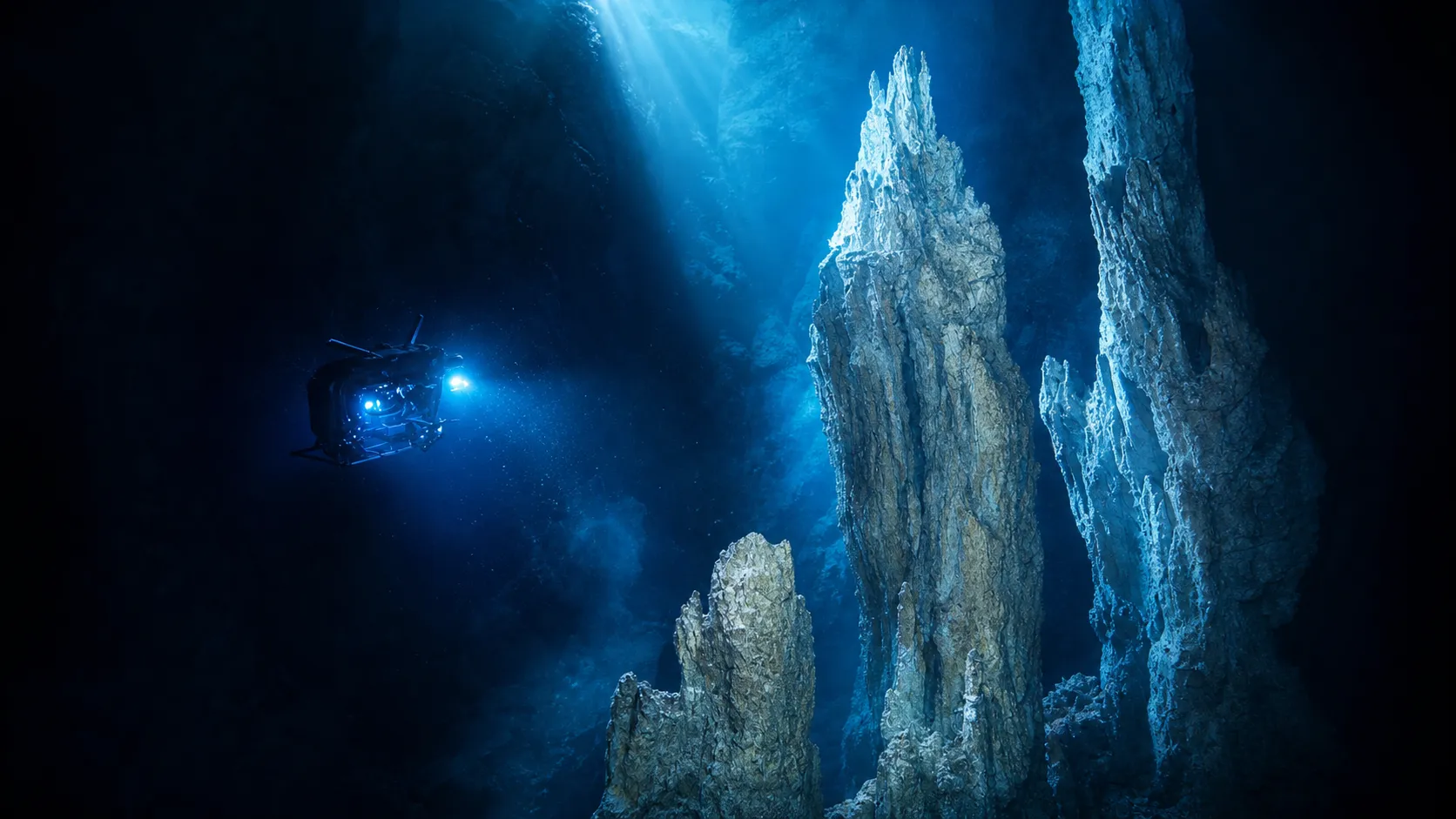
More than 2,300 feet below the Atlantic Ocean, researchers have found a place that looks unlike anywhere else on Earth.
Near the top of a submerged mountain west of the Mid-Atlantic Ridge, a dramatic cluster of rocky towers rises from the seafloor. The Lost City Hydrothermal Field sits on the Atlantis Massif, a broad underwater mountain formed where the ocean crust is pulling apart and mantle rock has been pushed close to the surface.
When remotely operated vehicles shine their lights across the scene, the formations appear pale and creamy, with an almost ghostly blue tint in the surrounding dark water.
Some of these structures are tiny, no larger than a toadstool, while the biggest reaches an enormous 60 meters, or close to 200 feet, in height.
This remarkable area is called the Lost City, and many scientists think it may offer important clues in the search to understand how life first started on Earth.
Researchers first identified the Lost City Hydrothermal Field in 2000, and it remains the longest-lasting venting system ever discovered in the ocean.
For a minimum of 120,000 years, and potentially much longer, rock from Earth’s mantle has been rising and reacting with seawater, producing hydrogen, methane, and other gases that seep into the ocean.
In 2023, scientists returned to the region during International Ocean Discovery Program Expedition 399, a drilling campaign focused on the Atlantis Massif. The mission recovered a record-breaking 1,268-meter core of mantle-derived rock, giving researchers an unprecedented look at the deep plumbing system that supports the Lost City vents.
That core is helping scientists trace how seawater, heat, and rock interact beneath the seafloor, and how those reactions may have shaped some of the chemistry needed for life long ago.
Even in these extreme conditions, life has managed to thrive. The hydrocarbons generated by the vents support unusual microbial ecosystems capable of surviving without oxygen.
Vent chimneys releasing gases at temperatures of up to 40°C host large numbers of snails and crustaceans. Bigger animals, including crabs, shrimp, sea urchins, and eels, are also sometimes seen in the area.
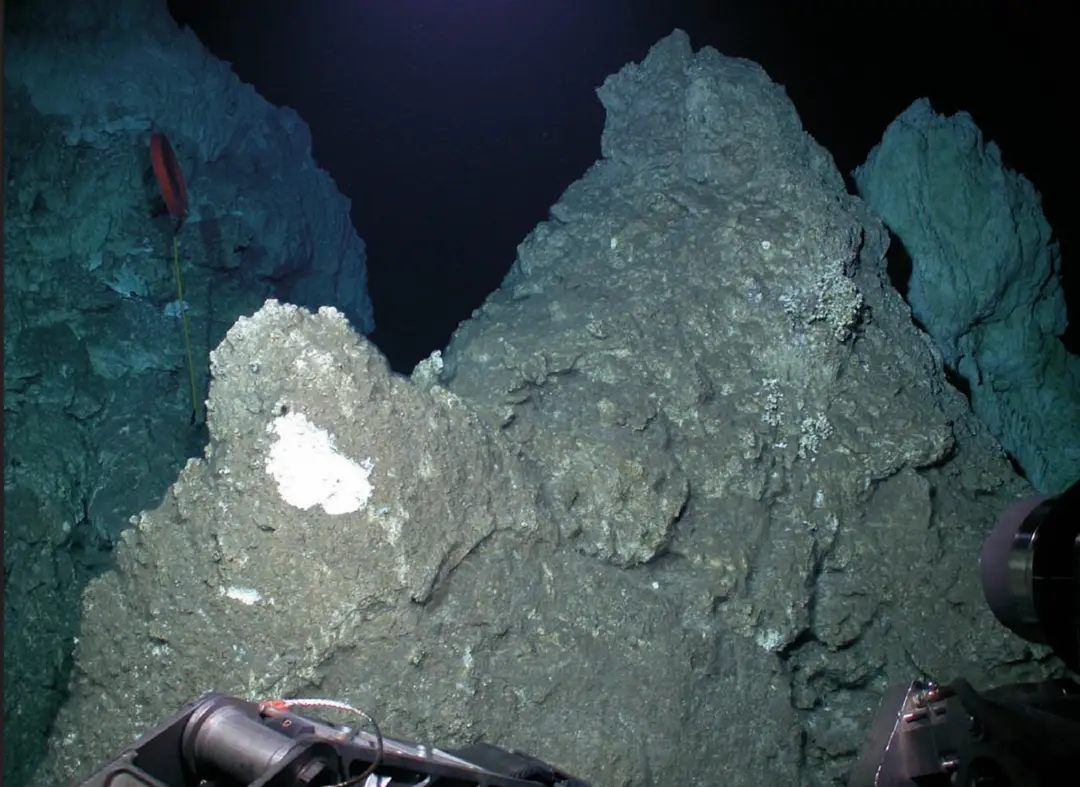
One reason the Lost City stands out is the way its hydrocarbons are created. In most places, such compounds are linked to sunlight or atmospheric carbon dioxide, but here they are formed through chemical reactions happening directly on the deep seafloor.
Because hydrocarbons are widely seen as essential ingredients for life, researchers think environments like this might also be capable of supporting life elsewhere in the solar system.
Microbiologist William Brazelton previously told The Smithsonian that this kind of ecosystem may not be unique to Earth. “This is an example of a type of ecosystem that could be active on Enceladus or Europa right this second,” he said, referring to two of the icy moons orbiting Saturn and Jupiter.
“And maybe Mars in the past.”
The Lost City is also very different from so-called black smokers, another variety of undersea volcanic vent that is often considered a possible setting for the origin of life. Black smokers are powered by magma heat and mostly create iron- and sulfur-rich minerals. By contrast, the vents at the Lost City produce as much as 100 times more hydrogen and methane, and their calcite towers are much larger, indicating they may have been active for a far longer period.
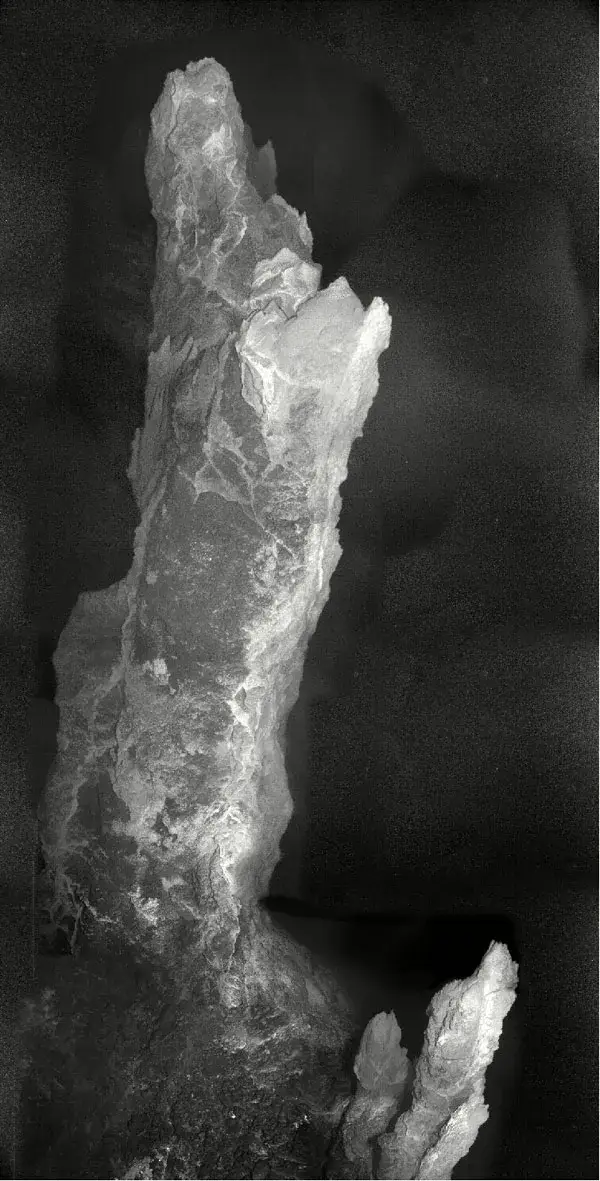
The tallest known structure in the field has been given the name Poseidon, after the Greek god of the sea. Close by, scientists from the University of Washington have described a cliff area where fluid slowly “weeps” out, creating fragile, finger-like carbonate formations.
Recent work has sharpened the picture even further. Studies published in 2024 found that Lost City vent fluids contain enough transition metals to plausibly support early-life metabolisms, while other analyses mapped how mixing between vent fluids and seawater shapes the towering chimneys that make the field so distinctive.
Still, the future of the site is uncertain. The Lost City sits in international waters, where deep-sea mining contracts have raised fears that exploration in the surrounding region could stir up sediment, disturb vent habitats, or damage the broader geological system even without directly targeting the field itself.
Poland’s exploration contract for polymetallic sulphides along the Mid-Atlantic Ridge remains under International Seabed Authority oversight, and in 2025 the country requested a deferral for part of its required relinquishment schedule. That has kept attention focused on how close industrial activity may come to the Lost City system.
Because of that risk, some experts want the Lost City to receive stronger international protection, hoping to safeguard a natural structure that existed in silence for tens of thousands of years before people even knew it was there.
UNESCO has already described the Lost City Hydrothermal Field as a place of outstanding scientific significance, but the convention that protects World Heritage sites does not yet extend to most of the high seas. For now, that leaves the Lost City famous, fragile, and still only partly explored.