

A woman says she has managed to lower her reported ‘skin age’ so that it now measures close to 10 years younger than her real age.
Kate Tolo shared details of the change on social media, where she outlined a series of lifestyle adjustments she believes contributed to the result.
She said the process involved tracking several health and skincare variables through what she described as a scientific method.
Tolo said her routine was influenced by self-styled ‘biohacker’ Bryan Johnson, who is known for following a highly regimented lifestyle in an effort to slow aging as much as possible.
Tolo and Johnson have been together for nearly five years, and the 30-year-old has now posted about the steps she says helped produce the shift.
“We started our health scientific experiment together, and I started to change my core habits… which no doubt had a major impact on my overall aging,” she said.
She clarified that she is not saying she physically appears to be 21, but that specific measurements place her skin in that range.
“I am not saying I look 21 yrs old… Or that I am 21 yrs old according to all skin markers – just the specific key skin markers that multi-spectral imaging can measure,” she said.
“And according to those 8 markers, my skin age is 21 years old.”
Aging affects the skin in multiple ways, including collagen levels, elasticity, hydration, pigmentation, and the appearance of wrinkles and pores. But so-called “skin age” is not a medical diagnosis, and the result usually depends on the imaging system, the database it is compared against, and how consistently measurements are taken over time.
I am 30 and my skin age is 21
I took a scientific approach, you can too. In this post I've shared everything I did to reverse my skin age and how you can do the same.
+ my skin protocol
+ how skin measurement works
+ how to start
+ how to track— Kate Tolo (@_katetolo) June 23, 2026
Tolo said she assessed her skin age with a method known as ‘multi-spectral imaging’, which works by shining different wavelengths of light onto the skin.
“It uses standardized visible, polarized, and UV lighting to assess surface and subsurface skin features,” she said.
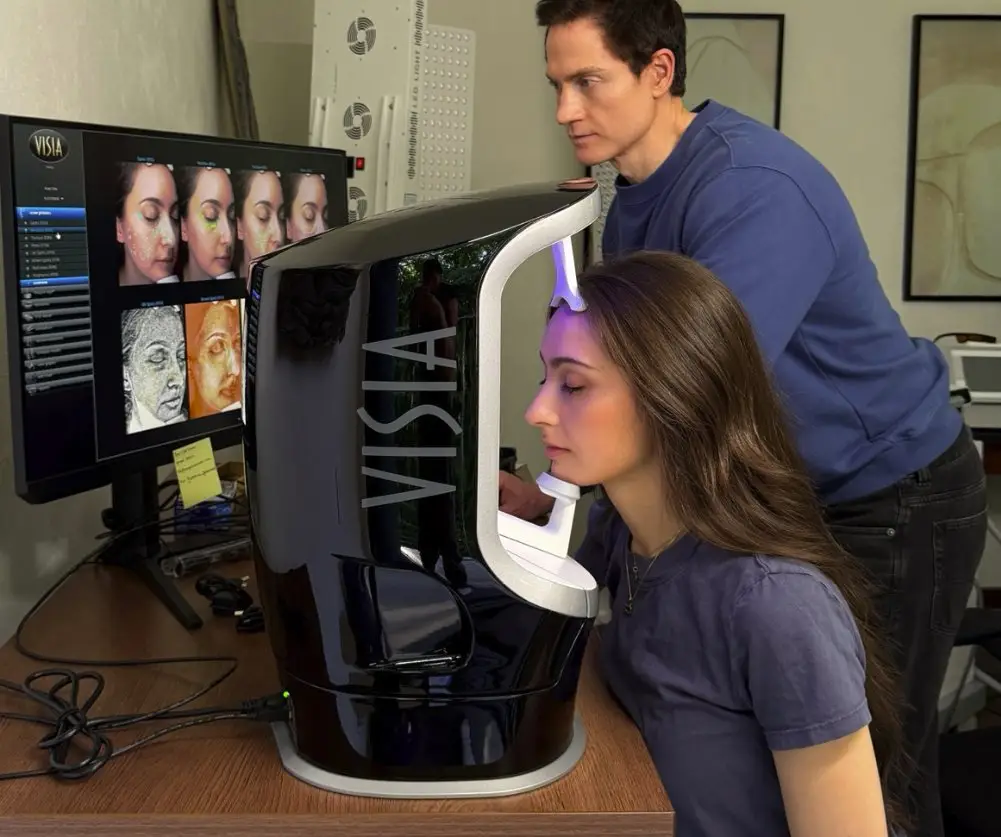
The light reflects differently depending on what it hits, allowing closer analysis of the subject. The same technique has also been used in other fields, including the recovery of erased writing from old manuscripts.
In skin analysis, similar systems are often used to look at features such as pores, texture, UV spots, redness, porphyrins, and wrinkles. Some systems also generate an estimated skin-age score by comparing those measurements with age-matched reference data.
She said: “It’s also worth noting that five years ago, I was eating McDonald’s daily and did not do anything specific for my skin.”
She added that when she was 27, the markers showed her skin age as 26, while now, at 30, those same markers put it at 21.
“This means that in 3 years, instead of accumulating 3 years of skin age, I reversed my skin-age by 5 years,” she said.
The kind of changes Tolo described are the same broad habits dermatologists usually associate with healthier-looking skin: daily sun protection, good sleep, consistent skincare, balanced nutrition, staying hydrated, and avoiding smoking or excess alcohol. Even so, experts generally caution that no single scan can capture the full picture of how skin is aging or how healthy it is overall.