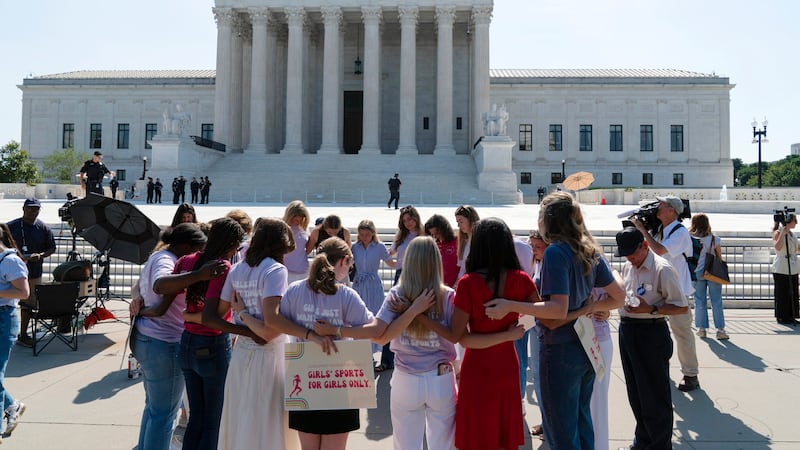
In a significant moment for Second Amendment jurisprudence, the Supreme Court announced Tuesday that it will consider whether laws banning semiautomatic rifles commonly known as assault weapons violate the Second Amendment. The justices said they will hear appeals challenging bans on the AR-15 and similar semiautomatic firearms in Connecticut and Cook County, Illinois.
The decision comes on the final day of the court’s term and represents a major shift. The Supreme Court had previously declined to take up similar cases, but this time a sufficient number of justices agreed to review the cases. Similar laws are in place in about a dozen states, covering major cities like New York, Los Angeles and Washington, D.C., meaning any ruling could have far-reaching consequences nationwide.
The two consolidated cases originate from challenges to long-standing bans. Cook County first passed its assault weapons ordinance in 1993, updated over the years, and it currently prohibits the possession, acquisition and transfer of 125 types of rifles, including AR-15s. Violators face up to six months in prison and a minimum $5,000 fine. Connecticut passed its ban in 1993 and strengthened its restrictions following the 2012 mass shooting at Sandy Hook Elementary School, which killed 20 children and six educators.
The plaintiffs challenging Cook County’s ban include two residents, Cutberto Viramontes and Christopher Khaya, along with two gun rights groups: the Firearms Policy Coalition and the Second Amendment Foundation. The Connecticut challenge involves similar plaintiffs and the Connecticut Citizens Defense League. One resident wants to purchase an AR-15 for self-defense, while another indicated they would primarily use one at a shooting range.
Lower courts have upheld both bans. In Cook County’s case, a federal judge upheld the law in 2018, and in 2019, the 7th Circuit Court of Appeals reaffirmed its position that such bans do not violate the Second Amendment. Connecticut similarly has had its ban upheld through the federal court system, with the 2nd Circuit Court of Appeals affirming it in August 2025.
Gun rights groups challenging the bans argue that the AR-15 is the most popular rifle in the country, owned by tens of millions of Americans for lawful purposes. They contend that firearms in common use for lawful purposes are protected by the Second Amendment and cannot be considered unusual or dangerous. In their appeal to the Supreme Court, challengers wrote, “If the Second Amendment does not protect the most popular rifles in the country, it is hard to see how it protects any firearms at all.”
The gun rights advocates drew support from unexpected sources. Justice Clarence Thomas wrote in 2024 that he found it difficult to square AR-15 bans with the Supreme Court’s current Second Amendment doctrine. Last year, Justice Brett Kavanaugh stated separately that the court should and presumably would address the AR-15 issue, predicting it would happen in the next term or two. These signals from the conservative justices gave gun rights advocates hope.
The states and local governments defending the bans argue that these weapons are the preferred choice of mass shooters and can be prohibited because they are similar to military-grade weapons. Cook County attorneys emphasized the weapons are designed to inflict maximum carnage and have no place in communities. Connecticut similarly has argued that assault weapons represent uniquely dangerous tools compared to other firearms.
This case represents the latest major Second Amendment dispute to reach the court following its landmark 2022 decision in New York State Rifle & Pistol Association v. Bruen. That ruling expanded Second Amendment protections and established a new test requiring that modern gun regulations demonstrate consistency with the nation’s historical tradition of firearm regulation. Gun control advocates worry this standard may make it difficult to defend assault weapons bans, since no historical analogue exists for weapons capable of the rapid, mass casualties seen in modern shooting incidents.
The Supreme Court has simultaneously bolstered some gun rights while upholding certain restrictions. Earlier this term, the justices struck down a Hawaii law restricting concealed carry and ruled that occasional marijuana users cannot be categorically prohibited from owning firearms. However, the court has also upheld restrictions on certain categories of people, such as those subject to domestic violence restraining orders.
Arguments in the case are expected in the fall, following the court’s new term beginning in October. A ruling is likely to come by next year. The National Shooting Sports Foundation estimates roughly 32 million modern sporting rifles are in circulation, while gun control advocates note that states have continued passing their own bans in recent years, including measures in Virginia and Rhode Island.
Congress allowed a federal assault weapons ban to expire in 2004, but Democrats have periodically supported renewing it following mass shooting incidents. The outcome of the Supreme Court case could determine whether states have the power to restrict these popular firearms or whether the Second Amendment prevents such bans nationwide.