

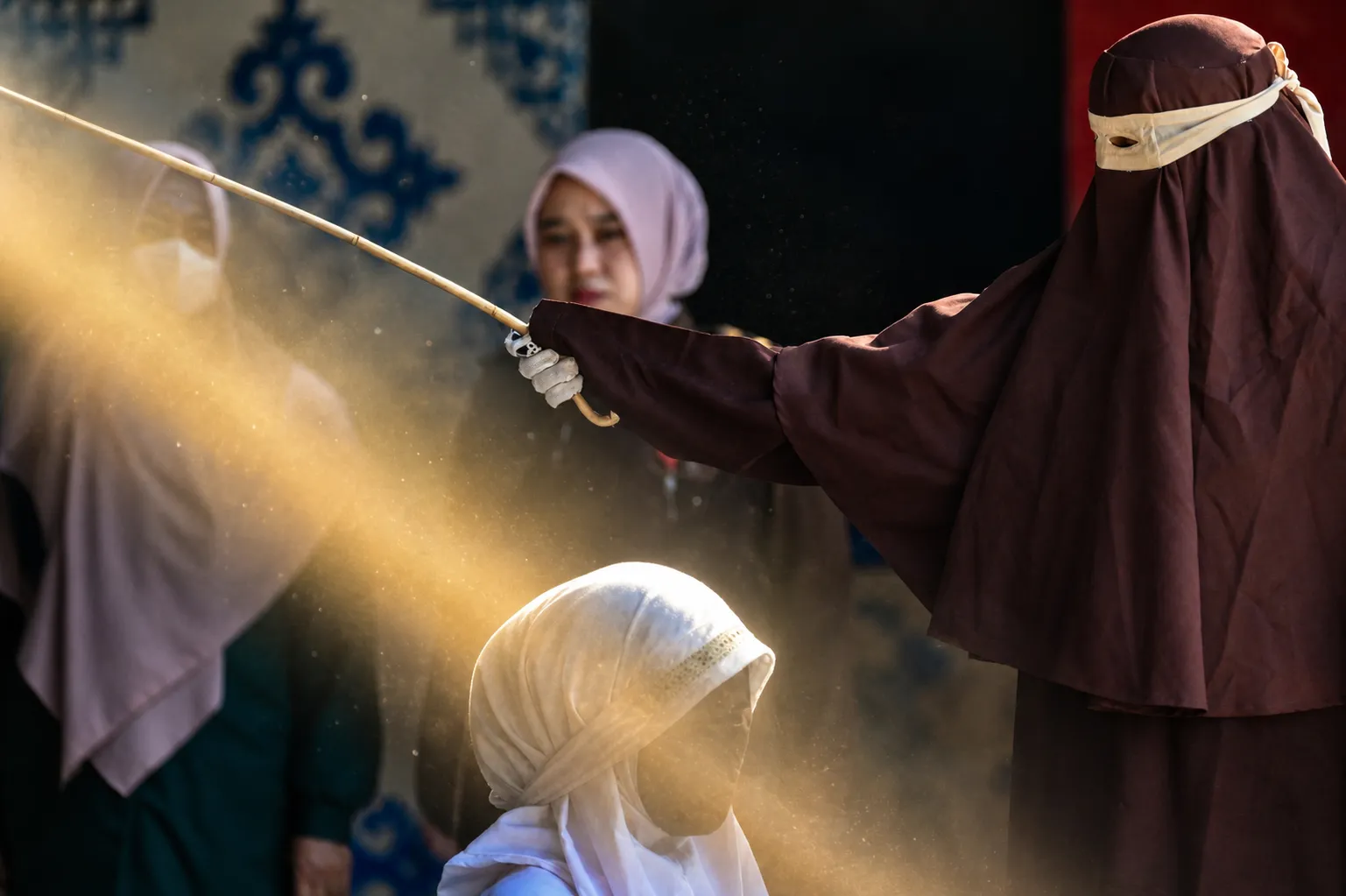
Two men in Indonesia’s Aceh province were publicly caned after an Islamic court convicted them of violating religious law by kissing and hugging, acts the court determined could lead to prohibited sexual relations. The men, ages 20 and 21, were sentenced to 80 strokes each and subjected to public punishment in Banda Aceh, the provincial capital, with an audience of roughly 100 people witnessing the flogging.
The pair made contact through an online dating application before meeting at Taman Sari city park in April. Residents saw them enter the same bathroom and alerted police patrolling the area. Officers broke into the toilet and discovered the men kissing and hugging, which led to their arrest and subsequent prosecution under Aceh’s Islamic Criminal Code.

The trial at the Islamic Shariah District Court was held behind closed doors, with the verdict opened to the public. During the proceedings, the lead judge, Rokhmadi M. Hum, stated that the two college students were “legally and convincingly” proven to have violated Islamic law by committing acts leading to same-sex sexual relations. Prosecutors had initially sought 85 strokes for each man, but the three-judge panel imposed what they described as a more lenient sentence of 80 strokes because the men were outstanding students who were polite in court, cooperated with authorities, and had no previous convictions. The judges ordered that the four months the men had spent in detention be deducted from their sentence.
This verdict marked the fifth time since 2006 that Aceh has ordered public caning for homosexuality-related offenses following the province’s implementation of Islamic law as part of a peace deal that ended a decades-long separatist conflict. In February, two other men were similarly caned at the same park after being convicted of having sexual relations.
Aceh is Indonesia’s only province permitted to enforce Islamic law and remains the sole region in the country where same-sex relations are criminalized. The province allows up to 100 lashes for various morality offenses, including same-sex relations, adultery, gambling, alcohol consumption, women wearing tight clothing, and men missing Friday prayers. The punishment is administered publicly with rattan canes by officials wearing robes and hoods.
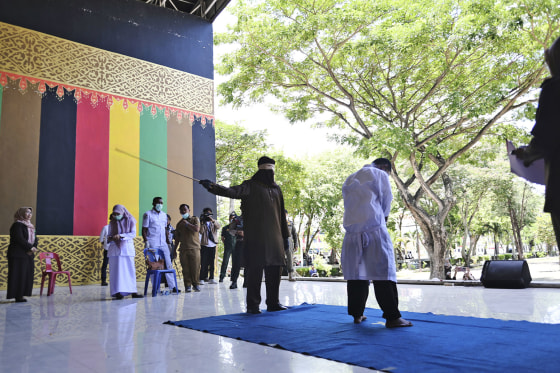
While homosexuality is not explicitly illegal under Indonesia’s national criminal code, Aceh’s special autonomy status—granted in 2001 following a peace agreement—permits the province to implement its own Islamic criminal law system. In 2015, Aceh expanded its Islamic bylaws to extend Sharia law to non-Muslims, who comprise approximately one percent of the province’s population.
International human rights organizations have strongly condemned the caning practice. Amnesty International described the punishment as “a disturbing act of state-sanctioned discrimination and cruelty,” emphasizing that “this punishment is a horrifying reminder of the institutionalized stigma and abuse faced by LGBTQ+ individuals in Aceh.” The organization has called for consensual same-sex activity between adults to never be criminalized and characterized corporal punishment as cruel, inhuman, and degrading conduct that may constitute torture under international law.
Maidina Rahmawati, acting executive director of the Institute for Criminal Justice Reform in Indonesia, stated that public caning contradicts various laws and regulations within Indonesia and goes against human rights interests. She noted that the public nature and exposure of such punishments harm Indonesia’s standing internationally.
In 2016, a coalition of human rights groups filed a petition with Indonesia’s Supreme Court seeking a review of Aceh’s regional regulations permitting caning, but the request was rejected. That same year, Indonesia’s Ministry of Home Affairs issued a letter to Aceh’s governor noting that regional laws should be enforced for minor crimes, though this guidance did not result in changes to the practice.
Indonesia, as a member of the United Nations Human Rights Council and a state party to the Convention Against Torture, has international obligations to protect human rights and prevent cruel and inhumane treatment. However, the country’s central government has stated it cannot unilaterally strike down Sharia law in Aceh given the province’s special autonomy status, though it has previously pressured Aceh officials to drop an earlier version of a law calling for capital punishment by stoning for adultery.
The public caning of the two men represents the continued application of corporal punishment in Aceh despite global criticism and Indonesia’s ratification of international treaties prohibiting such practices. The case highlights the ongoing tension between Aceh’s assertion of regional legal autonomy and broader commitments to international human rights standards.