


—
A new poll reveals a profound sense of political isolation among American Jewish adults, with the majority expressing little confidence in either major political party or President Donald Trump to support their community at a moment of heightened antisemitism and divisive debate over Middle East policy.
The AP-NORC poll, conducted in mid-June with responses from 1,022 Jewish adults, found that just 15 percent say the Democratic Party supports Jewish people in the United States “extremely” or “very” well, while about 33 percent say the party supports them somewhat well. Roughly 41 percent believe the Democratic Party supports the Jewish community “not very well” or “not well at all.”
Jewish adults hold even more skeptical views of President Trump and the Republican Party, with approximately 16 percent saying the Republicans support them extremely or very well and about half saying Trump and Republicans do not support Jewish people well. The finding is particularly striking given that Jewish Americans overwhelmingly identify as Democrats.
The sense of political abandonment comes at a critical juncture. Most Jewish Americans—63 percent—say prejudice against Jewish people is an “extremely” or “very” serious problem in the United States, a concern that far outpaces the general population. Only 38 percent of all U.S. Adults express similar levels of worry about antisemitism, underscoring the isolation many Jewish adults feel in their communities.

The disconnect between the Jewish community and political leadership extends beyond support metrics. For context, the poll comes nearly three years after the Hamas attack on Israel on October 7, 2023, which triggered both a regional conflict that expanded globally and an unprecedented surge in antisemitism. The same period has seen Israeli policy in Gaza become a flash point within both major American political parties, with support for Israel increasingly dividing Democrats and criticism of Israeli actions gaining ground among progressive activists.
The poll reflects these tensions through personal narratives. Yahm Levin, a 39-year-old Democrat from Los Angeles who is a former librarian, described feeling politically homeless. “I don’t really feel comfortable in leftist circles anymore,” she said. “I just want to be a Jewish American who has a connection to Israel. But I feel like I can’t do that. And it’s very frustrating. And sometimes a little scary.”
Her experience is not unique to Democrats. Max Sacher, a 27-year-old Jewish Republican from Austin, Texas, who has backed Trump, said his support shifted after witnessing what he saw as problematic elements of the Trump administration’s diplomatic approach to ending the months-long conflict with Iran. “I feel very lost politically,” Sacher said. “I used to have a home. Now I feel like I’m on an island in modern-day politics.”
Ellen Kuberski, a 72-year-old Jewish Democrat from Chicago, articulated a different frustration. She described “general disgust and hatred” for Trump but expressed deep disappointment with the Democratic Party, which she says has been more supportive of Palestinians than Israel or American Jews in recent years. “I tend to be more in line with the far left in just about everything else,” she said. “But now the far left is attacking the Jewish community.”
The polling captures a broader reality about Jewish political preferences. Jewish voters made up 3 percent of the 2024 electorate and overwhelmingly supported Democrat Kamala Harris over Trump, with 66 percent casting ballots for Harris and 33 percent for Trump. Yet this historical Democratic alignment masks growing fractures.
The survey found that many Jewish adults, 36 percent, say supporting Israel is “extremely” or “very” important to their Jewish identity, while another 26 percent say it’s “somewhat” important. This priority has increasingly become a source of tension across the political spectrum, as Democrats have faced internal divisions over Israel policy while Republicans court Jewish voters on the issue—even as Trump pursues diplomatic measures on Iran that some Jewish Republicans say undermine Israeli security interests.
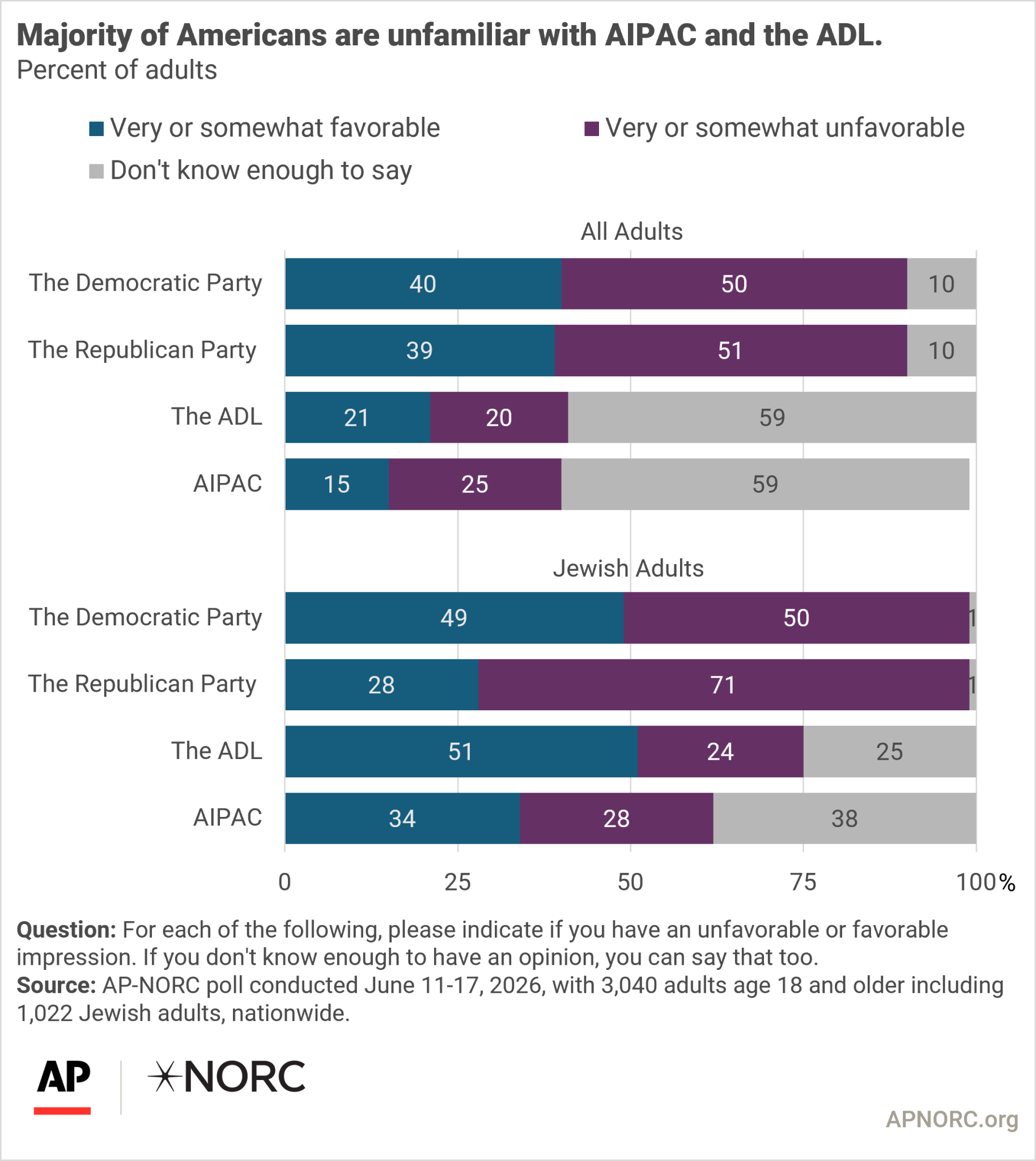
Views of the political parties themselves reflect the broader skepticism about their support for Jewish concerns. Half of Jewish adults hold unfavorable views of the Democratic Party, while 71 percent view the Republican Party unfavorably. Just 28 percent of Jews view the Republican Party favorably, a sharply lower proportion than the roughly 40 percent of all Americans who view either major party favorably.
The findings come at a time when tensions between Trump and Israeli Prime Minister Benjamin Netanyahu have become public, with disputes over an emerging U.S.-Iran diplomatic framework that Israeli officials fear does not adequately constrain Iranian power. These disagreements have become another source of anxiety for some Jewish Americans who once looked to Republican support for Israel as a political anchor.
The poll underscores what survey designers call “a rare detailed accounting of a key demographic that sits at the very center of some of the nation’s most divisive political debates.” Jewish American political perspectives have long been shaped by both domestic concerns—healthcare, the economy, and social issues—and deep attachments to Israel’s security. Today, those attachments are being tested in unprecedented ways across both political parties.
For many Jewish adults, the result is a sense that neither major party nor the president is providing the support they need at a moment when antisemitism is rising across the political spectrum and when fundamental questions about Israel policy are reshaping American politics itself.