


A group of twelve state attorneys general filed an antitrust lawsuit Monday seeking to block Paramount Skydance’s acquisition of Warner Bros. Discovery, marking a significant legal challenge to one of the largest media mergers in history despite the deal’s recent approval from federal regulators.
The coalition, led by California Attorney General Rob Bonta, alleges that the $111 billion transaction would substantially reduce competition across the entertainment industry. The states joining the lawsuit are Arizona, Colorado, Connecticut, Massachusetts, Minnesota, Nevada, New Jersey, New Mexico, New York, Oregon, and Washington. The suit was filed in the U.S. District Court for the Northern District of California.
Bonta announced the lawsuit at a press conference held in front of the Hollywood sign in Los Angeles, arguing that the merger would have far-reaching consequences for consumers and the industry. “This merger would snuff out competition, drive up prices, diminish content quality, and produce fewer movies and shows each year,” Bonta said during the event.
The states challenge the proposed merger on several grounds, alleging violations of the Clayton Act in three distinct markets: wide-release theatrical distribution, top-grossing theatrical distribution, and basic cable licensing. According to the complaint, the combined company would control approximately 27 percent of the wide-release theatrical distribution market, 30 percent of the market for anticipated blockbuster films, and 27 percent of the basic cable bundle. Together with Disney, Sony, and Universal, the five legacy studios would control roughly 86 percent of theatrical distribution and 90 percent of blockbuster distribution.
The states argue that combining two of Hollywood’s five remaining legacy studios would lead to higher prices, fewer movies and television shows, and diminished content quality. In their Monday complaint, the states said the merger would inflict substantial harm on movie theaters and basic cable distributors.
The attorneys general asked Paramount and Warner Bros. Not to close the merger until after the judicial process concludes. If the companies do not comply, the coalition stated it would file a temporary restraining order seeking judicial intervention to halt the deal.
The lawsuit comes one month after the U.S. Department of Justice gave its approval to the transaction on June 12 following an eight-month review. The DOJ’s Antitrust Division concluded the merger posed no threat to competition, issuing an unusually lengthy commentary arguing that the deal would not harm competition in the theatrical, streaming, and linear television markets. Despite this federal clearance, the states have chosen to challenge the transaction independently, a relatively uncommon occurrence for mergers of this scale.
Warner Bros. Shareholders overwhelmingly approved the merger in April, and the companies announced a definitive agreement in February after months of corporate maneuvering that included a failed competing bid from Netflix. Paramount is offering $31 per share in cash for all outstanding Warner Bros. Shares. The deal includes a “ticking fee” whereby Paramount must pay shareholders an additional 25 cents per share—approximately $650 million quarterly—if the transaction remains unclosed after September 30.
Paramount sharply rejected the lawsuit, calling it a misapplication of antitrust law that ignores the current competitive media landscape. The company argued that the combined entity would create a stronger competitor against dominant streaming and technology platforms like Netflix, Amazon, and Google that have come to dominate the market. Paramount also contended that delaying the merger would harm entertainment workers in California and nationwide, while shielding larger streaming rivals from meaningful competition.
The lawsuit has drawn strong support from entertainment industry groups and labor organizations. The Writers Guild of America called it “one of the worst proposed mergers we’ve seen,” warning that consolidation would result in fewer jobs, lower wages, less programming variety, and higher consumer prices. Tom Fontana, president of the Writers Guild of America East, said the merger would create an “alarming amount of consolidation and contraction” and cause “irreparable harm” to members, with people losing jobs and income.
Cinema United, the trade association representing movie theater owners, applauded the states’ action. President and CEO Michael O’Leary said the ramifications of further studio consolidation would be significant and lasting, affecting not just Hollywood but communities nationwide where movie theaters serve as economic and cultural centers.
More than 5,000 entertainment industry workers, including actors Jane Fonda, Bryan Cranston, and Ben Stiller, signed an open letter calling on regulators to block the merger, citing concerns about reduced opportunities for creators, fewer jobs, and potential impacts on diverse storytelling.
Questions of political influence have surrounded the deal since its inception. The DOJ’s approval came under the Trump administration, and critics have noted Paramount CEO David Ellison’s connections to President Trump. No Republicans have signed on to the states’ lawsuit, while Democrats have expressed skepticism about whether federal regulators under Trump adequately scrutinized the deal. Arizona Attorney General Kris Mayes suggested that something related to “a mega-billionaire named Ellison” influenced the Justice Department’s decision.
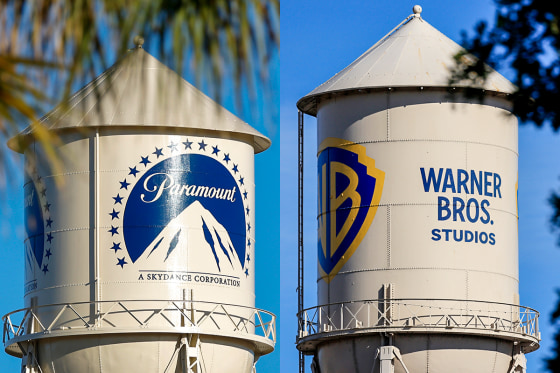
The merger would unite iconic entertainment assets including Paramount Pictures, Warner Bros. Studios, streaming services Paramount+ and HBO Max, and television networks including CBS, CNN, TNT, MTV, and BET. The combined company would control celebrated franchises and properties including Harry Potter, Batman, Top Gun, and Game of Thrones. Paramount CEO David Ellison has pledged that the merged company would release at least 30 films annually.
The lawsuit introduces uncertainty into a transaction that appeared close to completion. Paramount has secured approvals from regulators in several countries including Australia and Canada, but reviews remain ongoing in the European Union and the United Kingdom, both of which have indicated potential concerns about media consolidation and plurality of news sources.