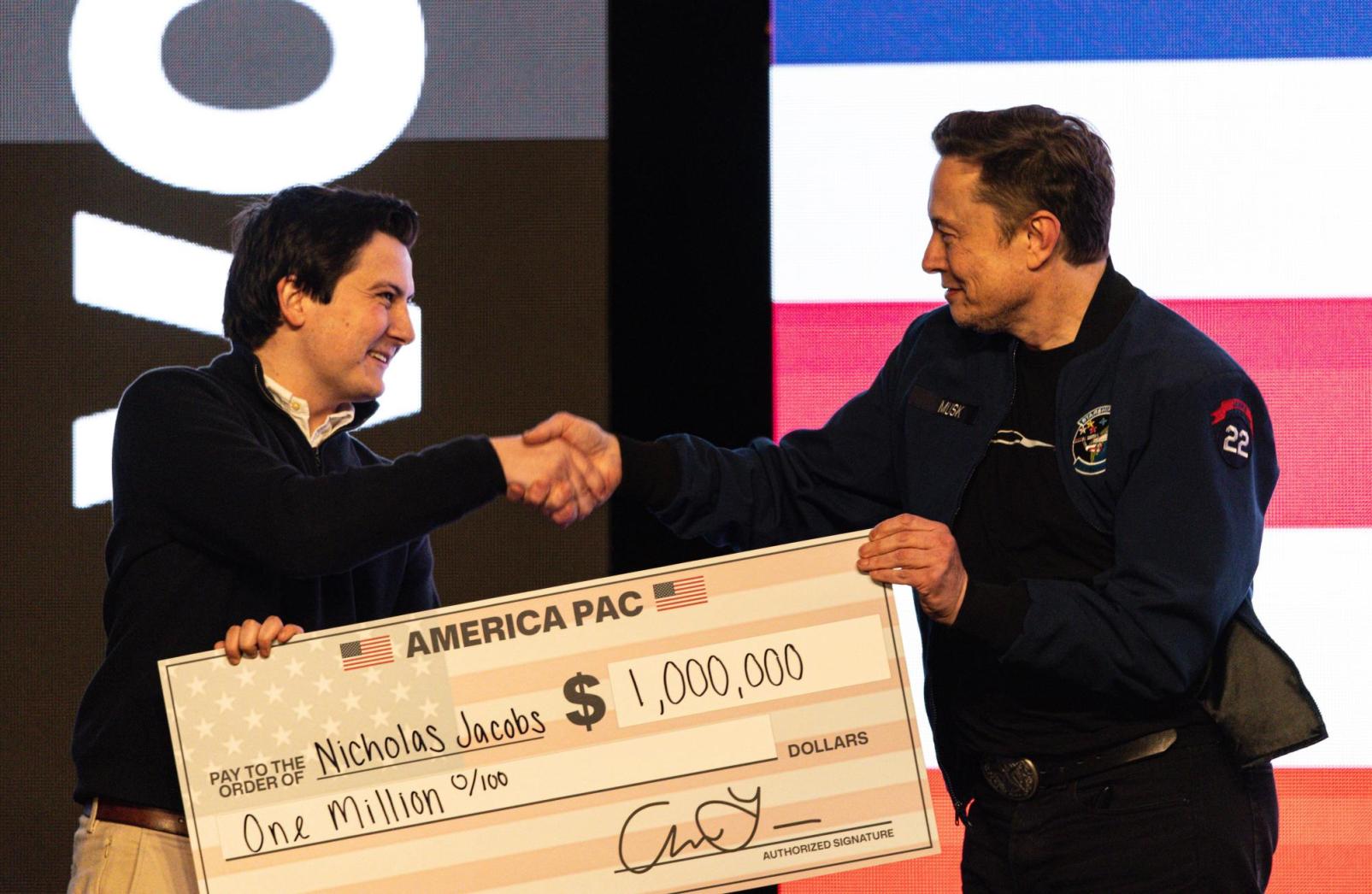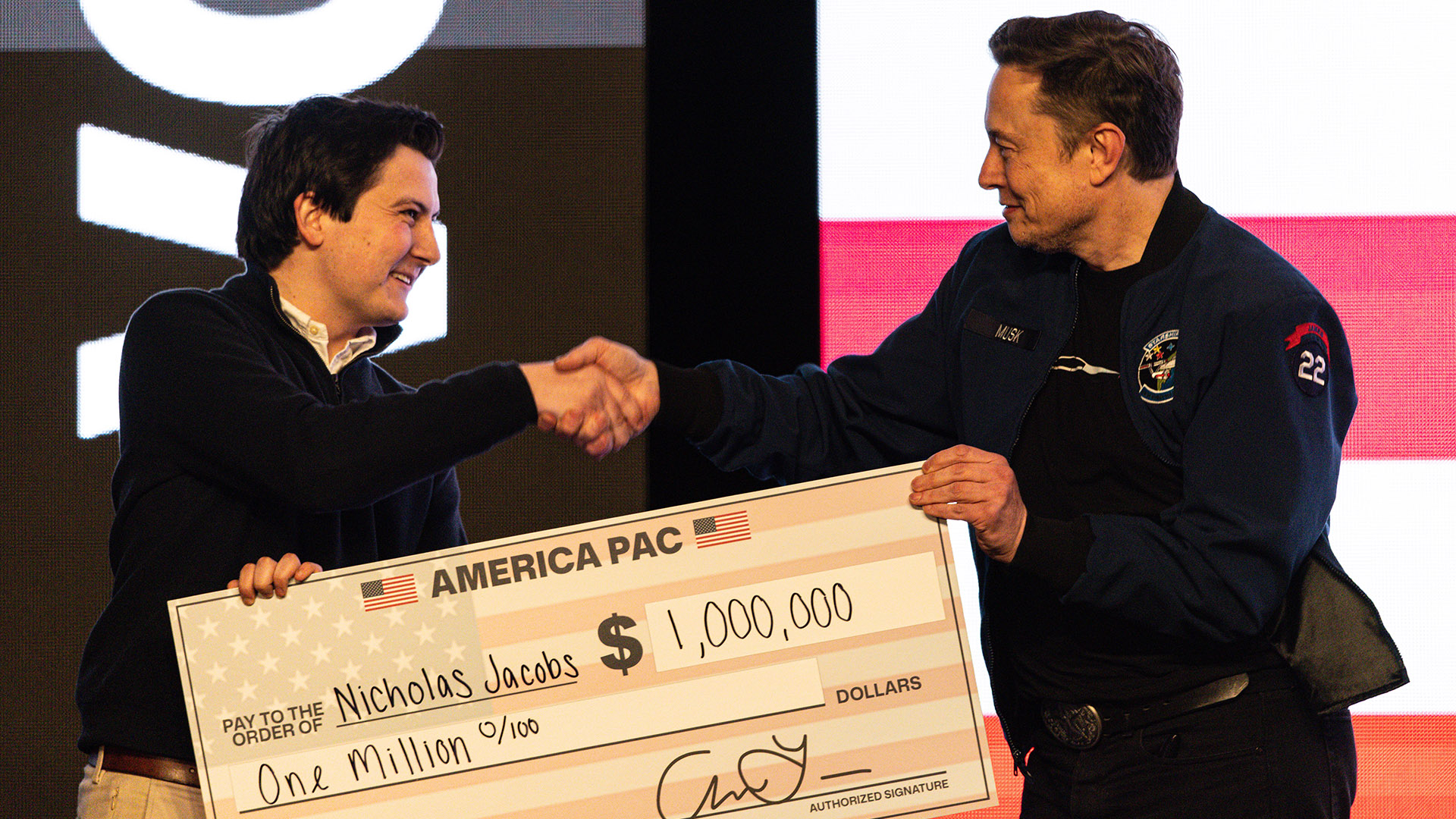
Billionaire Elon Musk likely broke Wisconsin law when he handed out $1 million checks to voters in the 2025 state Supreme Court election, a bipartisan panel has found. The Wisconsin Elections Commission last week referred two complaints to the Brown County district attorney’s office, which can choose to bring criminal charges over violating the state law against election bribery. Prosecutors have 40 days to report back to the commission.
The motion approved by the elections commission said it found probable cause that Musk broke Wisconsin law by making a social media post offering $1 million to people who voted in the Supreme Court election “in order to induce them to vote in that election.” The Wisconsin Elections Commission, consisting of three Democrats and three Republicans, voted 5-1 in closed session on Thursday to refer the complaints to the district attorney.
Wisconsin law prohibits offering, giving or promising to give any amount of money over $1 to induce anyone to go to the polls, vote, or vote for a particular person. The state’s election bribery statute carries serious criminal penalties.
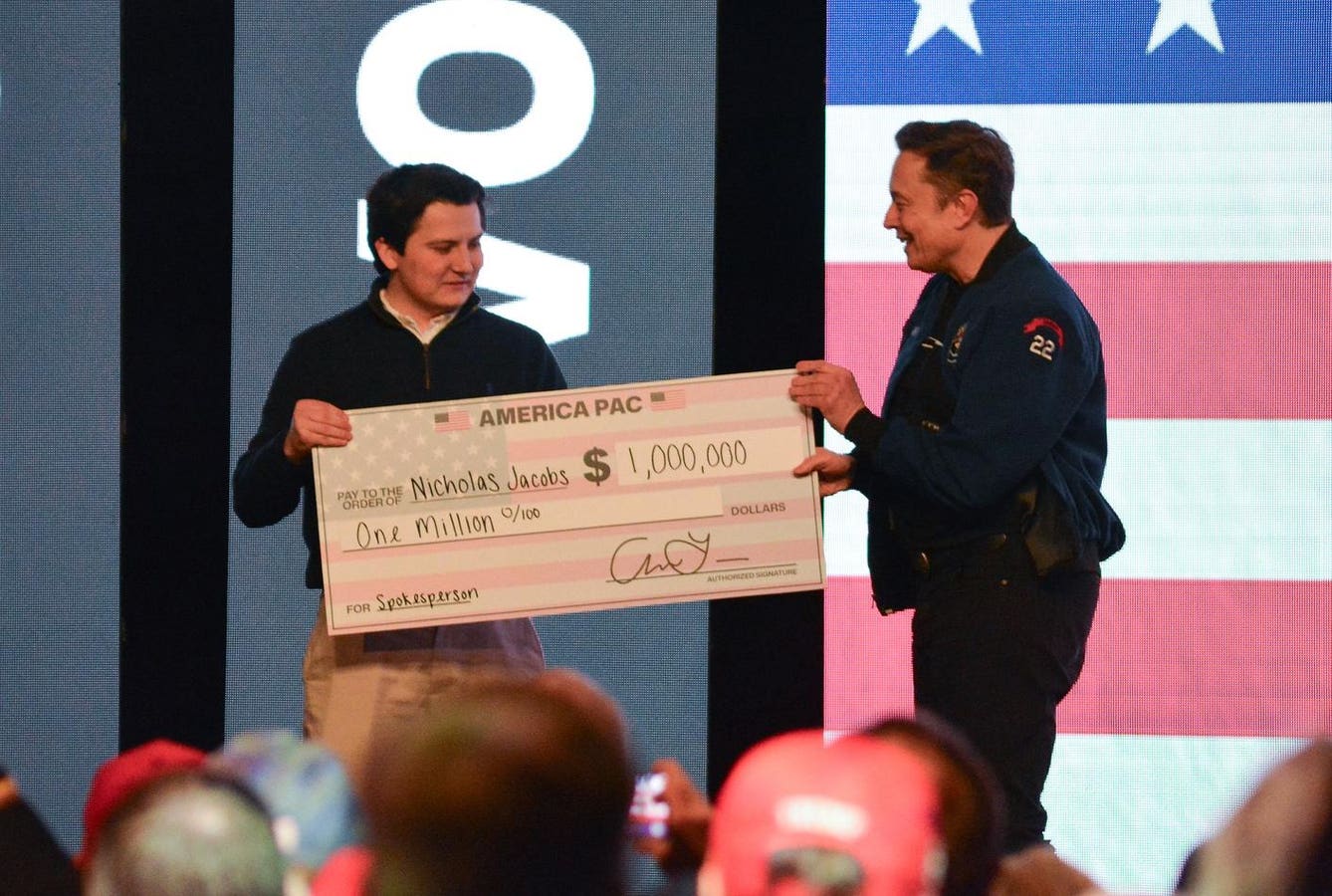
Three Wisconsin voters received checks from Musk, including two who got them in person at the Green Bay rally just days before the April 1 election. One recipient was Nicholas Jacobs, chair of the Wisconsin College Republicans. The other was Ekaterina Diestler, a graphic designer. A third voter also received a $1 million check but did not attend the rally.
Musk was deeply involved in the effort to flip majority control of the highest court in battleground Wisconsin. The tech titan and groups he supported spent at least $20 million on the candidate backed by Republicans, Brad Schimel. However, he lost by 10 percentage points to Democratic-backed candidate Susan Crawford. Spending on the election topped $100 million, making it the most expensive judicial race in U.S. History.
Two weeks before the election, Musk’s political action committee, America PAC, offered $100 to voters who signed a petition in opposition to “activist judges,” or referred someone to sign it. Musk initially said in a social media post that he planned to give $1 million to people who had already cast their ballots “in appreciation for you taking the time to vote.” He later clarified that the money would go to people who would be “spokesmen” for an online petition against activist judges.
Musk’s attorneys argued in legal filings in 2025 that Musk was exercising his free speech rights with the giveaways and any attempt to restrict that would violate both the Wisconsin and U.S. Constitutions. The payments are “intended to generate a grassroots movement in opposition to activist judges, not to expressly advocate for or against any candidate,” Musk’s attorneys argued in court filings.
Attempts to stop Musk failed in 2025. Wisconsin’s Democratic attorney general, Josh Kaul, sued to stop Musk from handing over the checks to two voters, but the lawsuit was rejected by state courts. The state Supreme Court declined to hear the case as an original action and gave no rationale for its decision.
Musk’s spending on the 2025 race has already resulted in one lawsuit filed by a government watchdog group, the Wisconsin Democracy Campaign, which seeks to prohibit him from ever again offering cash payments in the state. That lawsuit alleges that Musk and two groups he funds violated prohibitions on vote bribery and unauthorized lotteries and that his actions were an unlawful conspiracy and public nuisance.
This is not the first time Musk’s political action committee has faced scrutiny over its giveaway tactics. Before the 2024 presidential election, America PAC offered to pay $1 million a day to voters in Wisconsin and six other battleground states who signed a petition supporting the First and Second amendments. A judge in Pennsylvania said prosecutors failed to show the effort was an illegal lottery and allowed it to continue through Election Day. However, voters later filed a class action lawsuit against America PAC alleging they were defrauded after the PAC admitted it did not choose the winners at random.
A month after the lopsided loss in Wisconsin, Musk announced that he would be spending far less on political campaigns. Crawford’s win kept liberals in control of the state Supreme Court, and their majority grew to 5-2 after Democratic-backed candidate Chris Taylor’s victory this year.
Brown County District Attorney David Lasee, a Republican, did not immediately return a message seeking comment. Spokespeople for Musk did not immediately respond to requests for comment.