

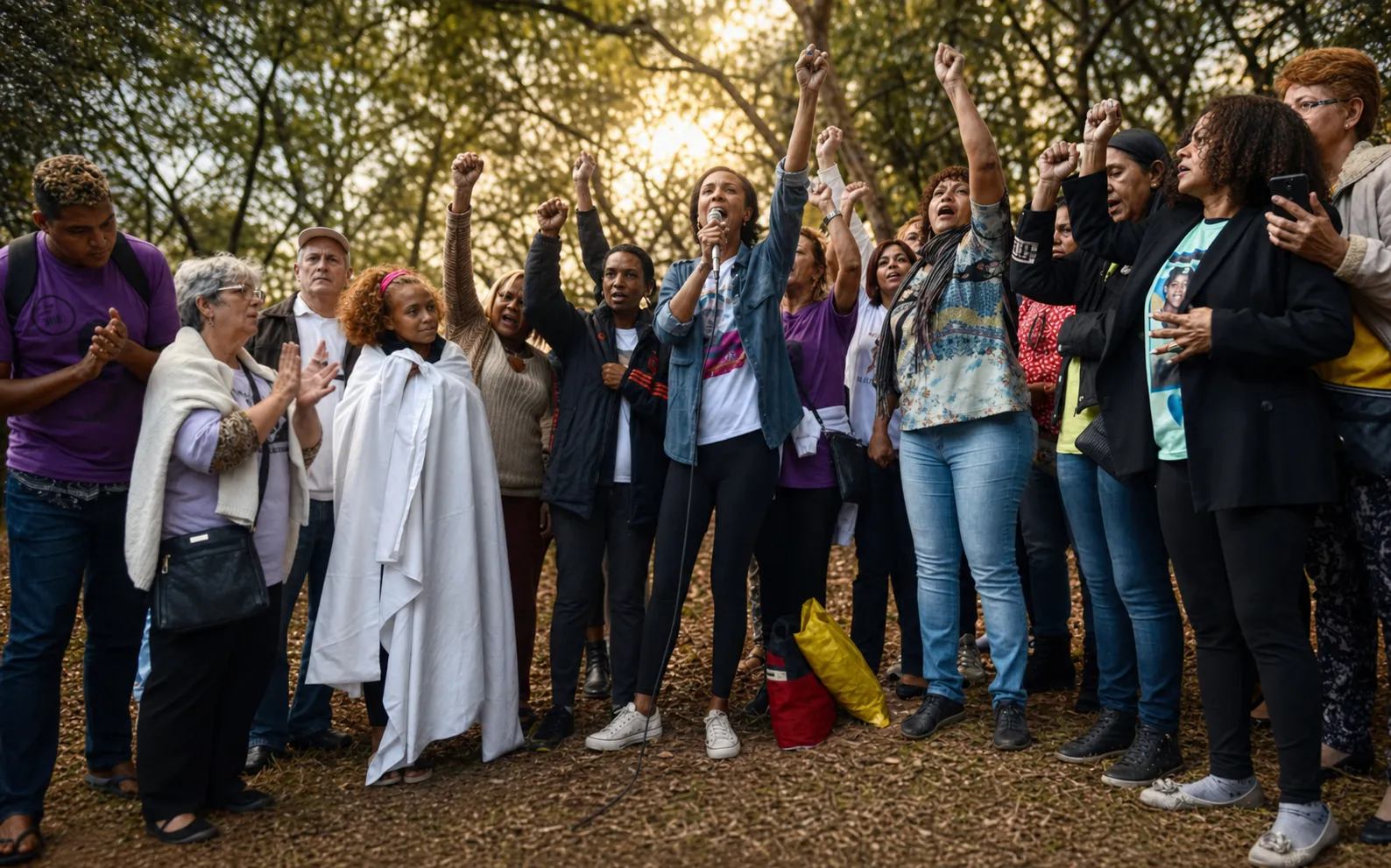
In Rio de Janeiro’s favelas, a group of mothers united by the loss of their sons to police violence are demanding the federal government implement a nationwide policy to support families devastated by state violence. Their plea represents one of the fastest growing social movements in Brazil, a country where police kill thousands of people annually with near-total impunity.
Ana Paula Oliveira’s 19-year-old son Johnatha was shot in the back in May 2014 while passing through the Manguinhos favela after visiting his grandmother. Police claimed they were dispersing a crowd protesting against police violence. Johnatha died from his injuries. Twelve years later, Oliveira stands among dozens of mothers who have transformed their grief into activism, insisting their sons are remembered as something more than statistics.
The pain nearly destroyed her. But finding solidarity with other grieving mothers saved her life, Oliveira has said. Together, these women attend judicial hearings, organize protests, and hold commemorative events where they provide each other the psychological support a indifferent state has failed to offer. Last year, they traveled to Brasilia to present their demands to the country’s legislative, judicial, and executive branches.
The scale of police violence in Brazil is staggering. In 2025 alone, police killed at least 5,920 people, according to Human Rights Watch. The Brazilian Forum on Public Safety reports that police have killed more than 6,000 people annually since 2018. A recent report found that of 4,330 people killed by police across nine Brazilian states in 2025, more than 86 percent were Black, despite Black Brazilians comprising only 55.5 percent of the population. A Black person in Brazil is roughly three and a half times more likely to be killed by police than a white person.
The vast majority of victims are young men. Nearly two-thirds of those killed by police in 2025 were 29 or younger, and 310 were children or adolescents. In October 2025, a police operation in Rio de Janeiro resulted in what is considered the deadliest police raid in the state’s history, leaving 122 people dead.
Oliveira’s case exemplifies the obstacles families face seeking justice. Though a jury initially convicted the police officer who killed Johnatha, the conviction was downgraded to manslaughter without intent to kill in 2024. Prosecutors appealed, but no new trial date has been set. Rather than face conviction for intentional homicide as Oliveira demands, the officer remains largely unpunished for a killing that effectively destroyed a family.
Other mothers have similarly channeled their losses into action. Monica Cunha’s 20-year-old son was killed by police in 2006. Since then, she became a councilwoman and this month launched her candidacy to run for state lawmaker in Brazil’s October elections. Nadia dos Santos lost two sons to police: Cleyton in 2015 when he was 18, and Cleyverson in 2022 at age 17. Her sister Glaucia dos Santos also lost a son, Fabricio, killed by police in 2014 at 17. The sisters founded support groups and began investigating the circumstances of their sons’ deaths through the courts. In 2023, officers involved in Fabricio’s death were sentenced to nine years in prison, a rare victory that gave the mothers hope.
The mothers are demanding far more than individual justice. They seek a comprehensive nationwide public policy to support relatives of victims of state violence and are requesting public funding to finance their work. Oliveira has suggested reparations could include placing victims’ names in public spaces and naming schools, hospitals, and daycare centers after the dead. She also emphasizes the need for public policies of nonrepetition that would prevent future killings.
Their activism occurs against the backdrop of Brazil’s October elections. Crime is a central issue for voters, and supporters of presidential hopeful Flávio Bolsonaro, son of former President Jair Bolsonaro, argue that police should be given unfettered support to fight heavily armed gangs in favelas. Such rhetoric stands in stark contrast to the mothers’ demands for accountability and systemic reform.
Nadia dos Santos, who traveled to Brasilia to present the mothers’ demands, expressed the toll of their activism: “The state should have the obligation to give us mothers who lose our sons because of the state’s violence reparations. We fight, we work, but we become ill. We need solutions.”
The mothers’ work is supported by Raave, a network of organizations assisting people affected by police killings in Rio. A coordinator for the organization said Raave is negotiating with the federal government to implement a pilot project developed by the mothers to provide care and guarantee the rights of families affected by state violence. Whether Brazil’s government will heed their calls remains uncertain, but the mothers say they will continue fighting. As one mother put it: “We need one another to cry together, to smile together and to fight together.”