

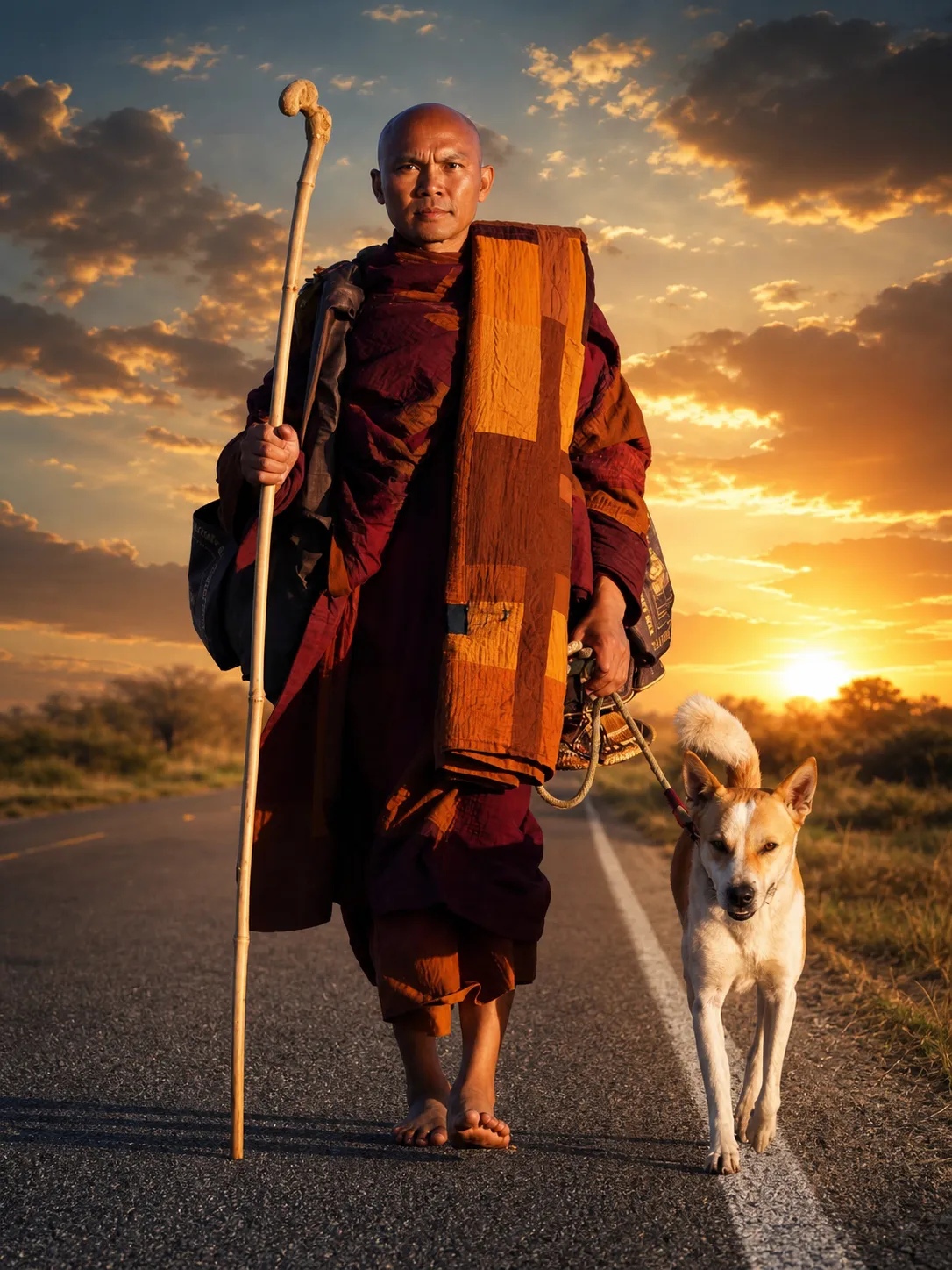
An unassuming Texas monk and a four-legged companion transformed a 2,300-mile spiritual journey across the American heartland into an international phenomenon, proving that a message of peace delivered one deliberate step at a time could captivate millions hungry for hope in a fractured world.
The Venerable Bhikkhu Pannakara, a Vietnamese-American Buddhist monk, led approximately 19 monks from Fort Worth’s Huong Dao Vipassana Bhavana Center on their Walk for Peace beginning October 26, 2025. Their destination was the nation’s capital, a distance they would cover in 108 days across ten states. By the time they arrived at the Lincoln Memorial on February 10, 2026, their social media following had exploded to millions, and Pannakara himself had drawn comparisons to the Dalai Lama, Martin Luther King Jr., and the peace activist Thich Nhat Hanh.
What makes the monk’s ascent to prominence remarkable is not just the distance or the meditation, but the improbable origin story of his companion: Aloka, a rescue dog with a distinctive heart-shaped marking on his forehead, discovered as a stray on the streets of India. During a 112-day peace pilgrimage in 2022, the monks encountered the scruffy dog near Kolkata, and something irreplaceable formed between them. Aloka was hit by a car, fell seriously ill, yet refused to abandon the monks even when they placed him in a truck for his own safety. He jumped out and rejoined them. The monks named him Aloka—meaning light in Sanskrit—and brought him to Texas. Four years later, he became a global sensation.
Pannakara’s journey to this moment is one of radical transformation. Born in Vietnam in 1981, he immigrated to the United States in 1997, earned a degree in information technology from the University of Texas at Arlington, and worked as an engineer at Motorola. In 2007, at an age when many consolidate their career gains, he chose a different path. He ordained as a novice monk and received full ordination in 2010. It was not a single traumatic event that prompted the shift, but the cumulative weight of witnessing loved ones suffer and the ruthlessness of competitive ambition. His parents wept at his ordination ceremony, though they eventually accepted his choice.
The Walk for Peace itself emerged from a solemn vow Pannakara made in 2022 during an International Vesak Ceremony. Kneeling before assembled monastics and visitors, he promised that if he could not complete his mission to promote peace and preserve Buddhist teachings in his lifetime, he would “be reborn to continue this project until its completion.” Walking 2,300 miles through America became the embodiment of that vow.
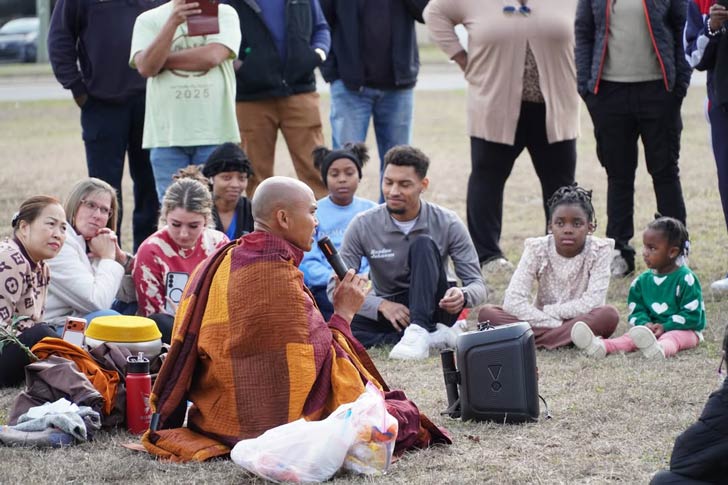
The monks departed Fort Worth in October 2025, clad in simple robes, many of them patchwork garments Pannakara had stitched together from cloth scraps collected during his Indian pilgrimage. They walked barefoot or in minimal footwear, often in silence, traversing 20 to 30 miles daily. At stops in state capitals, historic landmarks, and small towns, Pannakara delivered discourses on mindfulness and compassion that drew increasingly large crowds. He distributed thousands of peace bracelets—colorful cords representing mindfulness, compassion, and unity. His message was always the same: “We walk not to protest, but to awaken the peace that already lives within each of us.”
The journey tested everyone. In November, near Dayton, Texas, an escort vehicle was struck, and one monk suffered injuries requiring leg amputation. Yet he returned to complete the final day in Washington. Aloka required surgery for a torn ligament while passing through South Carolina in January, leading to weeks of recovery rides in a support vehicle. Veterinarians across the entire route volunteered free care, some having traveled to college together without coordinating their assistance. Despite these obstacles, momentum only accelerated.
As the monks moved eastward through winter, crowds swelled. What began with scattered individuals handing flowers evolved into hundreds gathering in small towns, and then thousands in cities like Atlanta, Charlotte, and Raleigh. When they crossed the historic Edmund Pettus Bridge in Selma, Alabama—site of the 1965 Civil Rights march—hundreds joined them. In Washington, thousands lined the streets. At the Lincoln Memorial, Pannakara addressed a massive crowd while Aloka stood at his side.
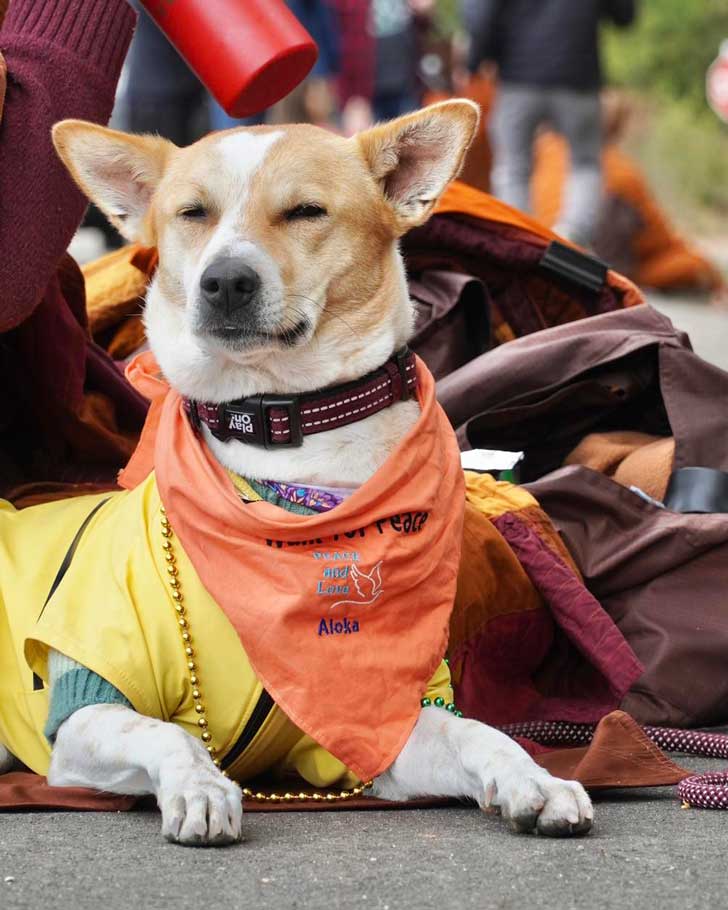
Pannakara remained apolitical throughout, refusing to weaponize the walk for partisan purposes, earning praise from senior Buddhist teachers. Yet his impact transcended politics. Women grieving lost children drove hundreds of miles to meet him. Strangers reported feeling genuine peace in his presence, describing something they saw in his eyes. A Dairy Queen in Texas gave the monks ice cream and made sure Aloka received treats. Doctors offered free checkups. Churches opened their doors. Americans of all backgrounds recognized something they desperately needed: a living embodiment of the peace they craved.
By journey’s end, the monks’ social media channels had accumulated more than 5.8 million combined followers across Facebook, Instagram, and TikTok. Aloka alone attracted over 1.5 million followers across his accounts, with some of his posts generating hundreds of thousands of likes. The story spread globally, and Pannakara, the former engineer from Texas, became one of the most visible modern figures in engaged Buddhism.
On February 14, the monks returned home to Fort Worth, concluding their pilgrimage. Yet the momentum did not stop. In the months following, Pannakara announced plans for additional peace walks. Plans emerged for a charitable foundation bearing Aloka’s name. The quiet spiritual practice of walking meditation—one of humanity’s oldest forms of prayer—had been transmuted into a contemporary movement that proved even in fractured times, millions will pause to witness and celebrate peace.