

Mais al-Gharam was barely 21 when she made a decision that would define the next two years of her life. Just hours after an Israeli airstrike on July 10, 2024, destroyed her family’s home in Gaza and killed her parents and younger brother, she reached out to HaMoked, an Israeli human rights organization, determined to save the siblings she had left behind. The youngest was just eight years old.
It was a moment that captured, in painful miniature, the tragedy of Gaza’s war and the extraordinary measures some families are taking to survive it. More than 58,000 children have lost one or both parents since October 2023, when the war began. For the al-Gharam family, separated by geography and citizenship before the war even started, the strike meant orphanhood for six of the eight siblings, and an impossible-seeming challenge for Mais, then 23, to reunite them.
The al-Gharam story is rooted in a history that long predates the current conflict. Mais’s father, Murad, came from Gaza. Her mother, Amal, was a Palestinian citizen of Israel. They met during the Second Intifada, in the early 2000s, when violence raged and Israel clamped down on Palestinian work permits. With Murad’s status in Israel threatened, they moved to Gaza permanently and settled in Nuseirat, a refugee camp in the central part of the enclave. Murad drove a taxi, and the couple had eight children together: Zuhour, 22; Jwaher, 21; Sabreen, 20; Ghfran, 17; Fady, 16; Maisara, 11; and Arjwan, 8. “We lived here together as a family and never lacked anything,” Zuhour later recalled.
When Mais was older, she moved to Israel to live with relatives, becoming a bridge between two worlds that the al-Gharam family straddled uneasily. She was in Israel two months before October 7, 2023, when everything changed. The al-Gharam family, like hundreds of thousands of others in Gaza, was displaced repeatedly through 2024. They moved seven times in the first half of the year, eventually reaching Rafah in southern Gaza, only to have to flee again when Israeli forces invaded there too.
By early July 2024, they had returned to Nuseirat and their own home. The area, they thought, might offer some measure of refuge. But at six in the morning on July 10, an airstrike struck their house. Walls collapsed. Debris crashed through the ceiling. The surviving siblings ran screaming into the street. Jwaher suffered fractures to her leg and fingers. At Al Aqsa Hospital in Deir al-Balah, doctors informed them that their mother, father, and brother Maisara were dead. “Suddenly the burden fell on us,” their sister Sabreen said. The survivors—five siblings ranging in age from 8 to 22—faced an impossible situation in a territory ravaged by conflict.
In the months that followed, they did what they could to survive. They cooked, cleaned, and collected firewood to boil water and keep warm. They opened a bakery in their neighborhood to earn money. They relied on charity and on funds sent by relatives in Nazareth, Israel, where Mais and her mother’s extended family lived. “We were forced—each of us—to take on a role that wasn’t ours,” Fady, then 16, said. Meanwhile, Mais threw herself into bureaucratic battle on the other side of the border.
Working with HaMoked and a team of lawyers, she began drafting letters to the Israeli Interior Ministry and COGAT, the military authority that oversees border crossings and humanitarian affairs in Gaza. She needed permits for her siblings to enter Israel, a court order appointing Zuhour as legal guardian to the minor children, and six successful applications for Israeli citizenship. It seemed impossible. The Interior Ministry initially rejected the request to apply for the “divided family” procedure to reunite the al-Gharams—because their mother was dead. But Mais, her lawyers, and HaMoked persisted. The family underwent DNA testing to prove the siblings’ relationship to Mais, an Israeli citizen. There were additional trips to the Kerem Shalom border crossing to sign paperwork for Israeli passports.
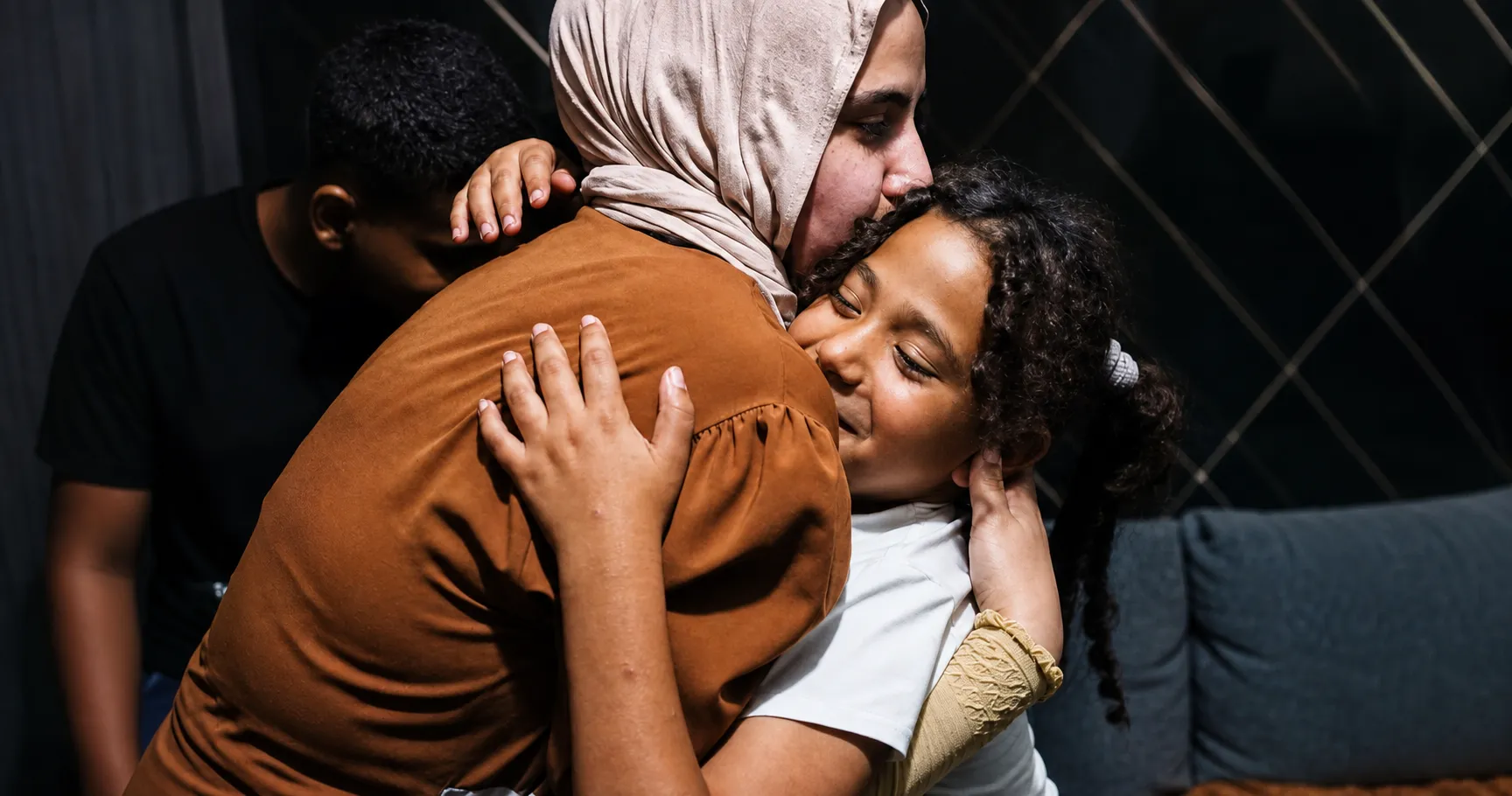
Nearly two years to the day after the airstrike that orphaned them, the five surviving siblings—Zuhour, Jwaher, Sabreen, Ghfran, and Fady—received their passports and permission to leave Gaza. They crossed into Israel on July 8, 2026, with Arjwan, who had been born while they were in Gaza and had never known anything but the enclave. Mais waited at the crossing, scanning for their faces as they passed through the gates.
The meeting at Kerem Shalom was followed by a half-day drive north to Nazareth, where their mother’s extended family received them with hugs and homemade food. Their grandfather, Faraj al-Gharam, struggled to find words for the moment. “It’s like coming back from the grave,” he said of his grandchildren. When they arrived, the siblings spoke mostly about ordinary hopes: spending time with relatives, going to school, seeing doctors. They had achieved their primary goal. “Family,” said Jwaher, 21, “is the most important thing.”
But the reunion carried mixed emotions. While they had found one another again, they could never reclaim what they had lost—their parents, their brother, their home, the life they had known in Nuseirat. The al-Gharam family is one of hundreds separated by the geography of the conflict, one of thousands orphaned by its violence. For them, the reunion offers a rare moment of hope amid a war that has claimed tens of thousands of lives and left countless more children alone, traumatized, and struggling to survive.