

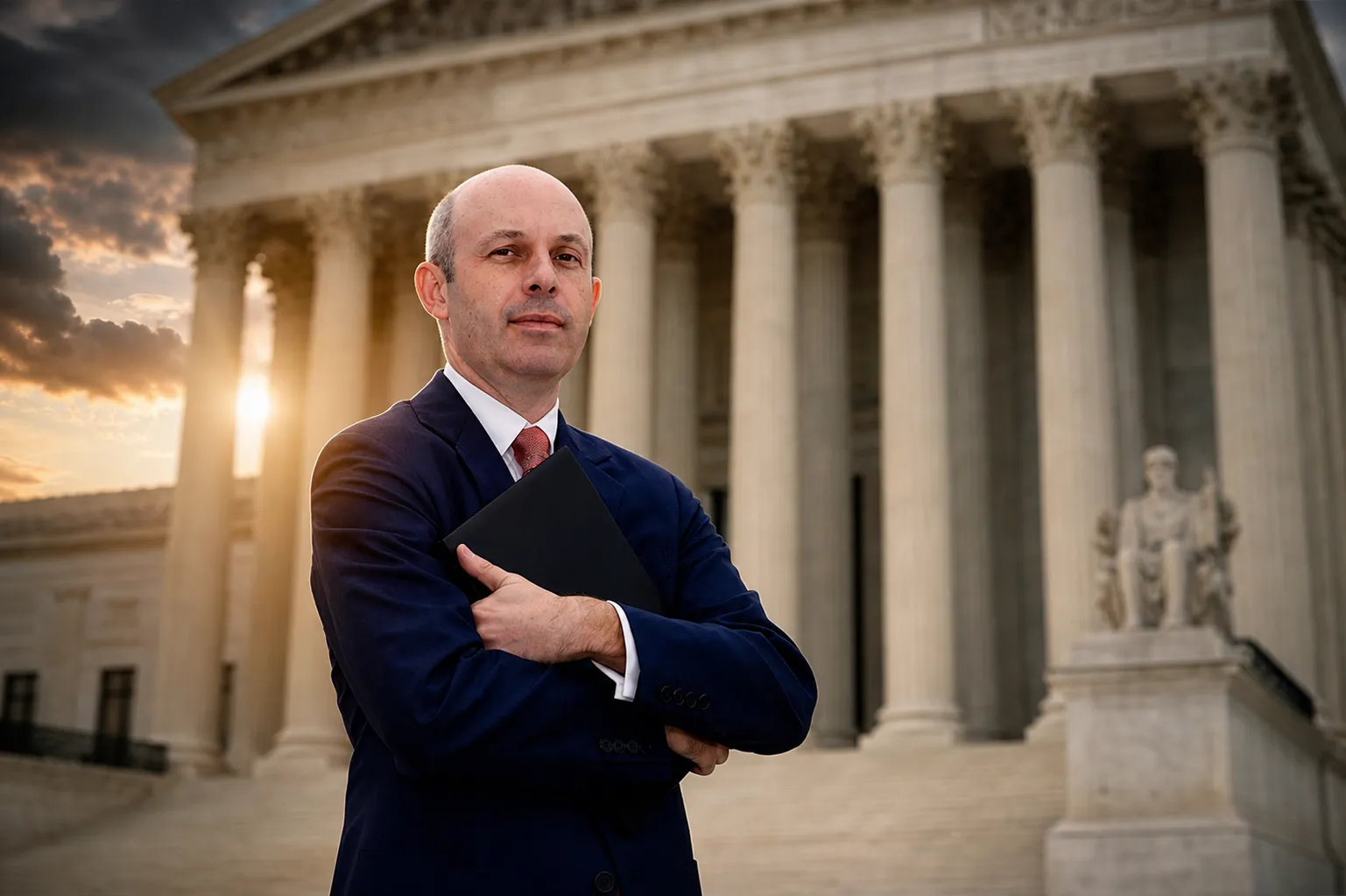
Thomas Goldstein, one of the nation’s most prominent appellate lawyers, was sentenced to six years in federal prison on Friday after being convicted of tax evasion and financial crimes linked to his secret life as an ultra-high-stakes poker player. The sentencing marked the dramatic downfall of a man who built an elite legal career arguing dozens of cases before the U.S. Supreme Court and co-founding SCOTUSblog, the widely read legal news website.
U.S. District Judge Lydia Griggsby imposed the sentence in federal court in Greenbelt, Maryland, months after a jury found Goldstein guilty of 12 of 16 counts in February. The conviction exposed a hidden world of multimillion-dollar poker games, concealed gambling income, and an elaborate scheme to hide his liabilities from the government and lenders. In addition to prison time, his marriage has dissolved and he stepped away from the boutique law firm he founded.
Goldstein’s fall from grace shocked Washington’s legal establishment. The lawyer had argued more than 40 cases before the U.S. Supreme Court before retiring from his practice in 2023. He served on the legal team that represented Al Gore in the 2000 election dispute before the Supreme Court. Yet behind his polished public image as a leading appellate attorney lay a double life: a compulsive gambling habit that consumed millions of dollars and led him to orchestrate an elaborate cover-up.
The six-year sentence falls between the government’s request for eight years and defense arguments for supervised release without prison. Prosecutors had painted Goldstein as a sophisticated attorney who deliberately and extensively engaged in misconduct to fund his gambling lifestyle and luxury spending.
The evidence presented at trial revealed the scope of Goldstein’s poker career. According to prosecutors, he raked in approximately $50 million in poker winnings in 2016 alone, including roughly $22 million from games he played in Asia. He frequently participated in games involving tens of millions of dollars with celebrity players and wealthy business figures. The trial included testimony from actor Tobey Maguire, who enlisted Goldstein’s help recovering a gambling debt from a billionaire.
Despite his massive poker winnings, Goldstein failed to pay taxes on the gambling income between 2016 and 2023. He concealed millions of dollars in poker wins and losses from the government, diverted legal fees from his law firm to pay gambling debts, and falsely classified those payments as legitimate business expenses. He then used his firm’s assets to satisfy additional poker debts while underreporting his overall income to avoid his tax obligations.
The fraud extended to Goldstein’s mortgage applications. In 2021, seeking to finance a $2.6 million home in Washington, D.C., Goldstein submitted false applications to mortgage lenders. He omitted more than $14 million in liabilities he owed on promissory notes and failed to disclose his outstanding tax obligations to the IRS. Those false statements enabled him to obtain a $1.98 million loan from one lender.
Prosecutors also detailed Goldstein’s lavish spending as evidence of his willful tax evasion. While owing millions to the IRS, he spent money on high-end watches, luxury cars, and expensive apartments. He also lied to IRS agents and hid his gambling debts from accountants, law firm employees, and mortgage lenders. The scheme unraveled when another gambler, feeling cheated by Goldstein, reported a 2016 debt to the IRS.
Goldstein testified in his own defense, characterizing his actions as mistakes rather than criminal conduct. His attorney, Jonathan Kravis, argued that his client had made innocent errors on tax returns but did not deliberately cheat the government. “A mistake is not a crime,” Kravis told jurors. He contended that Goldstein had repeatedly instructed his staff and accountants to correctly characterize his personal expenses and cited a 2014 email in which Goldstein told a firm employee that they always played by the rules.
However, prosecutors described Goldstein as a meticulous and sophisticated attorney who was well aware of his obligation to report gambling income and pay taxes. Justice Department prosecutor Sean Beaty called the scheme a “textbook tax-evasion plan” that Goldstein “executed nearly flawlessly.” Beaty emphasized that Goldstein “lied to everyone around him” about the extent of his gambling activities.
The jury deliberated for approximately two days before returning guilty verdicts on one count of tax evasion, four counts of willful failure to timely pay taxes, four of eight counts of aiding and assisting in the preparation of false tax returns, and three counts of making false statements on loan applications. Goldstein was acquitted on some counts.
The case has reverberated through the legal community, which largely had no idea about the extent of Goldstein’s gambling. Many who knew him professionally were shocked to learn about his double life. Goldstein’s indictment in January 2025 sent shockwaves through Washington’s appellate bar, where he had been regarded as a star of the elite Supreme Court practice.
Beyond the tax crimes and mortgage fraud, the original indictment had included allegations that Goldstein used his law firm to pay salaries and provide health insurance to four women with whom he was having or pursuing romantic relationships between 2016 and 2022. He met three of them through a “sugar daddy” dating website. However, the judge later threw out those charges from the prosecution’s case.
Now, with his conviction and six-year sentence, Goldstein faces a future starkly different from his accomplished past. His reputation as a stellar appellate lawyer lies in ruins. The network of elite courts and influential clients that once defined his career is closed to him. He enters federal prison as a cautionary tale about unchecked gambling addiction and the elaborate deceptions that can mask hidden lives, even among the most accomplished and trusted members of the legal profession.