


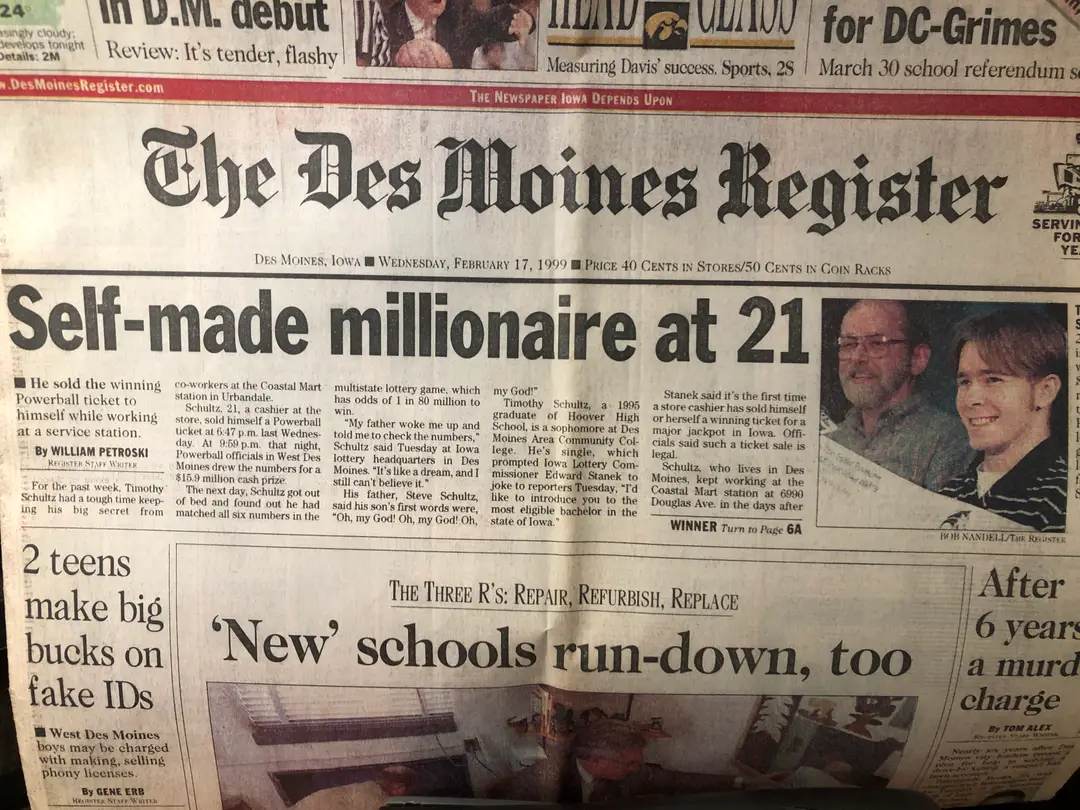
Timothy Schultz was just 21 and working at a gas station when he ended up selling himself the Powerball ticket that changed his life, landing him a $28 million jackpot. More than 25 years later, he is still talking about that win and what came after, now as the host of the Dreams & Fortune with Timothy Schultz podcast and a regular online creator who interviews other lottery winners about life after sudden wealth.
As well as hearing other people’s stories, Schultz has also reflected on his own experience, including the excitement of sudden wealth, the personal difficulties that followed, and the lessons he says came with it.
One of the earliest purchases he made after his 1999 win was a Nintendo 64, which was then one of the newest consoles around.
“It didn’t cost thousands of dollars, but to me, it felt extravagant,” he said. “I was in heaven.”
He said one of the first practical things he needed was a fresh set of clothes, after spending so much of his time in the same gas station uniform.
Schultz remembered shopping at the Mall of America as a strange and emotional moment, saying it felt like he was stepping away from his previous life.
He has also pushed back on one of the most repeated claims about lottery success: that most winners eventually end up broke.
“People throw around claims that 70, 80 or even 90 percent of winners lose everything within five years, as though that’s an established fact,” he said. “In reality, it’s closer to an urban legend.”
After speaking to dozens of winners, from people who collected $1 million to those who took home hundreds of millions, Schultz said that stereotype does not line up with what he has seen. More broadly, research and lottery organizations have also questioned the way that statistic has been repeated for years, noting that the claim is often overstated and not supported as a universal rule.
“Most are doing just fine and managing their money responsibly,” he said, adding that financial disasters ‘are simply the stories that receive the most attention’.
Still, he said becoming wealthy overnight brought challenges of its own. His circle of friends became much smaller, as he started to wonder whether some people were interested in him for the wrong reasons.
“I wasn’t just Tim the college student or Tim the gas station clerk. I was Tim the millionaire,” he said.
He said he was also flooded with requests from strangers asking for financial help, and that learning how to draw firm lines, including with people close to him, was one of the toughest parts of winning.
“Lending money could quickly complicate even a close friendship,” he explained.
Although he had enough money to stop working for good at 21, Schultz decided to go back to college and mostly kept his lottery win to himself.
He recalled one film class where a lecturer asked students whether they thought winning the lottery was really possible, while describing it as essentially “a tax on the poor”. Schultz was the only person in the room to raise his hand, without the lecturer realizing a Powerball winner was sitting right there.

According to Schultz, one of the biggest mistakes new winners make is rushing into decisions too fast.
“When you realize you’re holding a ticket worth millions, your heart is racing and your mind is going in a thousand directions,” he said. “But claiming the prize shouldn’t be treated like a race.”
He said anyone in that situation should first speak with a lawyer who understands lottery law in their state, because even the way a ticket is signed can influence what choices a winner has, including whether they can remain anonymous.
Schultz also said winners should be cautious about immediately handing control of their money to someone else.
“If I had a dime for every person who wanted to invest mine, I’d practically be a billionaire by now,” he joked, before urging winners to shop around for professionals they trust rather than anyone who ‘pressures you or promises spectacular returns.’
For him, one of the hardest parts was that while he still felt like the same person, other people often saw him differently.
“Almost overnight, I went from Tim the gas station clerk or Tim the college student to the millionaire kid who won the lottery,” he said.

When asked whether he has any regrets, Schultz singled out one missed opportunity with a laugh.
“I regret not buying Bitcoin 15 years ago. If I had, I’d probably be a gazillionaire by now,” he said, before adding that, jokes aside, he does not regret how his life unfolded. “Even the difficult moments taught me something and helped shape who I am today.”
Schultz previously said that getting advice from wealth professionals before cashing in the ticket played a major role in helping him avoid the problems that have hurt some other winners.
He said he took a conservative approach, putting money into “stocks, bonds, and mutual funds” so it would be there for the long term, and more than 25 years later that plan appears to have worked. He has said he can live off his investments while continuing to focus on podcasting, YouTube and other creative projects.