

Elon Musk’s social media platform X launched X Money on July 27, bringing banking and financial services directly into the social network for Premium and Premium+ subscribers across the United States. The service represents Musk’s most significant step yet toward transforming X into what he calls an “everything app,” combining social networking with everyday financial management.
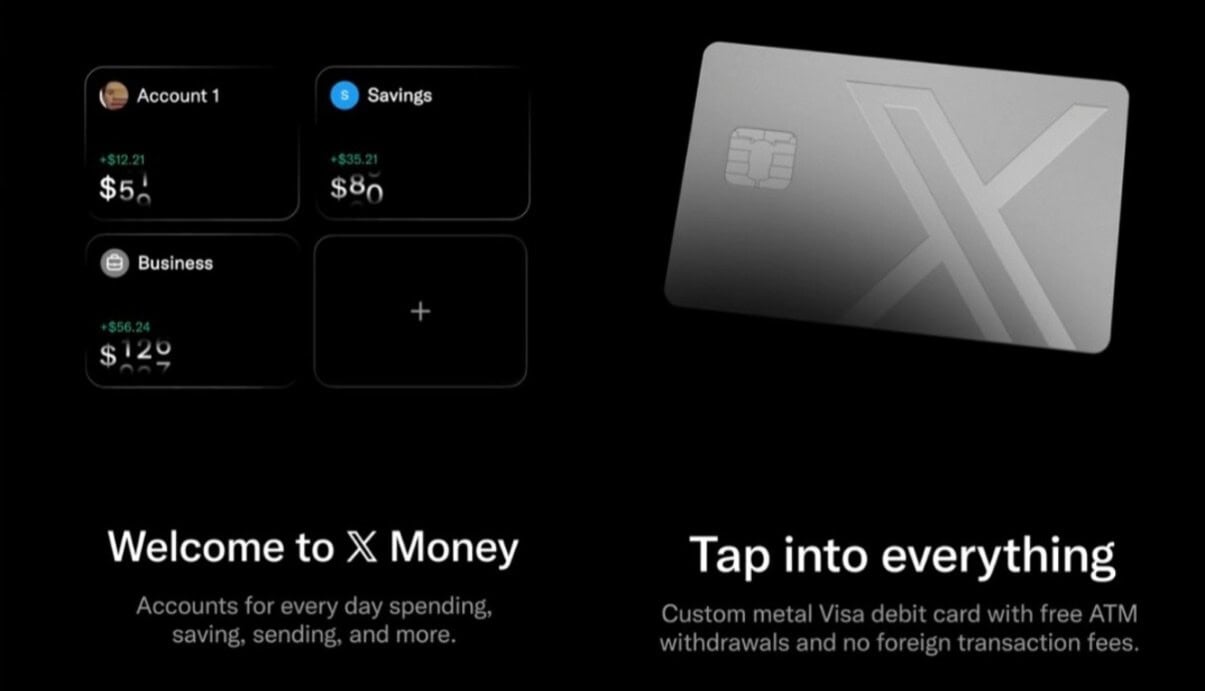
X Money offers Premium and Premium+ users a comprehensive suite of banking features embedded within the app, including a deposit account, peer-to-peer payments, and a Visa debit card. The service enables users to send money to other X users instantly at no cost, access early direct deposit by up to two days, make wire transfers, mail checks, and pay bills without leaving the platform. The debit card comes in both virtual and personalized metal versions, stamped with the user’s X handle.
The financial incentive to join is substantial. Premium+ subscribers receive a 6% annual percentage yield on deposits immediately, while standard Premium users can unlock the same rate by setting up direct deposits to their X Money account. The card provides 3% cash back on eligible purchases and includes free ATM withdrawals worldwide with no foreign transaction fees. These perks are designed to attract users away from established competitors like Venmo, Cash App, and traditional savings accounts.
X Money does not operate as a bank itself. Instead, the platform partners with Cross River Bank, a New Jersey-based financial institution, to hold customer deposits and provide FDIC insurance coverage. Standard deposits receive federal insurance up to $250,000 per depositor. For Premium+ subscribers, X offers an additional cash sweep program that distributes balances across multiple partner banks, extending aggregate FDIC coverage up to $10 million per account.
The Visa partnership is critical to the service’s real-time functionality. Visa Direct technology enables instant funding of the X Wallet, allows cardholders to connect debit cards for peer-to-peer payments, and processes instant bank account transfers. This infrastructure lets users move money without the delays typical of traditional banking.
The service rolled out initially to a small group of Premium+ subscribers in late June for testing purposes. Within hours of that launch, a user sent Musk $25 via X Money to demonstrate the peer-to-peer capability, and Musk publicly confirmed the transaction. The national expansion announced July 27 marks the end of the invite-only phase and the beginning of availability to all Premium and Premium+ subscribers.
However, X Money’s geographic reach has limits. The service is available in 41 states plus Washington, D.C., but New York and Massachusetts still lack regulatory approval. New York regulators have reportedly pressed for a denial of X’s money transmitter license, significantly limiting the service’s ability to market itself as truly national given New York’s financial importance.
The 6% yield has drawn scrutiny from federal lawmakers. In April 2026, Senator Elizabeth Warren sent a formal letter to Musk questioning how X Money could sustain such a high rate when the federal funds target range sits at roughly 3.5% to 3.75%. She also raised consumer protection concerns and flagged Cross River Bank’s prior enforcement history with the FDIC. In 2023, Cross River received a cease-and-desist order from regulators for unsafe banking practices related to fair lending compliance. The bank also faced earlier FDIC action in 2018 for unfair or deceptive practices in loan origination.
Warren warned that consumer safety and the stability of the financial system could be at risk based on X’s track record operating the social platform. She also questioned a provision in the GENIUS Act, the 2025 federal stablecoin law, which she said creates a “suspicious carveout” allowing companies like X to issue cryptocurrencies without the same regulatory approvals traditional issuers must obtain.
Musk has been pursuing the vision of an integrated financial platform on X for years. He first described the concept during Twitter’s acquisition in 2022, envisioning an app where users could manage their entire financial lives without leaving the platform. Earlier attempts to launch financial services faced regulatory hurdles and delays.
The security architecture of X Money relies on passkeys rather than traditional passwords, allowing users to authenticate via fingerprint, face recognition, or device PIN. Visa’s security and risk management infrastructure protects card transactions.
Questions remain about several aspects of X Money’s operation that have not been formally addressed. The company has published no policy on what happens to deposits if a user’s X account is suspended, restricted, or banned. Access to funds legally held at Cross River Bank would be mediated entirely through the X app, creating a unique risk profile compared to standalone payment apps.
X has also not committed to formal documentation about whether the 6% yield is permanent or promotional, whether it applies to the full balance or a capped portion, or what happens if the interest rate environment changes. These disclosure gaps were flagged when X Money first expanded to Premium users in June.
The launch also clarifies what X Money will not include in its initial rollout. The service currently processes only traditional U.S. Dollars with no integration of Bitcoin, Dogecoin, or stablecoins, despite Musk’s well-known enthusiasm for digital assets. Lead designers at X stated they remain open to adding cryptocurrency features at a future date.
The financial services market where X Money is competing includes PayPal, Square’s Cash App, and Venmo, all of which hold dominant positions among fintech platforms. Yet X enters the competition with an advantage none of these competitors possess: direct access to hundreds of millions of existing users on a single social platform. That distribution advantage is likely to influence X Money’s adoption curve significantly.
For Musk, X Money represents a return to financial services after more than two decades. In the late 1990s, Musk founded X.com, a financial company that later merged to form PayPal. With X now holding money transmitter licenses across most of the United States and a banking partnership in place, the long-promised everything app finally has a functional financial layer.