

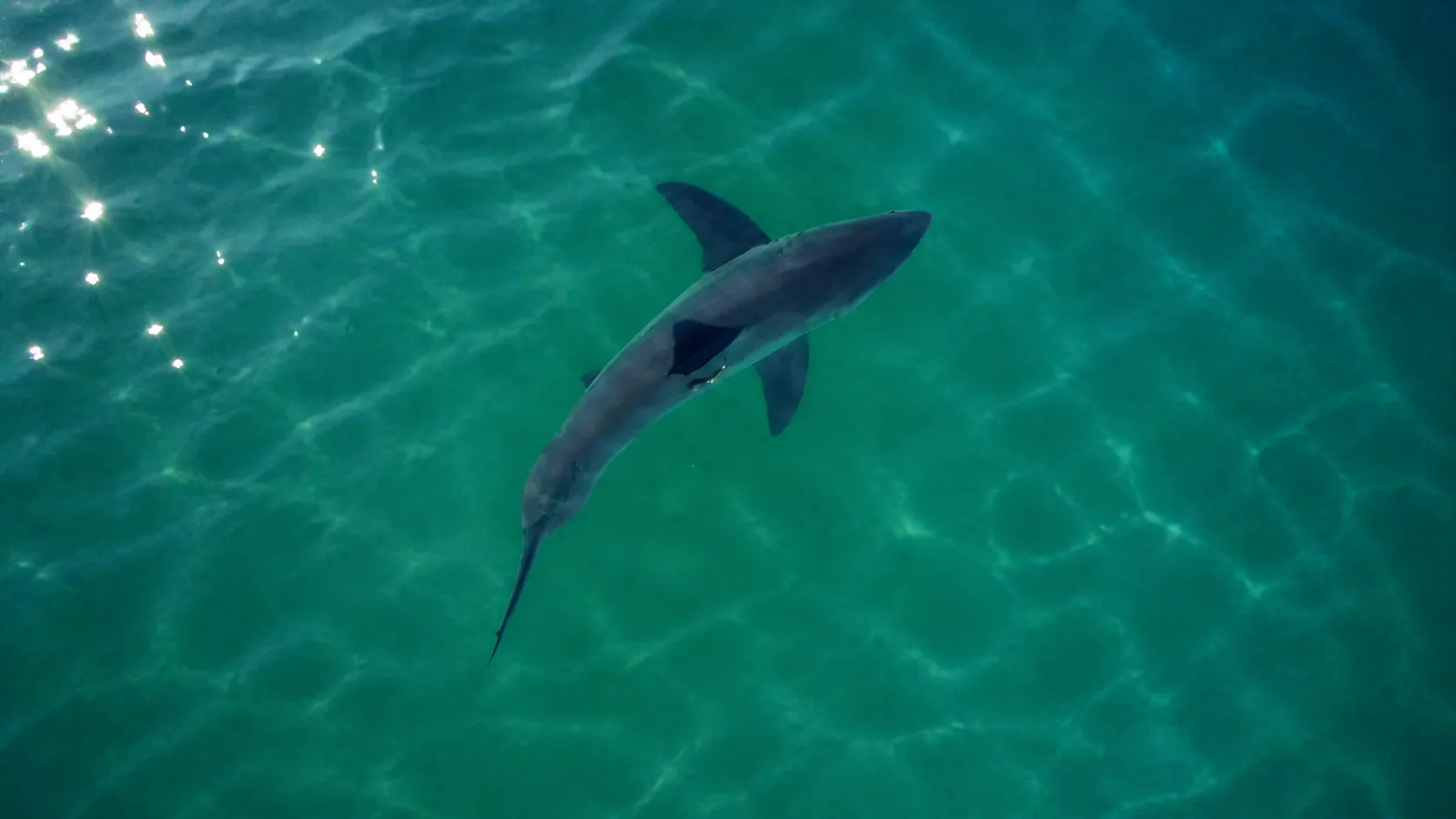
California State University Long Beach’s Shark Lab is patrolling local waters for sharks with the help of its new semi-autonomous shark surveillance robot.
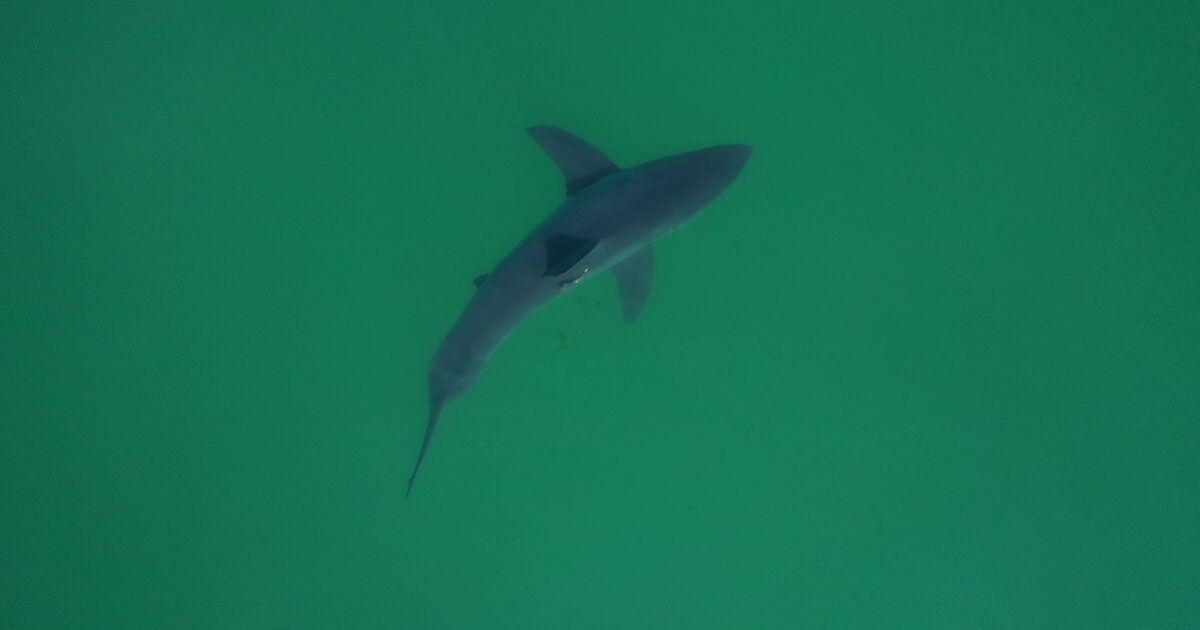
The robot is still a prototype, CSULB Shark Lab Director Christopher Lowe said, but could one day provide helpful information to lifeguards, who can advise beachgoers to avoid the water.
The device will listen for tagged great white sharks and test the water for shark environmental DNA, genetic identifiers found in shed skin, scales, blood and excrement.
The robot will also have an aerial drone nesting on its back to provide a birds-eye view of the water, and when complete, the shark-detecting robot will stream the data and 360 video back to the CSULB Shark Lab through Wi-Fi.
Once the drone is properly equipped, the CSULB Shark Lab plans to patrol specific beaches for a week at a time while sending lifeguards real-time data.
“Lots of research and development still needed,” the CSULB Shark Lab said. “But we’re off to a great start.”
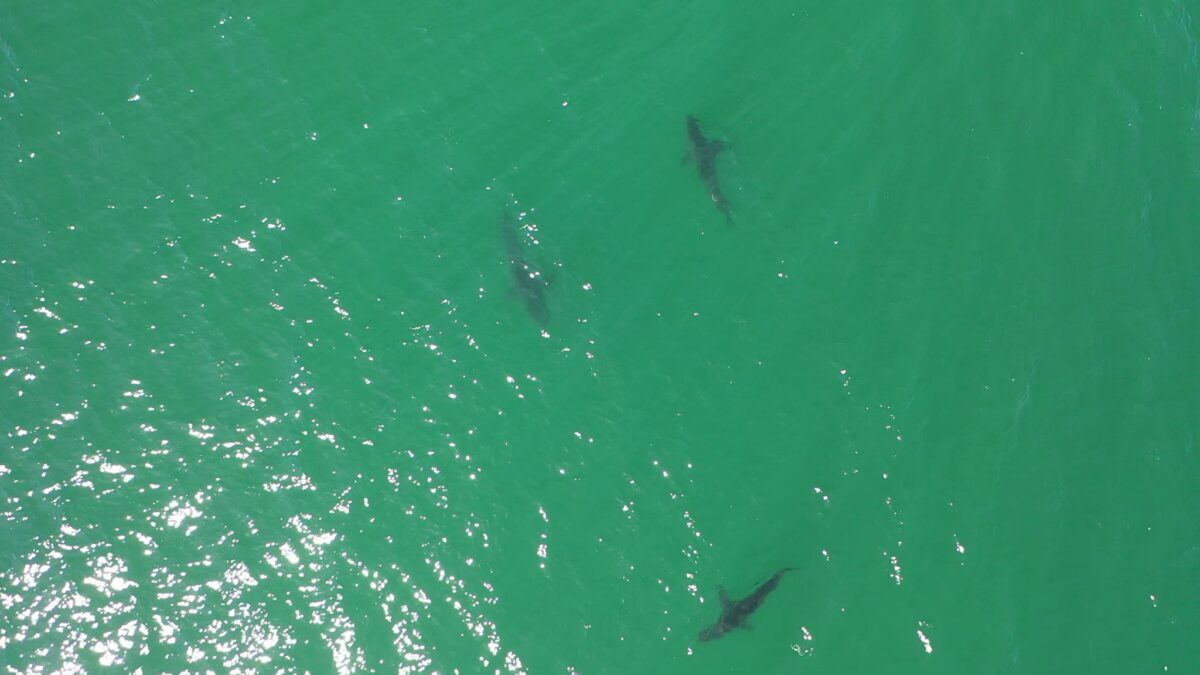
Neil Nathan, senior research scientist at Benioff Ocean Science Lab in Santa Barbara, leads the program, named SharkEye. He said: “We have been field testing this year, and with unusually warm waters this year from a recent marine heatwave and now a developing El Niño, there have been higher-than-average shark numbers at Padaro and other spots in Southern California — so a great year to field test our new app.”
“We are in the final stages of testing of our SharkEye app, which would be a free and open-source app with our AI detection model that could help other users (lifeguards/public safety officials) to monitor shark activity at their local beaches.”
SharkEye drone videos identify the number of great white sharks as well as their estimated size.
After being analyzed by an AI tool, push alerts are sent in real time to beachgoers nearby via a shark app.
If the apex predators are spotted, information is shared with local beaches and officials to help keep beachgoers safe and collect scientific data on the animals. A notification sent to nearby communities typically tells them how many sharks have been seen and where, and then local surf shops and surf camp owners are contacted.
Since starting the project, which is the first of its kind, seven years ago, scientists noticed that white shark populations in Southern California appeared to be increasing.
Scientists at UC Santa Barbara’s Benioff Ocean Science Laboratory have developed AI technology that uses drone flights to capture and scan videos to see if great white sharks are present off the coast of Padaro, California.
The survey site is at a beach called Padaro Beach, also known as Santa Claus Beach.
Nathan added: “Our program is trying to understand these aggregation sites as there is still so much we don’t know about their dynamics and persistence.”
The CSULB project was funded by the Seaver Institute in collaboration with the New York University Center of Robotics and the Monterey Bay Aquarium Research Institute.
Chris Lowe, professor and director of Cal State Long Beach’s Shark Lab, spoke about how El Niño is driving juvenile great white sharks north from Mexico into California’s coastal waters earlier than usual.
Although there are increased sightings, he emphasized that shark attacks remain rare because the animals generally do not view humans as prey.
Two new state-of-the-art buoys recently installed off Coronado are helping with ongoing efforts by the California State University Long Beach Shark Lab and City Lifeguards to better monitor the local white shark populations. The Shark Lab has tagged more than 175 white sharks with active transmitters along the southern California coast from Morro Bay to San Diego over the last seven years with 71 underwater acoustic receivers.
“These new buoys will improve shark detection response time and provide a tool for understanding shark behavior patterns,” said Dr. Chris Lowe, director of the Shark Lab and a professor in marine biology. “This is important in understanding population growth.”
Previously, tagged shark detections were shared with lifeguards monthly but did not provide adequate surveillance information. The new buoys equipped with solar-powered receivers will provide real-time tagged shark detection and environmental data.
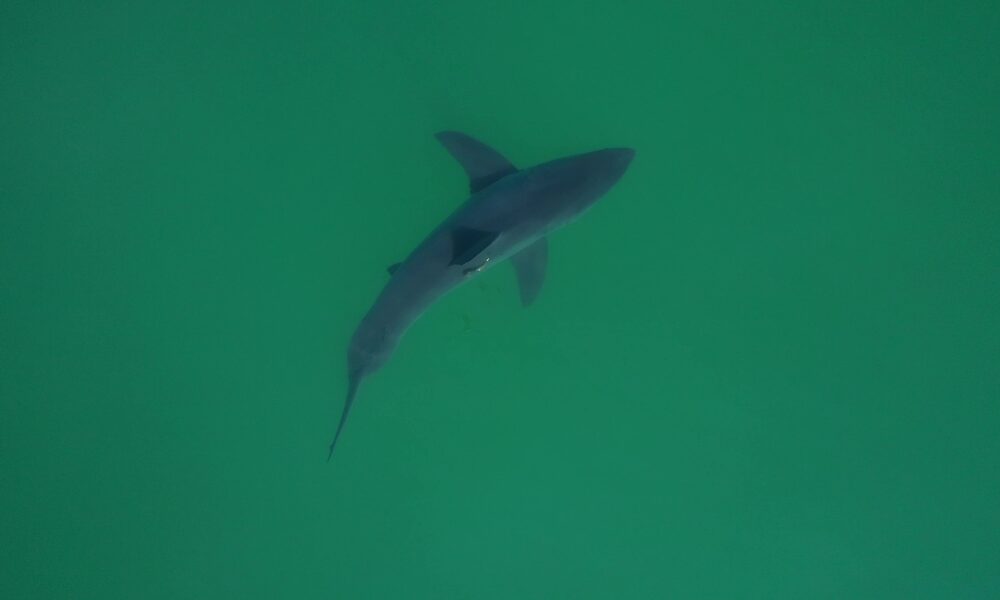
Shark Lab scientists and lifeguards have access to the text and email alerts from the software when sharks are detected as well as a web portal providing information about the shark and where it has been detected over time.
Douglas McCauley, professor of marine science at UC Santa Barbara, explained: “We want to forecast what kind of sharks might be coming our way to share the waves and the beach.”
Drones with video cameras on board are being used to spot sharks swimming near the beach, with flying drones sending live video back to the lifeguard who can then warn visitors that sharks are nearby.
Using drones to spot sharks is much quicker than patrolling the ocean on a boat, which can take hours.
A month ago, Seal Beach in Orange County decided to start using a drone for a more efficient way to detect sharks. “We were looking for a better way to identify the length, and what type of shark, and where they were, so we thought a drone might be useful,” Chief Joe Bailey, a Seal Beach lifeguard, said.
“We’ve been flying it two or three times a week, and it’s been a great success at being able to spot the sharks that are near our coastline.”
So successful that earlier this week, lifeguards spotted 10 sharks — all juvenile great whites, who don’t pose a threat to people — at a time.
“It was nice and calm and the water was clear, and it was really easy to pick them out,” Bailey said. “Everyone knows there’s sharks in the ocean. Maybe in years past, we didn’t have the technology to see them.”
Before implementing the drone, lifeguards had been going out via jet ski in a tedious, hours-long process to look for sharks. Now, they drive the drone to nearby Surfside, launch it, and within 10 minutes, can get a complete look at the area from 100 to 150 feet above the water’s surface, Bailey said.
Currently operating at Padaro Beach in Carpinteria, California, SharkEye represents a significant advancement in marine safety technology.