

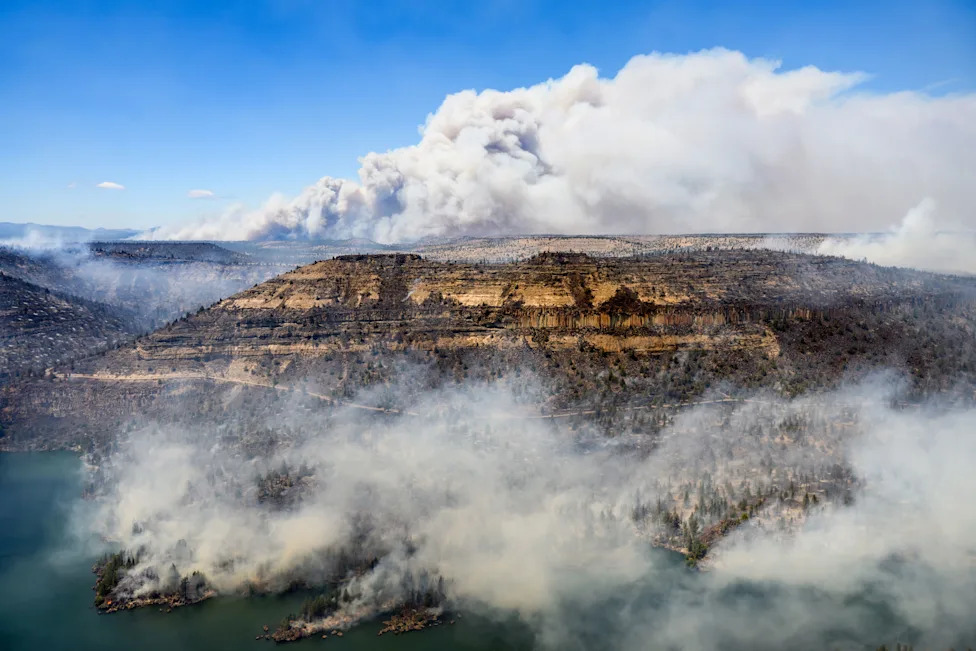
As of Sunday morning, the Northwest Interagency Coordination Center reported that large fires have burned 1,322,187 acres in Oregon and Washington this year.
Wildfires have burned over 1 million acres across both Oregon and Washington this year with fire season still in July.
The Pacific Northwest is enduring a record-breaking wildfire season, with more than one million acres burned before August’s climatological peak.
This acreage is already greater than the 10-year average for the entire year.
Dry thunderstorms that popped up over the Cascade Range on the evening of July 15, peppered Oregon and Washington with thousands of lightning strikes as they moved east across the states.
The AccuWeather Lightning Network detected more than 3,600 lightning strikes Wednesday within a 100-mile radius of Juniper Canyon in Central Oregon, with firefighters responding to at least 24 new fires Wednesday.
These blazes strengthened as they were fanned by gusty winds and raced through landscapes parched by extreme drought and baking in summer heat.
Vegetation is abnormally dry and flammable from the record snow drought this past winter.
For reference, last year just over 570,000 acres burned throughout the year.
As of Monday morning, there were 46 large uncontained fires burning in Oregon and Washington that, along with smaller fires in the area, had cumulatively burned more than 1.6 million acres of wildland.
Many communities faced evacuation orders as more than 10,000 firefighters battled wildfires throughout the state.
More than 1,100 firefighters have been battling the Rowe Creek Complex since it was ignited by lightning on July 15, working to contain one of the nation’s largest active wildfires burning 300,000 acres.
“Orders come into local dispatch centers to support fires and then as there’s competition for resources, we help sort that out,” Northwest Coordination Center spokesperson Lauren Maloney said.
“As of now, more than 1.7 million acres have burned across the region,” Maloney added. “We came into this part of this year in a drought condition. We had record low to near record-low snowpack in most areas of the PNW.”
“This is all-hands-on-deck here in Oregon,” Oregon Gov. Tina Kotek said.
Kotek said every available firefighter and firefighting resource is being used in the field.
In a statement issued Monday by the Confederated Tribes of Warm Springs, Tribal Chairman Dennis White III said, “I want to assure our Tribal membership that our highest priority is the safety and well-being of our Nation. We remain committed to protecting lives, property, and our lands. We will continue working closely with emergency responders, Incident Command, and or local, state, and federal partners as we navigate this crisis together.”
“I ask everyone to continue following evacuation orders, remain vigilant, and keep our firefighters, first responders, emergency personnel, and all those affected in your prayers,” White III added.
With 48 uncontained large fires and domestic resources stretched to their limits, NIFC has mobilized 74 fire management specialists from Australia and New Zealand, including a full 15-person Incident Management Team assigned to the Castle Fire in southern Oregon.
Governor Brad Little of Idaho said, “Idaho’s brave firefighters are working around the clock to protect lives, homes and communities under extremely challenging conditions.”
Dangerous fire weather ranging from hot temperatures, dry vegetation, low humidity and gusty winds allowed the lightning-sparked fires to spread rapidly across the region.
Dangerous fire weather conditions including 90-degree heat, wind gusts over 30 mph, and relative humidity in the single digits continue driving extreme fire behavior across the Pacific Northwest, with Red Flag Warnings in effect across much of the region.
Mid-July dry thunderstorms produced an extraordinary lightning barrage.
More than 8,000 lightning strikes ripped through Washington and Oregon over 24 hours as of 10:30 a.m. On July 16, with 8,199 lightning strikes recorded across both states, primarily beginning at 4:30 a.m. Before tapering off by about 11 a.m.
By the following day, NASA satellites had begun to detect large numbers of wildland fires burning throughout central and eastern Oregon.
Officials had initially reported more than 2,000 lightning strikes over a 72-hour period, but AccuWeather data indicates the total number of strikes in parts of Central Oregon was significantly higher.
Smoke from than 1.5 million acres burning in Oregon and Washington will reach as far Florida, with forecasters warning of an “extraordinary” outbreak billowing across the U.S.
The United States remains at National Preparedness Level 5, the highest level of national wildfire readiness, with firefighters responding to 95 large fires nationwide, including 13 new large incidents reported, and more than 25,700 firefighters and support personnel assigned to suppression efforts across the country while more than 1.62 million hectares (4 million acres) have burned so far this year.
2026 could end up similar to recent devastating wildfire years like 2020, 2021 and 2024.
The Oregon National Guard just announced it is sending more troops and helicopters to help fight the fires.