


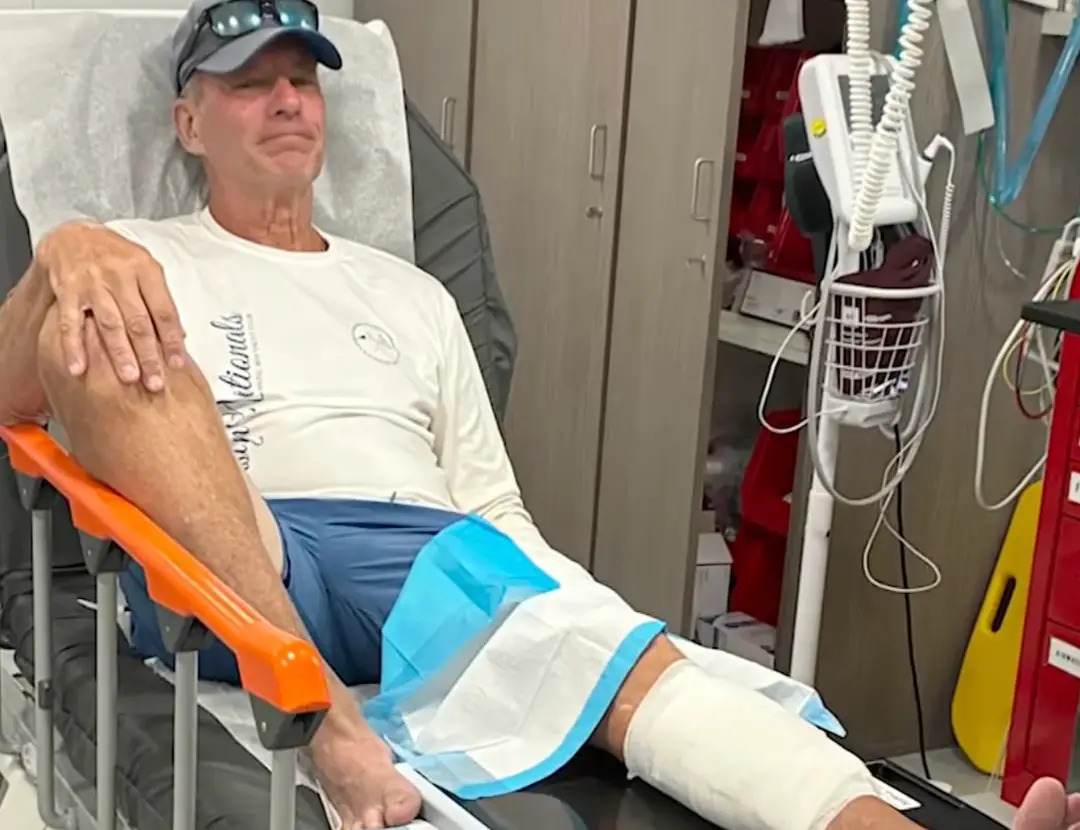
After surviving a shark bite in the western Bahamas that left him needing 26 stitches in his leg, one man returned home to an unexpected shark-themed welcome.
What was meant to be a special trip marking 40 years of marriage turned into a terrifying ordeal for John Schweizer, a 69-year-old from Niantic, Connecticut, who was attacked while vacationing in the Bahamas with his wife Marcy and their two adult sons.
The incident happened on July 24 during a snorkeling excursion with Caribbean reef sharks in the western Bahamas, which the family had expected to be one of the standout moments of their anniversary trip. Trouble began when Schweizer’s son noticed a dark shape moving beneath them in the water.
Speaking with NBC Connecticut, he said: “It was so fast, so immediate that you knew it happened. No doubt about it.”
Schweizer said the ocean had been ‘beautifully clear’ before the attack. But once the shark, believed to have been around 5 to 7 feet long, came near him, he realized he had been bitten. According to one account, the shark briefly pulled him underwater before he managed to return to the boat.
Even after that frightening experience, he still had one more surprise ahead of him when he got back to Connecticut.
Neighbors greeted him dressed in shark costumes, a gesture he clearly appreciated.
“That’s my neighborhood, and they’re wonderful people,” he said, after the community welcomed him home wearing shark costumes.
In the immediate aftermath of the bite, family members worked quickly to stop the bleeding.
“We used many, many towels and torniquets to hold and keep the blood at bay,” he recalled.
The Niantic, Connecticut resident was taken back to a cruise ship, where he received urgent medical care before later being moved to a hospital in Miami.
“The ship had an emergency room doctor on there and put in 26 stitches and four in my hand.”

Thanks to how well he recovered, and because he was able to walk, Schweizer was back home by the following day.
Despite the trauma, he was not entirely unfamiliar with sharks. As a keen fisherman, he has encountered them before in Long Island Sound.
He added: “You catch them, and you don’t want to go near them. They don’t bite, but there’s a lot of sharks that are being caught by Millstone [Nuclear Power Plant] and they’re here.”
Attacks involving Caribbean reef sharks are considered very rare. The Florida Museum of Natural History says it has recorded only four such incidents going all the way back to the 1500s. Research indicates that there have been documented attacks on humans by Caribbean reef sharks but no known fatalities from this particular species.

More broadly, the International Shark Attack File (ISAF) reports that there were 65 unprovoked shark bites worldwide in 2025. Of those cases, nine resulted in death, higher than the 10-year average of six fatalities. The data show that shark attacks remain relatively uncommon globally, with annual totals fluctuating from year to year depending on oceanographic conditions and human activity patterns.
Experts also note that most shark species are not considered dangerous to humans, and sharks generally avoid people. The Caribbean reef shark infrequently attacks humans and generally poses little risk to swimmers and snorkelers.
As for whether the ordeal has put him off for good, Schweizer made his feelings plain: “No. No. Not at all and I won’t do it again.”