

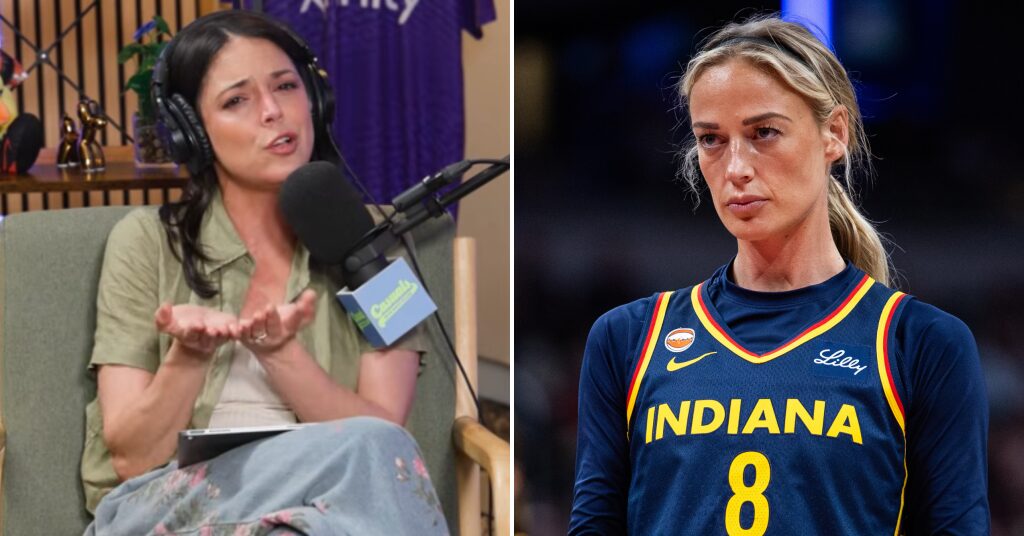
Sports media personality Katie Nolan, who has long supported transgender athletes’ inclusion in women’s sports, launched a scathing critique of Indiana Fever guard Sophie Cunningham this week, accusing the WNBA star of blindly amplifying a divisive political message without applying critical thinking to the complex issue.
In a lengthy segment on her Casuals podcast posted Friday, Nolan took direct aim at Cunningham over comments the Fever guard made in an ESPN profile earlier this month opposing transgender participation in women’s sports. Cunningham said in that interview that she believes young girls should not compete against “biological men” and that protecting girls in locker rooms and sports is important to her.
Nolan argued that Cunningham is being manipulated by those invested in promoting the transgender athlete issue, which she characterized as heavily politicized. “You’re taking the message that’s being given to you by people who are highly invested in this dividing stuff, and you’re helping them sell it by not questioning it at all. Which is extra crazy given the fact that you’re surrounded by people you could talk to about this issue to better understand it,” Nolan said, addressing Cunningham directly.
The criticism centered on what Nolan viewed as hypocrisy and a lack of intellectual rigor. She pointed out that Cunningham recently made a surprise appearance as an octagon girl at a UFC event on July 11, while simultaneously positioning herself as concerned about protecting women. Nolan noted that UFC president Dana White was once caught on camera striking his wife, and that fighter Conor McGregor was found liable by a civil jury for sexual assault of a woman and has since lost two appeals.
“You couldn’t catch me dead at that fight. F— Conor McGregor, respectfully,” Nolan said. “And you follow up by saying that it’s really important for you to protect little girls from some theoretical transgender person who might take advantage of — so many things would have to happen for the harm you’re claiming to be worried about to actually be carried out — meanwhile men come into women’s sports in various positions of authority and they take advantage of women all the time. And where were you, Sophie, on any of that?”
Nolan also highlighted what she sees as a broader pattern of ignoring real threats to women in sports while focusing political energy on a far less prevalent issue. She noted that many sports governing bodies have already implemented bans on transgender athletes, and that the Trump administration has aggressively pursued restrictive policies in collegiate and Olympic sports. “You’ve already ‘won,’ quote-unquote, in that way. And yet you and others seem unwilling to let this go,” she said.
Cunningham’s comments have triggered an unprecedented cultural and political firestorm in the WNBA. The controversy began when the ESPN profile quoted her expressing support for restricting transgender women and girls from competing in women’s sports. Since then, the issue has eclipsed basketball coverage and created visible divisions among fans, players, and league officials.
The situation intensified dramatically in Seattle during a Fever-Storm game on Tuesday, when supporters and counterprotesters gathered outside Climate Pledge Arena. A group advocating for restricting transgender athletes’ participation held a rally in support of Cunningham, while a counter-demonstration organized by transgender inclusion advocates took place nearby. Inside the arena, Cunningham was booed whenever she touched the basketball. The tension escalated when Seattle Storm minority owner Celeste Keaton confronted two teenage Fever fans who were holding pro-Cunningham signs, leading the WNBA to suspend Keaton for five home games.
Cunningham’s own head coach, Stephanie White, publicly distanced herself from the guard’s position. When asked about her stance on the issue, White said she did not believe “exclusion is an answer,” though she acknowledged she was not “educated enough” on the science involved to take a definitive position. The coach also admitted frustration with the controversy overshadowing the Fever’s winning basketball.
The backlash against Cunningham extends beyond the WNBA. She was heavily booed by fans in Portland during a subsequent game and made a confrontational gesture in response. Meanwhile, rallies have been organized outside Fever arenas, with some groups using her comments to promote state ballot measures that would restrict transgender student-athletes in K-12 sports.
Throughout the uproar, Cunningham has consistently maintained that her position is not rooted in hatred toward transgender people. In her interview, she said she has “received a lot of negative feedback about me hating trans” but emphasized, “I never once said that. I think that I am here to extend love. But I also think with that love is truth, being honest.”
Nolan’s criticism represents the most prominent pushback from within sports media, particularly from someone who has previously argued that women athletes should focus energy on addressing genuine safety threats in sports rather than the comparatively rare issue of transgender participation. The broader controversy has drawn unlikely participants into the debate, from Republican lawmakers to White House officials, further cementing the issue as a flashpoint in American culture wars extending far beyond sports itself.