

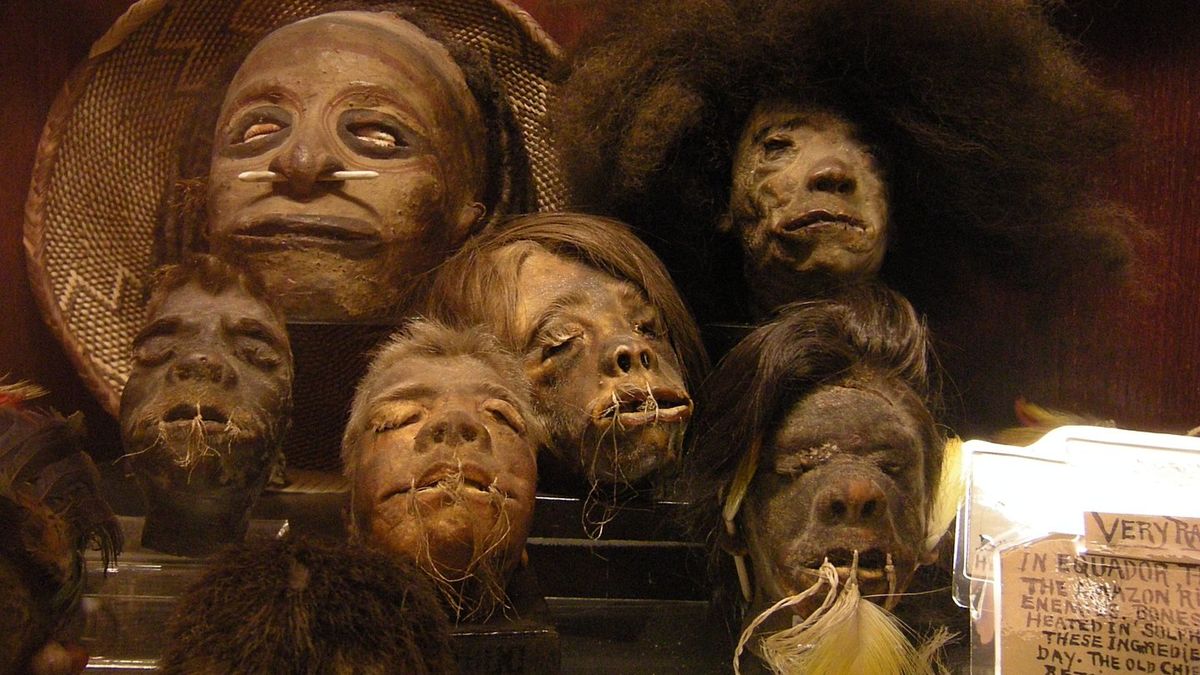
A US man who relocated to the Ecuadorian Amazon to start a life with an Amazonian tribeswoman has shared chilling accounts passed down through his wife’s family, including claims that the once-sacred tradition of making shrunken heads has, in some cases, been turned into something far removed from its original meaning.
Justin, who is half Amazonian and lives with the Shuar people, has spoken publicly about stories told to him by his wife Maria’s grandmother about the ritual known as ‘tsantsa’ and how she believes its purpose has shifted over time.
“Our ancestors, our grandparents, used to kill people,” she told him on one of his YouTube videos documenting life with the Shuar tribe.
“They cut off the head, peeled it along with all its hair, and then cooked it. And then they did a festival with them, put something through their nose, and hung them like a flag. It was a ceremony, that’s how my grandma explained it to me, but I never really knew.
“I never saw it. It was before my time.”
By her account, tsantsa was once connected to warfare and carried out only on defeated enemies. She also alleged that, more recently, outsiders have encouraged a very different version of the practice by offering money for killings within the same community.
Historically, tsantsas were made from the heads of warriors killed in combat. In some cases, monkeys or sloths were also used, while a number of examples found in Western museum collections have later been identified as fake. Shuar traditions suggest their ancestors created ritual tsantsas from the remains of humans, sloths, and monkeys for hundreds of years, with Europeans noting the practice when they arrived in the 1500s.
Research published by Western University outlines the traditional method as removing the skin of the head at the neck, stitching the eyes and mouth closed, and boiling it until it reduced to about the size of a fist. Heated stones were then used to shape the features, and the skin was darkened before the tsantsa was used in ceremony. The process was highly ritualistic and could take several days to complete.
Among the Shuar and neighboring Achuar peoples, tsantsas have long been regarded as sacred objects. The ritual is believed to have trapped the avenging spirit, or ‘muisak’, of the slain warrior, with that power then transferred to the women of the tribe to help bring strong harvests and protect the community from spiritual retribution.
After that spiritual transfer was believed to have taken place, the head itself was no longer considered useful and would be discarded or kept only briefly. For that reason, a ceremonial tsantsa was traditionally made from a male warrior, since women and children were not thought to possess the same spiritual force sought through the ritual.
The spiritual framework underlying the practice was complex. The Shuar believed that a slain enemy’s muisak, if left uncontrolled, would seek vengeance against the killer and his community. By creating a tsantsa and sealing its orifices, warriors could prevent the muisak from escaping and instead harness its power for community benefit, including fertility and protection. The ritual also elevated a warrior’s status within the community and demonstrated his courage and ability to protect his kin.
Maria’s grandmother said that original meaning has, in her view, been eroded, and that some killings are now allegedly carried out for profit rather than ceremony.
“Now they say the gringos order people to be killed so that they can do the tsantsa, our own people,” she said. “Some in the tribe don’t work, so it’s easy money for them.
“They go to kill their own people, their own family, to get their heads. It wasn’t like that before.”
She stressed that this, to her, is not the tradition older generations described.
“My grandparents did it only to their enemies, to make the shrunken head, then celebrate. Now people do it for money, like a business for the lazy people. We don’t approve of that,” she said.
The transformation of tsantsa from a sacred ritual to a commercial commodity began in the mid-19th century as European and American explorers, missionaries, and collectors sought the heads as exotic curiosities. Contact with outside traders disrupted traditional practices, as external demand incentivized production beyond ritual warfare purposes. By the late 19th century, tsantsas entered formal export channels and appeared in curio shops in cities like Lima and Iquitos, marketed to travelers and collectors fascinated by the practice. This commercial demand led some tribes to create heads specifically for sale, and as authentic ritual-prepared specimens became scarce, forgers began creating fakes using animal skins or other non-human materials to maximize profit. It is estimated that approximately 80 percent of the shrunken heads in museums and private collections worldwide are forgeries.
Museums have increasingly grappled with how to responsibly handle and display tsantsas in their collections. The Pitt Rivers Museum at Oxford removed its tsantsas from public display in 2020, deciding that their exhibition did not sufficiently help visitors understand the cultural practices related to their creation and instead reinforced stereotypical and racist perceptions of Shuar culture. The museum is now working with Shuar representatives from Ecuador to address the display and management of these sacred objects. The Shuar and Achuar peoples have expressed that their ancestors sold or traded these items to Western collectors without fully realizing the implications for how their cultural practices would be represented.
Justin, who has spent years documenting everyday life among the Shuar on social media, said these stories show the strain between maintaining ancestral customs and dealing with growing outside influence, modern technology and financial pressure. The narrative highlights how external forces and economic incentives have fundamentally altered the spiritual and cultural meaning of practices that once held deep significance for indigenous communities.