

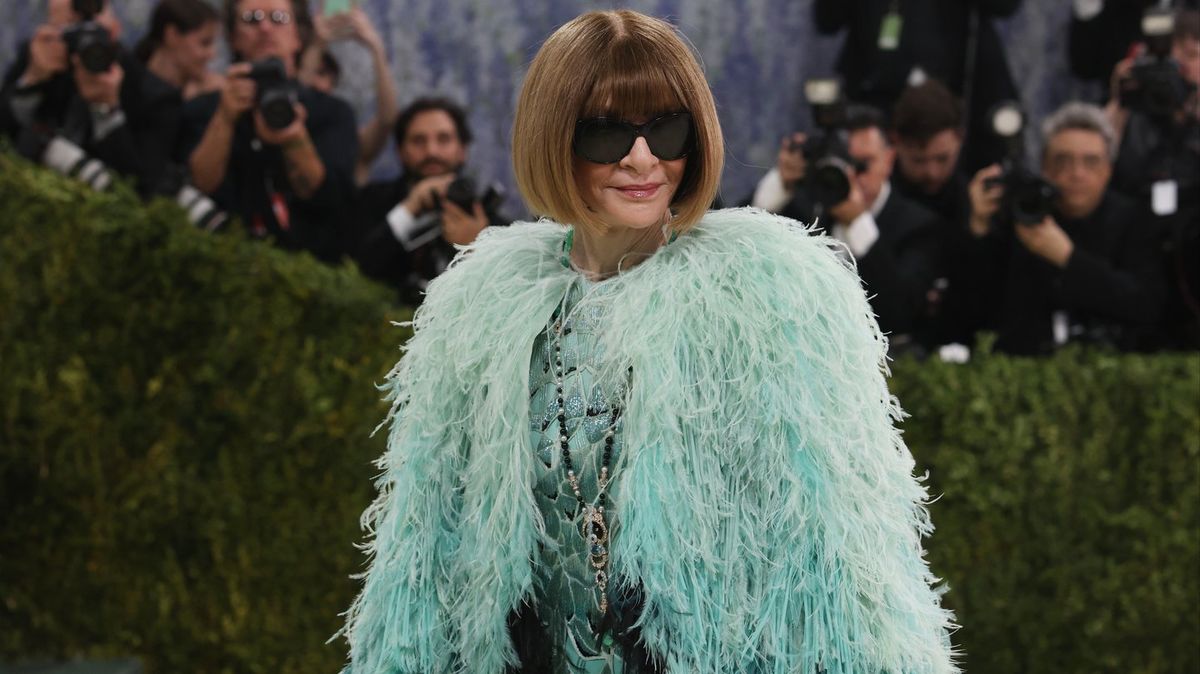
Anna Wintour, the longtime Vogue figurehead and Met Gala host, has addressed the backlash surrounding the decision to spotlight John Galliano at the 2027 event, after some critics objected to celebrating a designer with a deeply controversial history.
The Metropolitan Museum of Art’s Costume Institute will build its spring 2027 exhibition around Galliano, under the title John Galliano: Horizons, with the Met Gala theme also expected to reflect his work. Galliano will become just the third living designer to receive a solo exhibition at the Met, following Yves Saint Laurent in 1983 and Rei Kawakubo of Comme des Garçons in 2017.
Galliano, now 65, first rose to major prominence in luxury fashion when he joined Givenchy in 1995, becoming the first British designer to head a French haute couture house. He later moved to Dior, where he served as creative director from 1996 until 2011.
More recently, he led Maison Margiela in the same role from 2014 through 2024.
His career, however, has long been shadowed by controversy. Among the most serious incidents were convictions in Paris for public insults based on origin, religious affiliation, race, or ethnicity, which led to him being ordered to pay a suspended fine of 6,000 euros, equivalent to approximately $8,415.
The conviction stemmed from two separate incidents in 2010 and 2011 at a Paris café, during which Galliano made antisemitic and racist remarks. That case followed the emergence of a video in which Galliano was seen in a Paris restaurant expressing admiration for Hitler. Dior suspended Galliano in February 2011 and permanently dismissed him from his position the following month.
Before the exhibition’s announcement, Wintour and other Met Gala organizers met privately with prominent Jewish leaders and rabbis to discuss concerns about honoring Galliano. Jonathan Greenblatt, chief executive of the Anti-Defamation League, stated that the organization believes Galliano has “genuinely worked through the issues that led to his antisemitic outburst years ago in Paris” and that his “efforts to repair the damage his words caused and to learn from that incident should be applauded.”
Despite these meetings, the announcement sparked significant backlash on social media, with some critics questioning the decision at a time of rising antisemitism. The museum’s press materials emphasized that the exhibition will directly address Galliano’s conduct, his treatment for substance addiction, and his later public acknowledgment of his actions, rather than presenting a conventional narrative of disgrace and redemption.
“There is no one more deserving of an exhibition of this scale than John Galliano. His body of work—at Dior, Givenchy, Margiela, his namesake label and more—combines erudition and creativity, darkness and light, the past, the present, the future all smashing together in a brilliant way.”
Wintour also said:
“He’s a great designer and his career isn’t defined by a moment—something that he will live with for the rest of his life. The exhibition won’t shy away from any of the darkness in John’s past. It’s part of what has shaped him. The show will take in the full arc of his career and grapple with all of it.”
Andrew Bolton, the Costume Institute’s curator in charge, also commented on the thinking behind the exhibition.
“Every Galliano collection begins as a journey among things separated by time, place, or medium: portrait and posture, silhouette and story, memory and material.
“Horizons’ approaches fashion as a form of cartography, mapping not territories but affinities, tensions, and transformations. It traces how images become ideas, ideas become material, and material becomes emotion.”
Bolton further added:
“Yet a horizon reveals not only what lies before us but also where we stand. The exhibition therefore considers both how Galliano has remapped the world through fashion and how his conduct, its consequences, and changing cultural values have reshaped our understanding of his work.”
The exhibition will open in May 2027 and will be organized into three sections, including displays of garments, accessories, sketches, and archival materials that trace Galliano’s four-decade career. It marks the first major museum retrospective to examine the full breadth of his design influence.