

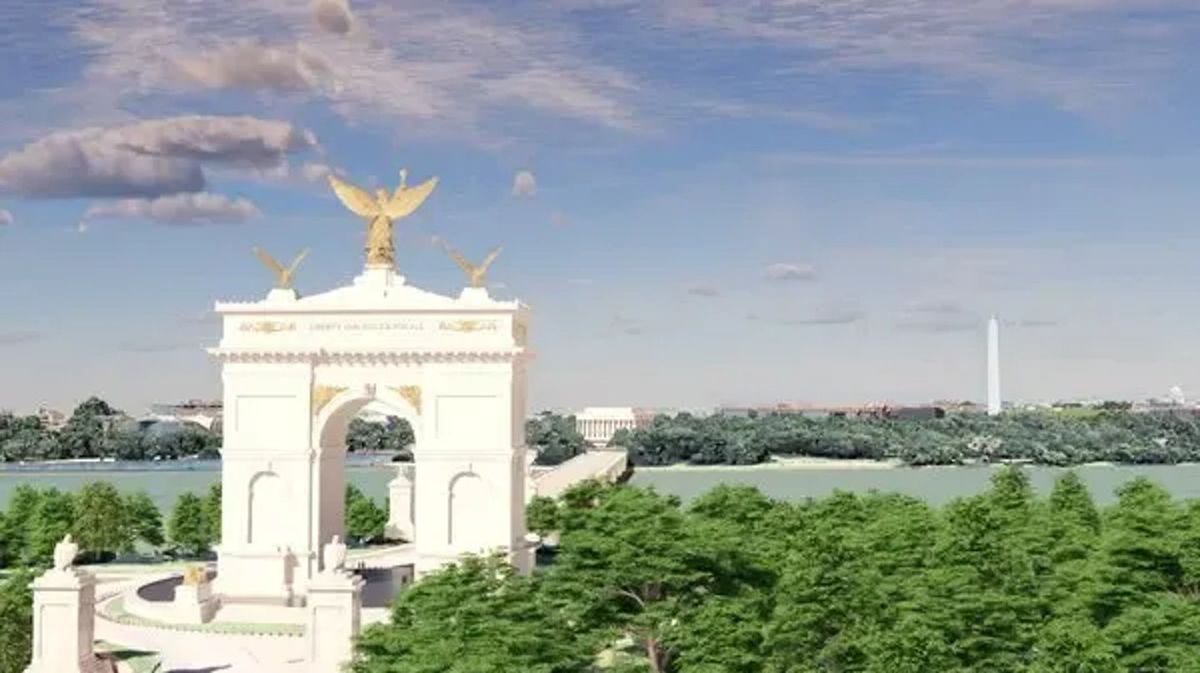
A federal review has found that the Trump administration’s proposed ‘triumphal arc’ for America’s 250th anniversary could harm dozens of historic landmarks in and around Washington, DC.
Along with plans for a Patriot Games-style event, President Donald Trump has continued pushing for a 250-foot monument on Columbia Island in the capital, a proposal that critics have nicknamed the ‘Arc de Trump’.
Trump first floated the idea in 2025, when he showed reporters in the Oval Office a scale model of the structure. The suggested location was Memorial Circle on Memorial Drive, between the Arlington Memorial Bridge and Arlington National Cemetery, across the Potomac from the Lincoln Memorial. Columbia Island, also known as Lady Bird Johnson Park, is a historic site at the west end of the National Mall’s ceremonial axis.
By December 2025, he had named a project manager and said work would begin within two months. The plan has since drawn opposition, including a lawsuit from an advocacy organization seeking to block construction.
When Trump launched the Great American State Fair on June 25, 2026, visitors were also shown a smaller version of the arch.
The National Park Service has now completed the legally required review of the proposal under Section 106 of the National Historic Preservation Act and concluded that the structure would have adverse effects on 37 separate historic sites.
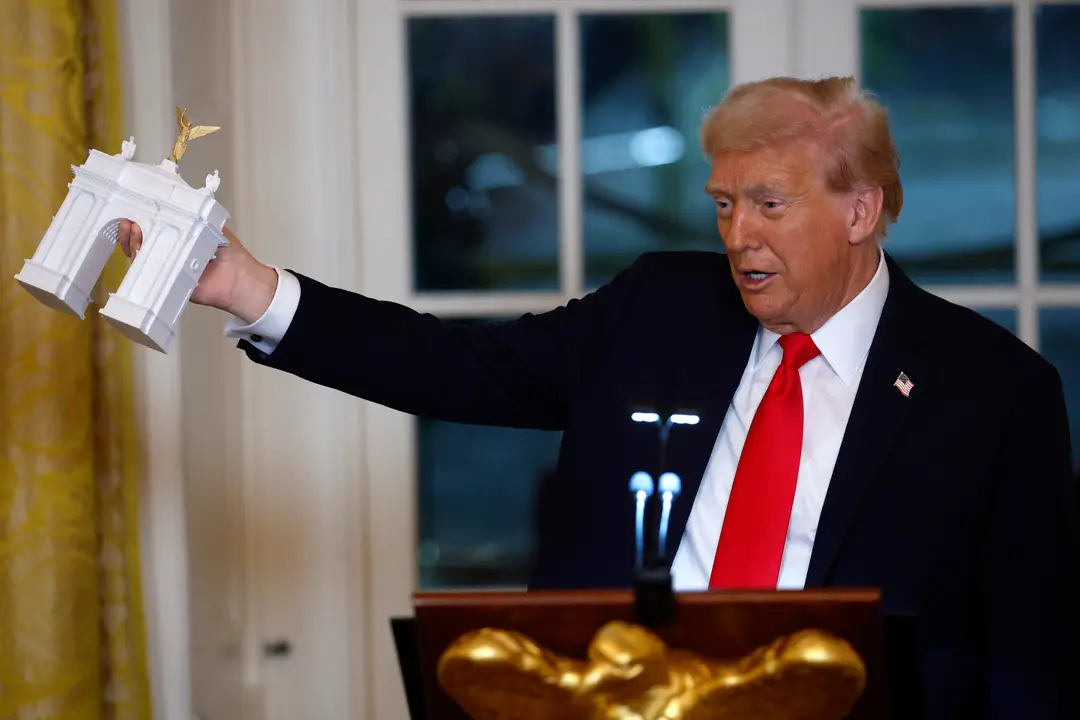
The proposed monument would stand at roughly twice the height of the Lincoln Memorial and would far exceed the city’s usual building-height limits. At 250 feet, the structure would surpass Paris’ Arc de Triomphe, which stands 164 feet high, making it the world’s largest triumphal arch.
According to the Park Service, that scale would also alter the setting and visual character of a wide range of nearby memorials and historic places.
Appendix C of the review identifies 37 locations expected to be negatively affected, including the Lincoln Memorial, the Washington Monument, the Thomas Jefferson Memorial, Arlington National Cemetery, the Robert E. Lee Memorial, the Pentagon, the George Mason Memorial, the U.S. Capitol, and the National Mall Historic District.
“The Arch would introduce a new vertical feature into a landscape system historically characterized by carefully managed horizontal monumental compositions, open river-oriented views, and coordinated scenic parkway experiences.”
The agency also invited feedback from outside organizations, and several preservation officials quickly raised objections.
Virginia state historic preservation officer Roger W. Kirchen criticized the project’s impact, describing the damage caused by the arch and its design as deliberate rather than incidental in comments to the outlet.
“intending to dominate the surrounding landscape”
Arlington County historic preservation principal planner Mical Durak similarly argued that the monument was out of place in such a significant area.
“scale and mass of the arch is inappropriate in the context of its historic setting”
“And [it] would negatively impact the physical and symbolic unity conveyed via the Arlington Memorial Bridge and Memorial Avenue between the Lincoln Memorial and Arlington house,”
The arch would also include an observation deck, which could provide visitors with views of private funerals held at Arlington National Cemetery. Additionally, the arch would obstruct the view from the cemetery of the Eternal Flame at President John F. Kennedy’s gravesite.
Still, the Interior Department has defended the proposal and presented it as a patriotic national project.
“Great nations build beautiful structures and works of art that cultivate national pride and love of country.
“In this tradition, Secretary Burgum is thrilled to champion the United States Triumphal Arch which will be a project that all Americans can be proud of.
“In America’s 250th year, President Trump wants to fulfill this vision and build the Triumphal Arch to celebrate the triumphs of the American people, inspires patriotism and love of country, and beautify our nation’s capital.”
The renderings for the arch feature the words “One Nation Under God” prominently and include four large golden lions at the base of Memorial Circle. The administration has argued that the project fulfills a vision dating back to the 1924 Arlington Memorial Bridge Commission design, which included plans for monumental columns on Columbia Island, though the current design significantly departs from those original concepts.
The White House has also offered its support for the plan.
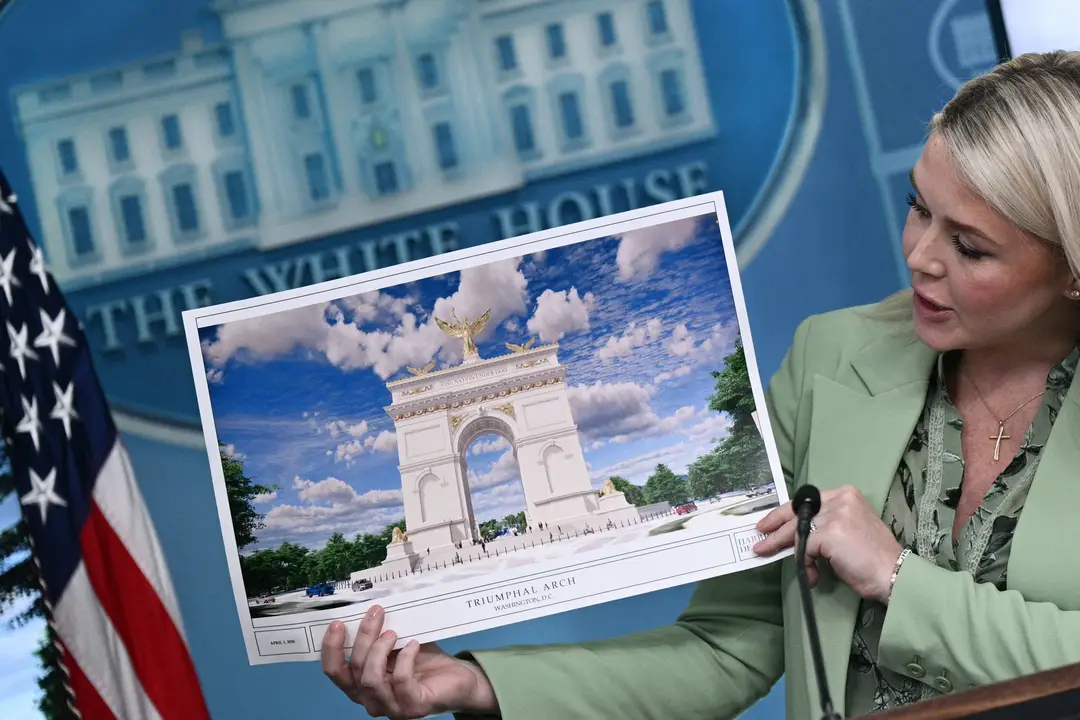
“The Triumphal Arch in Memorial Circle is going to be one of the most iconic landmarks not only in Washington, D.C., but throughout the world.
“It will enhance the visitor experience at Arlington National Cemetery for veterans, the families of the fallen, and all Americans alike, serving as a visual reminder of the noble sacrifices borne by so many American heroes throughout our 250 year history so we can enjoy our freedoms today.”
Critics and legal experts have raised concerns that construction of the arch on Memorial Circle, which is managed by the National Park Service and is considered protected federal land, may require Congressional authorization under the Commemorative Works Act. The administration has not indicated plans to seek such approval from Congress. Additionally, there are concerns about the arch’s proximity to Washington Reagan National Airport and the potential interference with airspace.
Even with the growing criticism, the Park Service review reportedly does not have the power to halt the development on its own.