

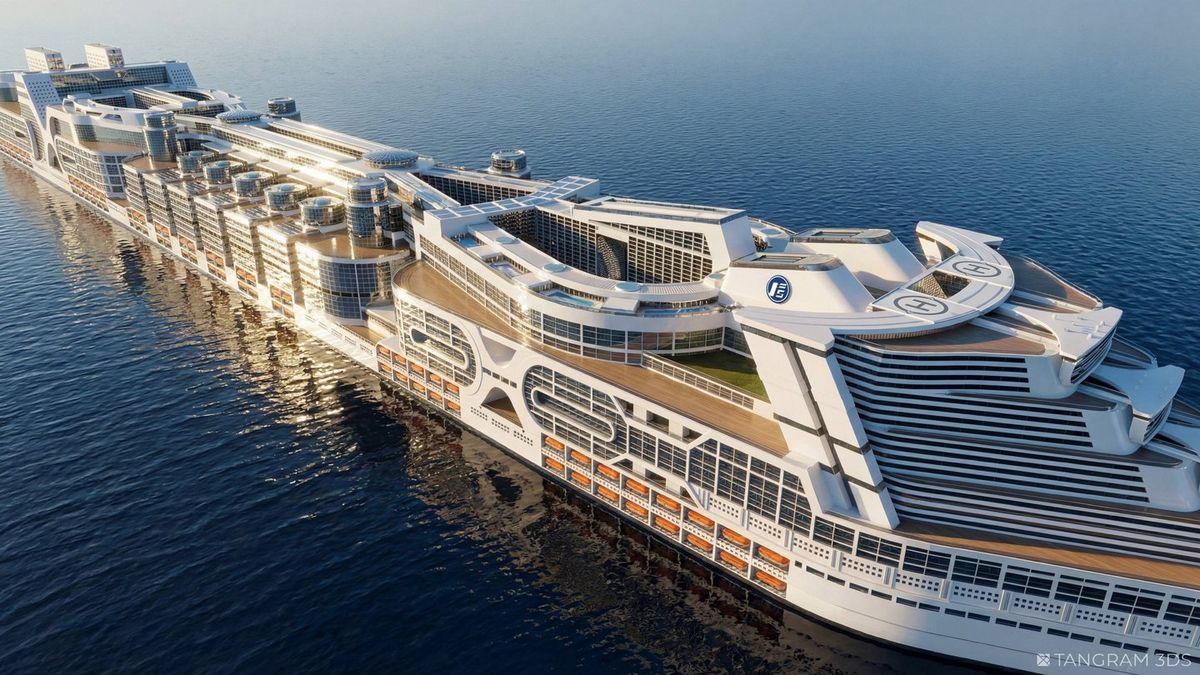
Picture a future where your home, workplace, gym, social life and even medical appointments all happen at sea, with an entire city moving around the globe instead of staying rooted in one place.
That is the concept behind the ‘Freedom Ship’, a huge floating development planned to house 50,000 permanent residents, alongside 10,000 visitors and guests, and 20,000 crew members over the long term.
‘a city designed to move with the world’
Originally proposed in the late 1990s by engineer Norman Nixon, the project is now being developed by Freedom Cruise Line International, led by CEO Roger M. Gooch. The proposal is enormous, stretching horizontally to more than three times the height of the Empire State Building, measuring roughly one mile in length and 800 feet in width across 30 decks. Rather than functioning like a conventional cruise liner, it is being presented as a stable, long-term urban environment.
‘grounded, balanced and structured to endure over time’
The design includes permanent residences alongside offices, green spaces and everyday amenities. Entertainment and leisure are also central to the idea, with plans for fitness areas, restaurants, casinos and nightclubs.
Here is a closer look at what the project promises.
According to the plans, life on board is meant to feel like life in a conventional city, with shared spaces intended to bring residents together rather than isolate them.
‘participate in community life as much as they would in a land-based city’
“Education, healthcare, commerce, and public spaces are integrated into the platform to support everyday needs over time.
“The intent is continuity: a place where people establish routines, relationships, and a lasting sense of belonging.”
A major part of the pitch is not just that people can live on the vessel, but that they can do so while travelling the world without repeatedly uprooting their lives.
The site notes the ‘mobility’ isn’t ‘about speed or novelty’.
‘it is about access – allowing residents to experience the world without the disruption of relocation while maintaining a consistent place to live and work’
The platform itself is set to be vast, with a working footprint measuring 750 feet in width and 5,280 feet in length. The layout is divided into four distinct sections covering arrivals and departures, the central city zone, hospitality spaces and residential areas. The vessel is planned to weigh over 2 million gross tons, making it significantly larger than any cruise ship currently in operation.
The project is led by E. Kevin Schopfer, founder and Chief Design Architect of Schopfer Associates, an internationally recognized design consulting firm specializing in architecture, urban design, and complex large-scale developments. The plans place heavy emphasis on landscaped public areas across the floating city.
“Freedom Ship will introduce multiple venues including pocket parks, botanical gardens, courtyard gardens, and a central park.”
The design reflects Schopfer’s broader vision for floating architecture and urban environments.
‘BLUland’ – Floating Architecture and Urban Design
Even with such a strong focus on communal living, the plan suggests residents would still have their own private space while being encouraged to mix with others in shared settings.
‘respecting privacy’
Because the ship would move between regions and ports, the experience is being framed as one of continual exposure to different places and people, potentially making international exchange part of ordinary life. Passengers and residents would transfer to and from land via ferries and other vessels, with eight helipads also built into the ship.
‘ongoing opportunities for cultural exchange, collaboration, and participation in global commerce as part of everyday life’
The people behind the project say the aim is not to persuade everyone to abandon land altogether. Instead, they describe it as an alternative model for how urban life could work.
‘replace life ashore’
‘replicate it exactly’
“Instead,” the site explains, “it proposes a parallel model of urban living—one that unfolds continuously over time, shaped by place, movement, and the collective life of its inhabitants.”
The project remains in the design and planning stages. The estimated construction cost is approximately $15-16 billion. If funding is secured, construction would tentatively begin in Indonesia and take three to four years, with some residents potentially moving aboard before the ship is fully completed. Developers say the vessel would continuously circumnavigate the globe, stopping at major ports for extended periods. However, the project continues to face significant challenges related to financing, maritime regulations, environmental impact, and questions about governance in international waters. Despite periodic revivals since the 1990s, the Freedom Ship has never advanced to construction.