

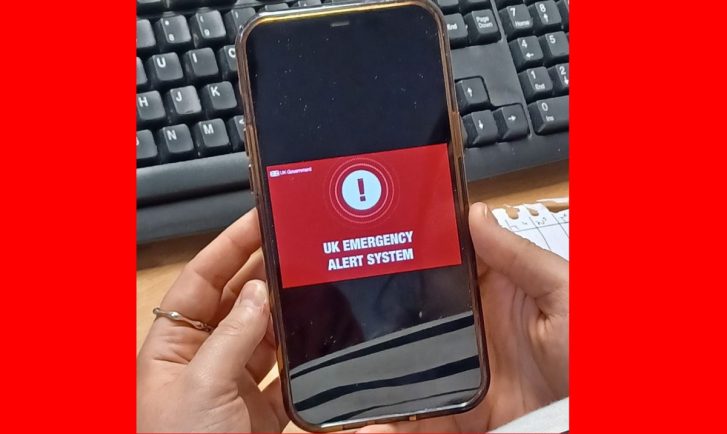
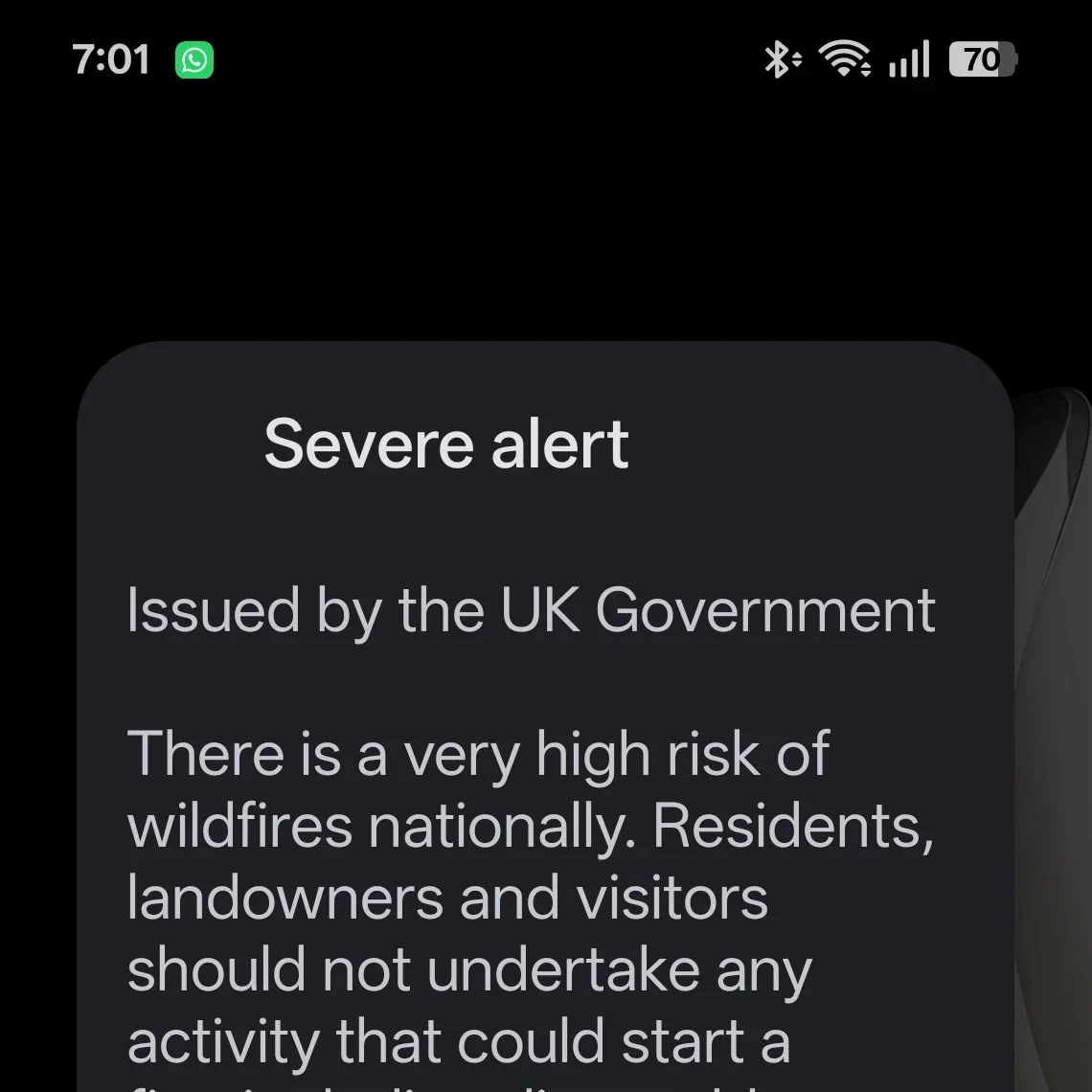
Millions of people across England and Wales received a blaring emergency alert on their mobile phones on Friday evening as the UK government deployed its most significant use of the national Emergency Alert system in response to an active incident. The loud, siren-like notification pierced through homes, workplaces, cinemas and television broadcasts at approximately 7pm, warning of a very high risk of wildfires sweeping the nation during an unprecedented heatwave.
The alert, sent on a rolling basis from 7pm, read: “There is a very high risk of wildfires nationally. Residents, landowners and visitors should not undertake any activity that could start a fire, including disposable barbecues, firepits, garden incinerators or fireworks. Even a small flame can rapidly develop into a major wildfire placing lives, homes, businesses and emergency responders at risk.”
Prime Minister Andy Burnham explained the reasoning behind the startling alert in a statement, saying the request came directly from Fire and Rescue Services. “This evening, an Emergency Alert has been sent to people across England and Wales as the wildfire risk remains very high. The request came directly from Fire and Rescue Services,” he said on social media platform X. “I was in Stourbridge today and saw first-hand the devastating impact these fires have had on people’s homes and lives.”
Burnham’s visit to Stourbridge in the West Midlands came after a particularly devastating fire there had destroyed 19 homes during what Britain recorded as its hottest day of the year. Temperatures had reached 38.1°C at Kew Gardens in London on Thursday, making it one of the most sweltering days ever recorded nationally. The wildfire at Stourbridge had spread rapidly from dry grassland into residential areas, with approximately 100 firefighters battling the blaze during the extreme heat.
“Our priority now is to keep everyone safe and prevent more fires from starting. During this period of extreme heat, I’m asking everyone to take extra care. Please do not light any fires in gardens, the countryside or other open spaces, including parks, moorland and wooded areas,” Burnham continued. “Our firefighters and emergency responders are working around the clock in incredibly difficult conditions. We can all help them. Please take the Emergency Alert seriously and follow the guidance in place.”
The alert disrupted live television and radio broadcasts across the nation. The BBC’s The One Show, which was marking its 20th anniversary with a special extended episode, had hosts Alex Jones and Roman Kemp drowned out by the alarm within minutes of the show beginning. Jones shook her head and raised her hands, asking: “You couldn’t make that up could you. Is that a fire alarm?” Theatregoers at the London Palladium waiting for a performance of Jesus Christ Superstar gasped as the alert sounded on phones throughout the auditorium.
The emergency alert system itself represents a significant escalation in government response to the crisis. Cabinet Office minister Louise Haigh described Friday’s use as “the most extensive use of the UK’s emergency alert system in response to an active incident.” This marked the first time the system was activated for a genuine emergency rather than a test, following earlier tests in April 2023 and September 2024.
The alert coincided with the announcement of an immediate ban on disposable barbecues across England, Wales and Scotland. The government stressed that the measure would remain in place until further notice as the nation grapples with what fire chiefs have described as a record level of wildfires. Phil Garrigan, chair of the National Fire Chiefs Council, said that the number of wildfires had now exceeded last year’s total of 1,017, with the summer of 2026 expected to be the hottest ever recorded in Britain.
Work and Pensions Secretary Pat McFadden defended the alert system’s deployment, saying: “It is a vital tool for keeping the nation safe when lives are on the line – and every minute matters.” The government also released a statement noting that while the alert might have been inconvenient, “it’s a small price to pay for a system that could one day help save lives.”
The wildfire crisis reflects Britain’s entry into what experts are calling a new era of fire risk. The country is currently enduring its fifth heatwave of the summer, with severe drought conditions leaving the landscape tinder-dry and highly susceptible to rapid fire spread. Burnham had warned earlier that “Britain is a tinderbox right now,” with approximately 37 fires smouldering across the country at the time of his visit to Stourbridge.
Emergency services reported significant casualties from the Stourbridge blaze, with 54 patients treated by paramedics and 19 taken to hospital, including a child and three firefighters. The rapid spread of the fire demonstrated how vulnerable residential areas have become when extreme heat and drought create perfect conditions for flames to develop from a single spark into a major conflagration within minutes.
The alert did trigger a surge in 999 calls across the country as confused members of the public attempted to report what they believed might be emergencies. Police forces had to issue appeals for people to carefully consider whether their calls constituted genuine emergencies before dialling, as emergency services struggled to manage the volume of inquiries generated by the alert.
The government’s decision to deploy the Emergency Alert system represented an acknowledgment that traditional communication methods were insufficient to reach the entire population quickly enough to prevent further disaster during the critical hours of extreme heat. As Britain faces the prospect of continued high temperatures and elevated wildfire risk in the coming days, the alert serves as a stark reminder of how dramatically the nation’s weather patterns have shifted and the scale of the challenge confronting emergency services and residents alike.