


Christopher Scott has spoken out about the violence, suicide and gang warfare he survived during 13 years in a Texas prison for a murder he did not commit.
Scott, now in his 50s, was 27 when he was convicted of the 1997 murder of Alfonzo Aguilar during a Dallas home invasion. He was exonerated in 2009 after the Dallas County District Attorney’s Conviction Integrity Unit reinvestigated his case. Now he has given a detailed interview to the outlet about how he endured more than a decade behind bars.
The former inmate described entering prison with a single focus. “It’s like survival has to kick in… I gotta watch everything and everybody in jail because I don’t know these people and they don’t know me,” he said.
Scott’s adjustment grew more dangerous when officials moved him from a relatively comfortable jail section into a wing housing more serious and repeat offenders. He had fought as a child, but prison demanded a different level of vigilance. “Somebody come my way, I just gotta do what I gotta do. I know how to fight. I can’t show no fear,” he said.
Prisoners learned to sleep with one eye open. “You gotta sleep light, trust no one, don’t turn your back on anyone, and live with your back against the wall,” Scott added.
The violence was constant and graphic. “You saw people get stabbed, people get killed, people get thrown over the balcony… You see some horrible things in prison,” he said. Scott also witnessed inmates who could no longer cope take their own lives or harm themselves.
Racial and gang lines added another threat. Prisoners were expected to side with their own group during conflicts, and refusing carried consequences beyond the immediate confrontation. Scott believed physical confrontation was unavoidable no matter how careful an inmate tried to be.
“I don’t care who you is in prison. You’re gonna have a fight sooner or later,” he said. He fought a handful of times and worked to establish that he was not an easy target.
But prison mirrored outside social dynamics too: relationships, status, cliques, jealousy and drugs all circulated behind the walls. The psychological weight often proved harder to escape than physical danger.
After receiving a sentence requiring at least 40 years before parole eligibility, Scott struggled to process his future. “I’m 27. I would be 67 when I come up for parole,” he recalled. At times he feared he would never leave alive.
Scott spent roughly two and a half years in brutal Texas heat working prison fields before building a relationship with his crew’s supervising officer and transferring to kitchen work. After field labor, inmates would sometimes flood their cells with water and lie in the evaporating puddle for relief.
Routine became his salvation. He exercised, read as many as three books weekly, and followed soap operas daily. “That foundation I built inside of prison let me get out of prison because it kept me out of trouble,” he said.
On April 6, 1997, a man named Alfonzo Aguilar was shot and killed during a home invasion at a relative’s duplex in Dallas. His wife, Celia, was attacked by a second man. The next day, police brought Celia in to view photographs. She walked past Claude Simmons, who was in custody on an unrelated drug charge, and identified him. She then picked out Christopher Scott’s photo as the second alleged attacker. Scott and Simmons were tried separately in October 1997. The prosecution’s case rested almost entirely on Celia’s identification, and the trial judge refused to let the defense introduce evidence pointing to two other men, one of whom had reportedly confessed to the crime to a girlfriend.
Scott’s case was taken up by the Dallas County District Attorney’s Conviction Integrity Unit, established by Craig Watkins, the first Black district attorney in Texas history, after he took office in 2007. It was the first such unit in the country, created specifically to review and correct wrongful convictions, and went on to help free around two dozen people wrongly imprisoned in Dallas County. Following further investigation, Scott was released in 2009 and formally declared innocent. He described that moment as the best day of his life.
Since his release, Scott has dedicated himself to helping other wrongfully convicted people. He helped establish the House of Renewed Hope to investigate potential miscarriages of justice, working alongside lawyers, students and volunteers. The organization was featured in the 2017 documentary True Conviction, which followed Scott and fellow Texas exonerees Steven Phillips and Johnnie Lindsey—who served a combined 60 years for crimes they did not commit—as they investigated other alleged wrongful convictions.
“There are things you can’t get back,” Scott said, referring to the years away from his family. “That’s why helping other people now matters so much.”

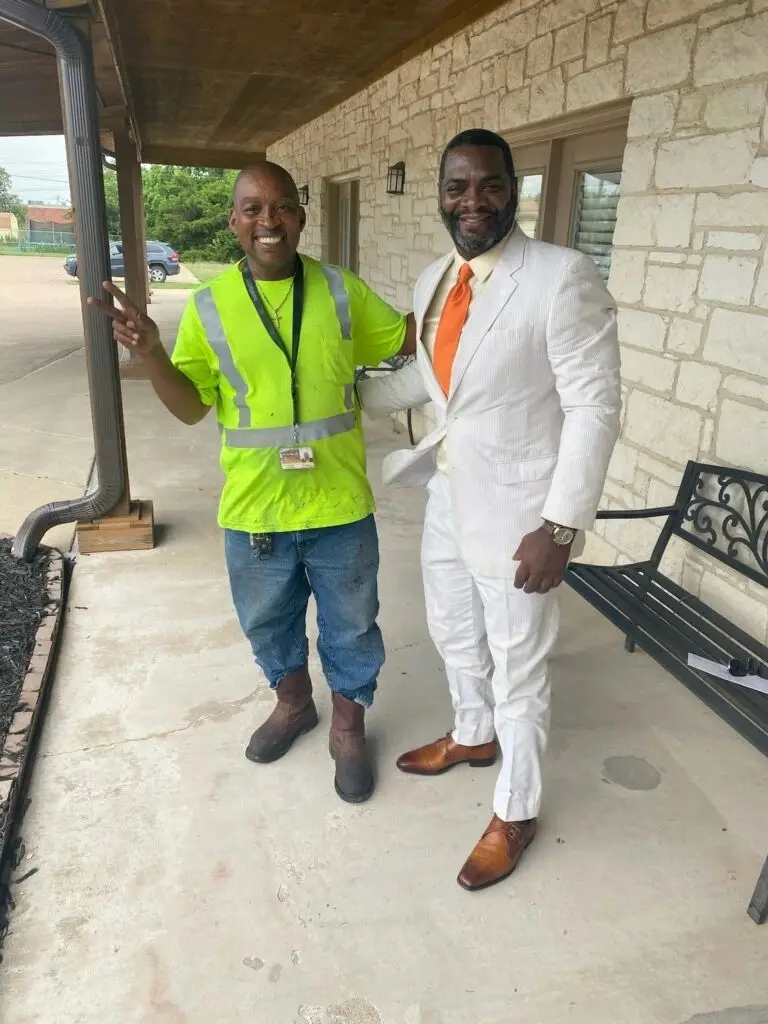
Scott continues his work with the House of Renewed Hope in Dallas.