

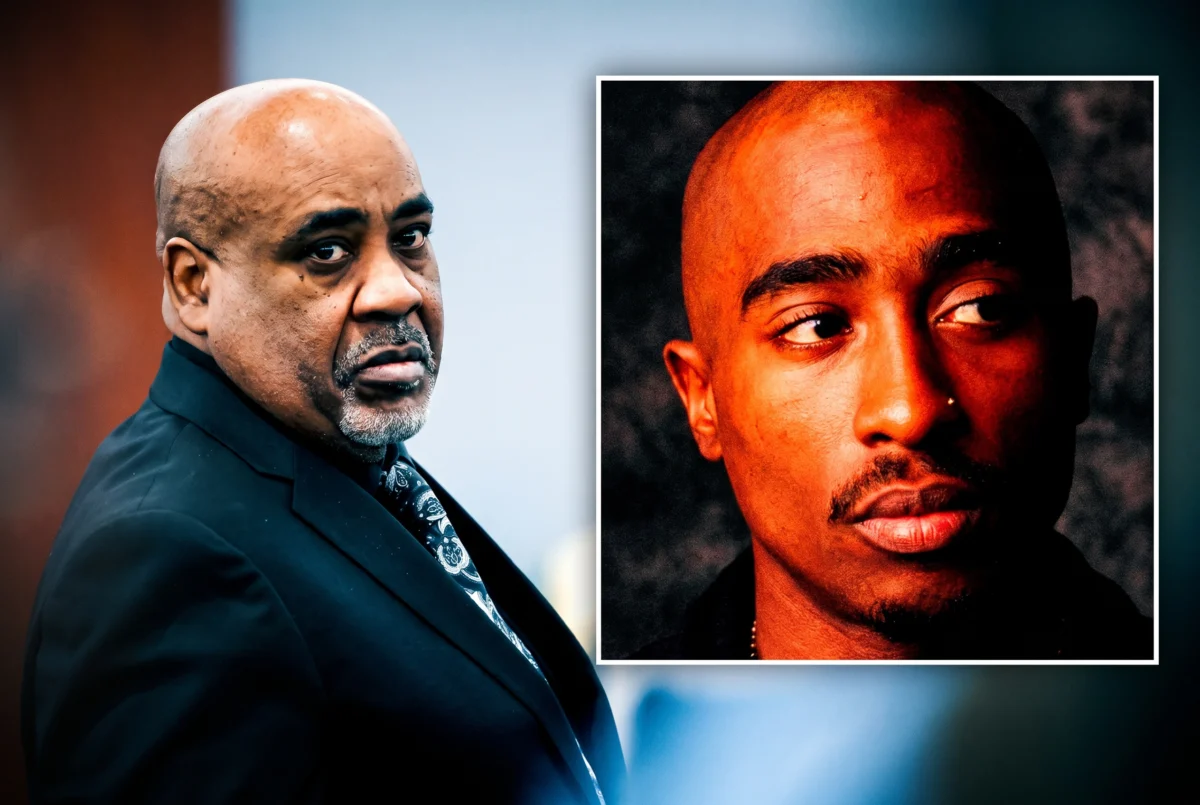
Duane “Keffe D” Davis has been found guilty of murdering Tupac Shakur.
Davis, 63, learned his fate Monday in a Las Vegas courtroom after roughly two weeks of testimony, becoming the first person ever convicted in the 1996 killing that has haunted hip-hop for nearly three decades. The Nevada jury returned its verdict after deliberating for less than three hours, delivering long-delayed accountability in one of entertainment’s most infamous unsolved crimes.

Prosecutors never accused Davis of firing the fatal shots. Instead, they argued the former high-ranking “shot caller” in a Los Angeles Crips chapter handed the gun to the triggerman — long believed to be his nephew Orlando Anderson, who died in a 1998 gang shootout — and masterminded the entire ambush. Their case leaned heavily on Davis’ own words, which he offered up in two separate contexts years apart.
Davis first apparently admitted involvement while trying to avoid potential charges in 2008, then laid out the full plot in a 2019 memoir that investigators used to build the case leading to his 2023 arrest. Chief Deputy District Attorney Binu Palal told jurors during closing arguments that the defendant’s statements were merely “the icing on the cake,” insisting the case was “drenched with circumstantial evidence” placing him at the center of the conspiracy.
The motive traced back to hours before the shooting, when Anderson had been publicly beaten by Shakur — who prosecutors said was affiliated with a rival Blood gang. Palal argued that under the unspoken rules of 1990s Compton gang culture, such a humiliation demanded violent retaliation.
“That was the nature of the gang life in the 1990s in Compton – you had no choice, you could not go back to Compton after being beaten publicly,” Palal said during his closing arguments.
The prosecutor painted Davis as the architect of that vengeance. Palal continued: “He got a gun and went hunting for Tupac Shakur.”
Davis’ defense attorney Michael Sanft fought to dismantle the credibility of those self-incriminating statements. Sanft characterized the memoir as historical fiction, pushing the comparison to Hollywood spectacle during his closing statement to the jury.
“Has anybody seen the documentary called ‘Titanic,’ with Jack and Rose?” Sanft jibed.
The attorney’s rhetorical gamble failed to sway the panel. The verdict marks a legal milestone in a case that has spawned countless theories, books, and documentaries since Shakur died at 25 from wounds suffered in the Las Vegas drive-by.
Shakur was riding in a car on the night of Sept. 7, 1996, when another vehicle pulled alongside and gunfire erupted. He clung to life for several days before succumbing, leaving behind a towering legacy as a pioneer of the burgeoning rap scene and a cultural figure whose influence only expanded after death.
The conviction closes no door entirely — Anderson, the alleged gunman, never faced charges before his own violent death two years later, and questions about potential accomplices linger in the margins of the official record. Yet for the first time, a court has assigned criminal responsibility for the murder itself.
Davis had spent years publicly discussing the killing before his arrest, a pattern of loose talk that prosecutors ultimately weaponized against him. His 2019 memoir, in particular, functioned as both confession and evidentiary foundation, giving investigators a narrative thread they could pull through the cold case.
The trial’s swift conclusion — two weeks of testimony, under three hours of deliberation — belied the decades of investigative stagnation that preceded it. Multiple law enforcement agencies had pursued leads over the years, but the case resisted resolution until Davis’ own prolific commentary provided what authorities needed.
Sanft’s defense strategy hinged on framing those very statements as unreliable bravado, the kind of exaggerated gangland storytelling that mixes fact with myth. The “Titanic” comparison aimed to persuade jurors that Davis had constructed a compelling narrative without regard to literal truth, much as filmmakers had with the doomed ocean liner’s fictional passengers.
The jury rejected that framing, accepting instead Palal’s argument that the circumstantial and direct evidence converged on a single conclusion.
Sentencing for Davis has not yet been scheduled.