

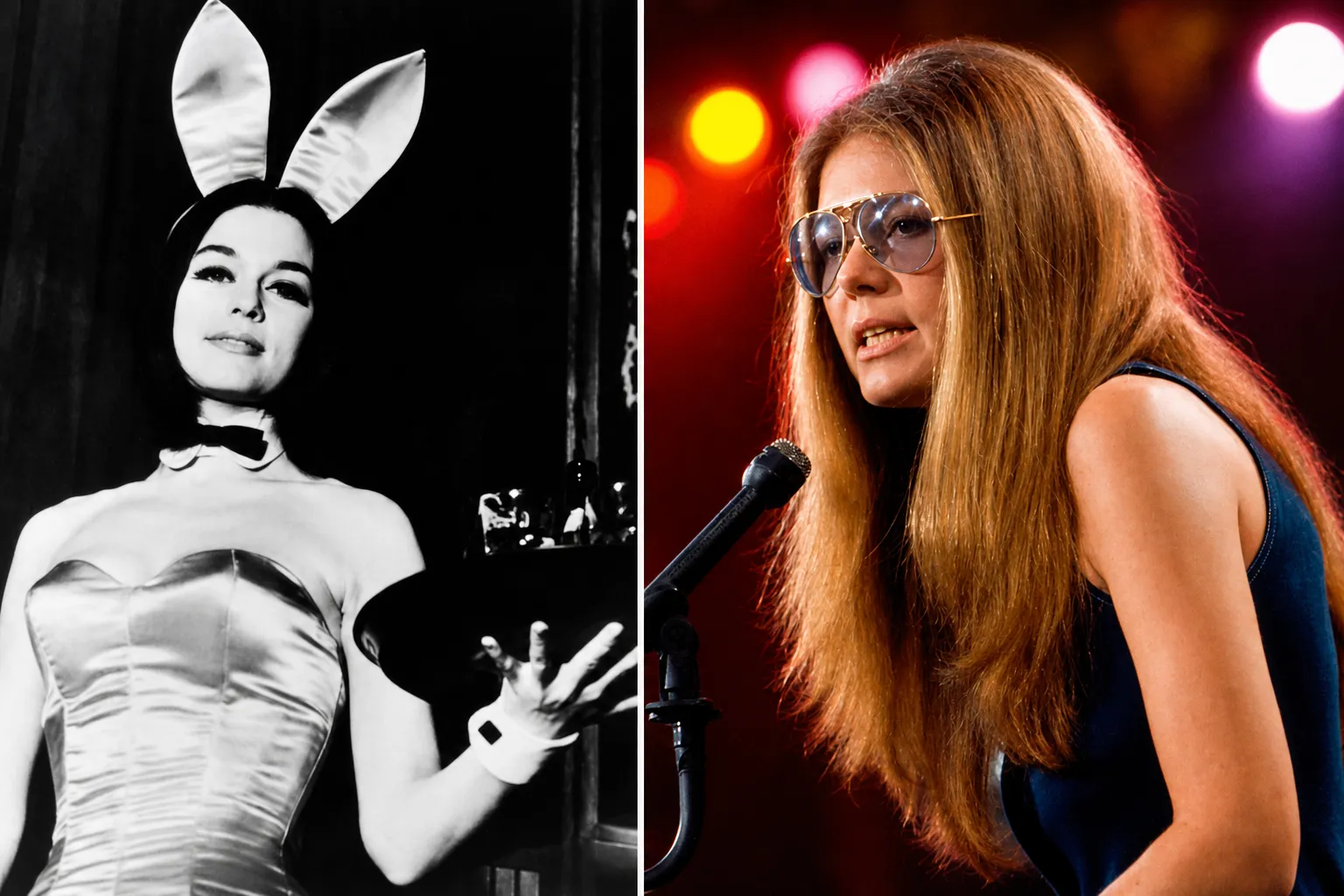
Gloria Steinem’s death at 92 has renewed attention on the undercover assignment that made her famous and then haunted her for decades.
The pioneering feminist, who died Wednesday, was 28 and struggling for footing in New York City’s male-dominated journalism scene in 1963 when she spotted an advertisement seeking “attractive young girls” for the Playboy Club. She applied under the false identity Marie Catherine Ochs, shaved two years off her age to meet the 21-to-24 requirement, and was hired as a “door bunny” greeting visitors at the Midtown Manhattan club.
She spent 11 days in the role, strapped into a costume she would later describe as suffocating. “Being a Playboy Bunny was like being hung on a meat hook,” she told Interview Magazine in 2020, decades after the assignment. “I had to work very hard in 3-inch heels and a costume so tight that I could hardly breathe.”
The working conditions she documented proved brutal. Bunnies faced fines for dirty tails or crooked ears, invasive physical examinations, and systematic confiscation of their tips. Male co-workers leered and summoned them with calls of “here, bunny, bunny, bunny.”
Her resulting article, “A Bunny’s Tale,” published in Show magazine weeks after she quit, became an instant sensation. It transformed Steinem from an obscure byline into a household name and announced her emergence as a women’s advocate. The expose even forced Hugh Hefner to eliminate some practices, including the physical exams.
Yet the piece also inflicted lasting damage on the career it had launched. Steinem later judged the decision to go undercover as a catastrophic miscalculation that allowed critics to dismiss her for generations.
“I was just beginning to be assigned serious pieces and suddenly I was a Bunny,” she said in 2011. “I could not have made a bigger mistake.”
“It was personally and professionally a disaster,” she continued. “In the short term, it was much harder to get assignments, and in the long term it’s been used to ridicule me.”
The stigma persisted for over half a century. “To this day, when people don’t like me they introduce me as a former Bunny, as a put-down,” she told the Times in 2016. The 1985 television movie “A Bunny’s Tale,” starring Kirstie Alley, only cemented the association in popular memory.
Steinem did eventually encounter Hefner face-to-face, though not during her undercover days. “I did not meet Hugh Hefner during the dreadful experience of being a Playboy Bunny, but I did meet him when I interviewed him,” she said. “The most surprising thing about him was that he was pathetic. He was like an 8-year-old boy pretending to be a grown-up man.”
Despite her personal regret, Steinem never disavowed the material benefits her reporting secured for the women who continued working at the club. “On the other hand, I did improve the working conditions for those women,” she told the Times.
Steinem’s death comes just weeks before the scheduled release of a new memoir.