

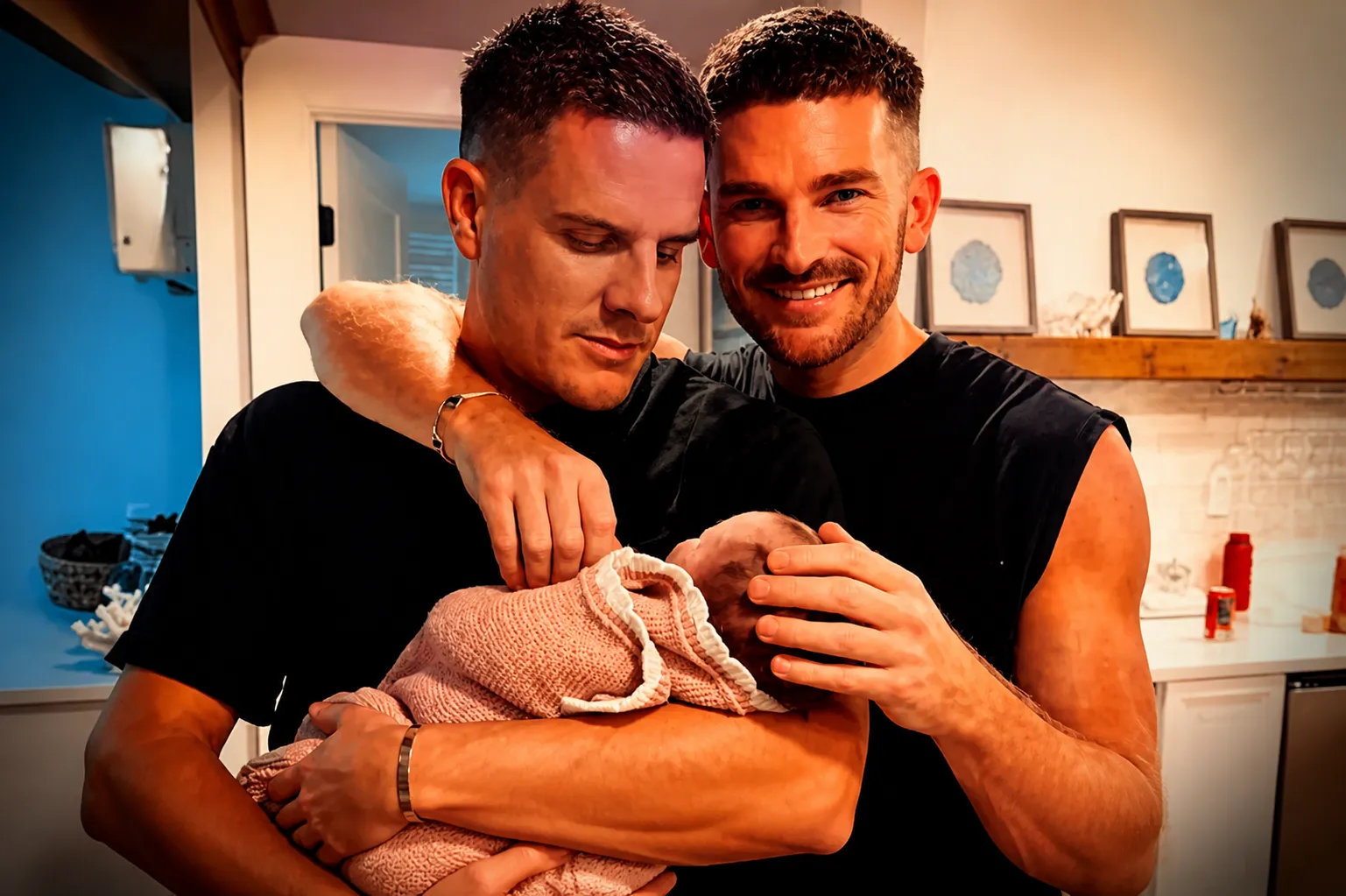
Adam Frisby and Jamie Corbett say their day in Parliament left them deflated after MPs allegedly reduced their surrogacy reform push to a debate about “wealthy men exploiting women.”
The British couple, who welcomed daughter Leven via a US surrogate in January, launched a petition to overhaul UK parental rights after hitting repeated bureaucratic walls. Frisby, 37, founder of clothing brand In The Style, and Corbett, 35, saw their petition debated in the House of Commons on September 7, but emerged with little hope for immediate change. “We really believed today might move something forward. It didn’t. We gave it everything,” they wrote in a joint Instagram statement following the session.

Their campaign began with a far more personal frustration: enrolling Leven in the National Health Service. Corbett said presenter Sarah-Jane Mee on The UK Tonight that a doctor’s surgery receptionist immediately demanded to know who the child’s mother and father were. “So I went in and said, ‘Well, we’re a surrogate family, she has two fathers.’ And they said to us, ‘Well we can’t put that on our systems in the NHS, so we need to know who the mother is,'” he recalled. The surgery eventually proved understanding, but the exchange marked only the beginning of their administrative ordeal.
On a subsequent visit, the couple discovered notes in Leven’s medical file flagging that they were not her legal guardians in the United Kingdom. Under current British law, the American surrogate remains Leven’s legal parent until a parental order of roughly 200 pages wins approval, a process that typically stretches to 12 months. This limbo status creates practical crises each time the family seeks medical care. “It’s one of those situations that when we go into the doctors’ and when we call them, they’ll say to us, ‘Who’s the biological father? We need to know, because we have to have consent,'” Corbett explained to Mee. “But then because of this grey area around the parental order, even though one of us is legally the biological father for Leven, we’re still not classed as her parents in the UK because our surrogate in the US is.”
The strain has weighed heavily on both men. Frisby described to Mee the emotional toll of an early legal consultation that outlined everything they could not do once Leven arrived. “When we had the call initially to fight with our lawyer to sort of be told, ‘This is what you can’t do when Leven’s here…’, [Corbett] came off particularly emotional and I did aswell,” he said. “We were both kind of like, this isn’t how it should be, this is our daughter, we planned her for many many years and actually, we’ve got all these issues that we may face and you know, God forbid, touch wood, if ever Leven was in need of medical attention in hospital, we’d have to go and get consent from the High Court or from our surrogate and it’s just not how it should be, really.”
Beyond medical bureaucracy, the couple has faced home visits from social workers assessing their fitness to parent. Frisby found the experience particularly galling given the circumstances of Leven’s conception. “It just feels wrong in the circumstances,” he told Mee. “I always say this, but, a surrogate child isn’t an accidental child. They are planned for many years, and so wanted, so to have social workers assess that we’re fit enough to be parents when we already are just feels very off,” Corbett added that if such assessments are mandatory, they should logically occur before a surrogate child’s birth rather than after the parents have already assumed full caregiving responsibilities.
The couple’s US arrangement involved both a surrogate and an egg donor, meaning Leven has no legal mother in the conventional sense under British frameworks. Yet NHS systems and other institutions remain configured around traditional parental categories, forcing the family into repeated explanations of their situation. The parliamentary debate, which they had hoped would advance concrete reforms, instead appeared to them to stray from their lived experience into abstract arguments about exploitation and class.
Frisby and Corbett’s case highlights a growing gap between British family structures and British law as surrogacy, particularly international arrangements, becomes more common. Their petition attracted sufficient signatures to trigger the parliamentary debate, but the couple’s own assessment of the session suggests reform remains distant despite their personal advocacy.