

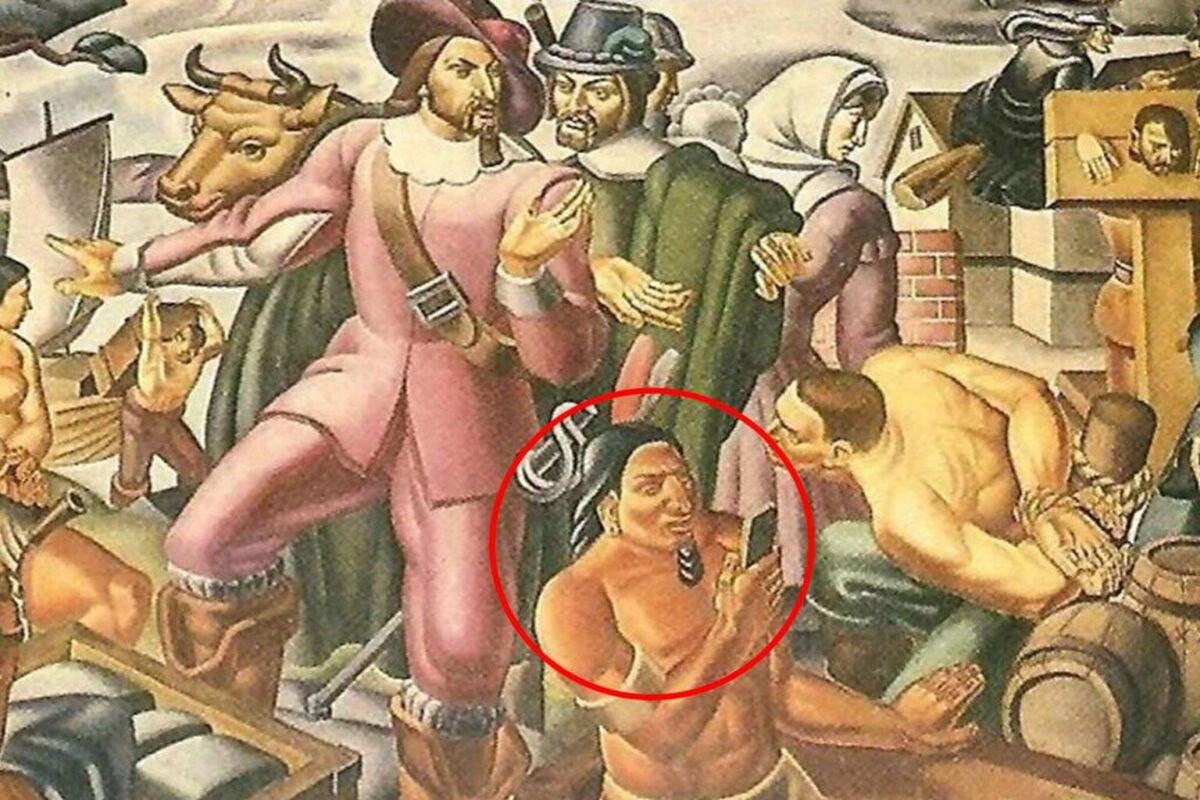
A 1937 mural depicting 17th-century Massachusetts colonists has sparked a viral conspiracy theory that an indigenous figure is holding a modern smartphone.
Umberto Romano’s “Mr. Pynchon and the Settling of Springfield,” completed nearly 90 years ago, shows a Native American man at the center of the composition staring intently at a rectangular, dark-backed object with reflective trim. The artwork, located in the Commonwealth of Massachusetts State Office building in Springfield, has become fresh fodder for online speculation about time travelers or anachronistic technology hidden in historical art.
“iPhone in painting from 1937 JUST DISCOVERED???” wrote one poster on X Tuesday.
“Now that one actually looks like a cell phone,” another user reportedly posted.
X users noted last March that the mural hangs in what was once the Springfield Main Post Office. The building housed six works Romano finished with students, all funded by the Federal Arts Project, a 1935-1943 government program that employed visual artists during the Great Depression, according to the Smithsonian National Postal Museum.
Historians have offered a far simpler explanation for the object. Mirrors were common trade items in 17th-century American colonies, which likely explains why the man appears to be studying his own reflection.
The mural’s central English figure, William Pynchon, was one of the founders of present-day Springfield. Pynchon moved to North America from Essex, England, in 1590 and became a founder and assistant treasurer in the Massachusetts Bay Colony. He acquired the land that would become Springfield from the Agawam Native Americans in 1636.
Romano, an Italian American muralist, took considerable pains to ensure historical accuracy in his work. He consulted with local historian Harry Andrews Wright and author Esther Forbes, intending to capture the region’s development across three centuries, from 1636 to 1936, according to the Smithsonian.
Rather than depicting a single moment, the mural functions as a mosaic of the settlement’s establishment. Pynchon stands as the central figure overseeing interactions between the English settlers and the local Pocomtuc and Nipmuc peoples.
While the work reflects the complex history of the area, art historians note that Romano’s semi-abstract style and deliberate choices in composition, absent anachronistic technology, are the intended focus of the piece. The smartphone theory appears to spring from the object’s rectangular shape and the figure’s absorbed posture, both easily explained by the mirror hypothesis.
The Federal Arts Project that funded Romano’s work was part of the larger Works Progress Administration, the New Deal agency that provided employment for millions of Americans during the Great Depression. Visual artists across the country received government support to create public works, many of which still hang in post offices, courthouses, and other government buildings today.
The Springfield mural is not the first historical artwork to attract modern technology conspiracy theories. Similar claims have surfaced around figures in medieval paintings appearing to hold “iPhones,” typically explained as prayer books, mirrors, or other period-appropriate objects. The pattern reflects persistent internet fascination with finding contemporary items in historical contexts.
Romano’s deliberate consultation with historians Wright and Forbes suggests he took care to represent the 1636 land transaction and settlement period with reasonable fidelity. The mirror, as a trade good exchanged between colonists and Native Americans, would have been a recognizable and historically grounded element for viewers in 1937.
The mural remains on public display in its original Springfield location, where visitors can judge the controversial object for themselves.