


James Leininger’s parents became convinced their toddler was reliving a past life after he began screaming about a fiery plane crash during recurrent nightmares.
Andrea Leininger, the boy’s mother, said that the episodes started when her son was two years old, following a family trip to a flight museum in Dallas with his father, Bruce. The nightmares struck three to four times a week, each one violent and aviation-themed.
“I’d wake him up and he’d be screaming,” she said.
When Andrea pressed her young son for details, the words that came back unsettled her. He spoke of an “airplane crash on fire, little man can’t get out.”
The Leiningers initially dismissed the episodes. James watched only children’s programming, never World War II documentaries or military films. Yet the specificity of his knowledge kept mounting. Andrea once pointed to what looked like a bomb attached to the underside of a toy plane. James corrected her immediately: it was a drop tank.
“I’d never heard of a drop tank. I didn’t know what a drop tank was,” she added.
His statements grew more elaborate and personal. Andrea recalled her son telling her: “Mama, before I was born, I was a pilot, and my airplane got shot in the engine, and it crashed in the water, and that’s how I died.”
Bruce Leininger began investigating the names and details his son had volunteered. James claimed his plane had taken off from a boat called “Natoma” alongside a friend named Jack Larsen. He also pointed to a photograph of Iwo Jima in a book and told his father, “My airplane got shot down there, Daddy.”
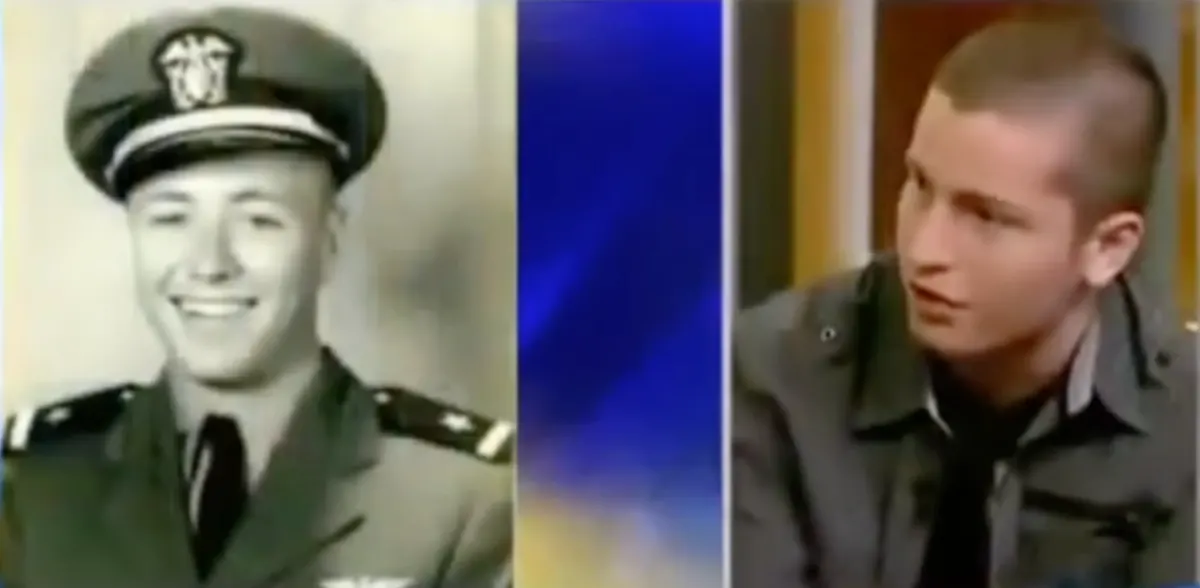
Bruce’s research uncovered a World War II escort carrier, the USS Natoma Bay. He attended a reunion of the ship’s veterans and confirmed that a pilot named Jack Larsen had indeed served aboard. More strikingly, he learned that James M. Huston, Jr. Was the only pilot from that carrier killed during the Battle of Iwo Jima.
The family gathered additional corroboration from military records and eyewitness accounts. A veteran who observed Huston’s final moments later stated on television: “I saw the hit. I would say he was hit head on, yeah, right on the middle of the engine.”
Bruce spoke with three separate eyewitnesses to the 1945 incident. Their accounts aligned with the details James had been reporting in his nightmares and casual remarks.
For the majority of James Leininger’s early childhood, his family operated under the understanding that he was recalling the life of Huston, a 21-year-old Navy fighter pilot who died in 1945. The Leiningers came to believe their son was the reincarnation of the fallen aviator, though no independent scientific evidence has ever established that his memories originated from a past life rather than from ordinary sources of childhood information.
The case has circulated widely in discussions of apparent past-life memories in children, a phenomenon occasionally reported anecdotally but not validated through controlled research. Skeptics note that young children absorb information from numerous unnoticed sources, and that confirmation bias can shape how parents interpret ambiguous statements.
James Leininger is now an adult. His family has continued to discuss their experience in interviews and a 2009 book, “Soul Survivor: The Reincarnation of a World War II Fighter Pilot,” co-authored by Bruce Leininger with Andrea Leininger and Ken Gross.