

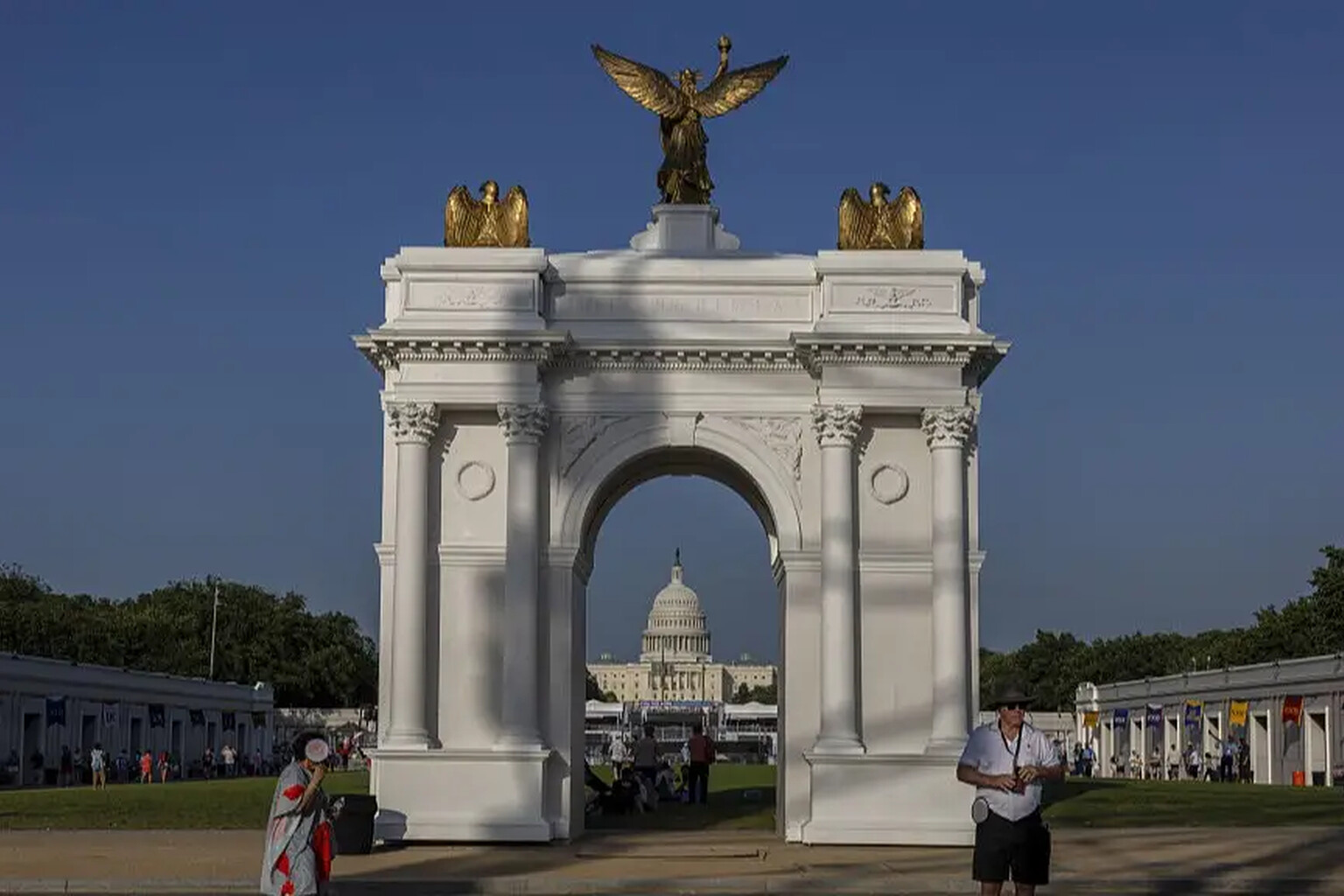
President Donald Trump revealed his planned 250-foot D.C. Triumphal arch will now serve as an active military installation.
The former president announced the pivot in a Truth Social post, stating the structure will function as what he called a “top grade Military Complex/Triumphal Arch.” Trump, 78, attributed the change to pressure from the armed forces, writing it came “at the strong request of the United States Military.”
According to his post, the arch will “house, store, and have the rapid ability to use large numbers of drones, plus Snipers, on both the roof and plaza areas.” The structure is also set to hold “large quantities of sniper ammunition in storage.”
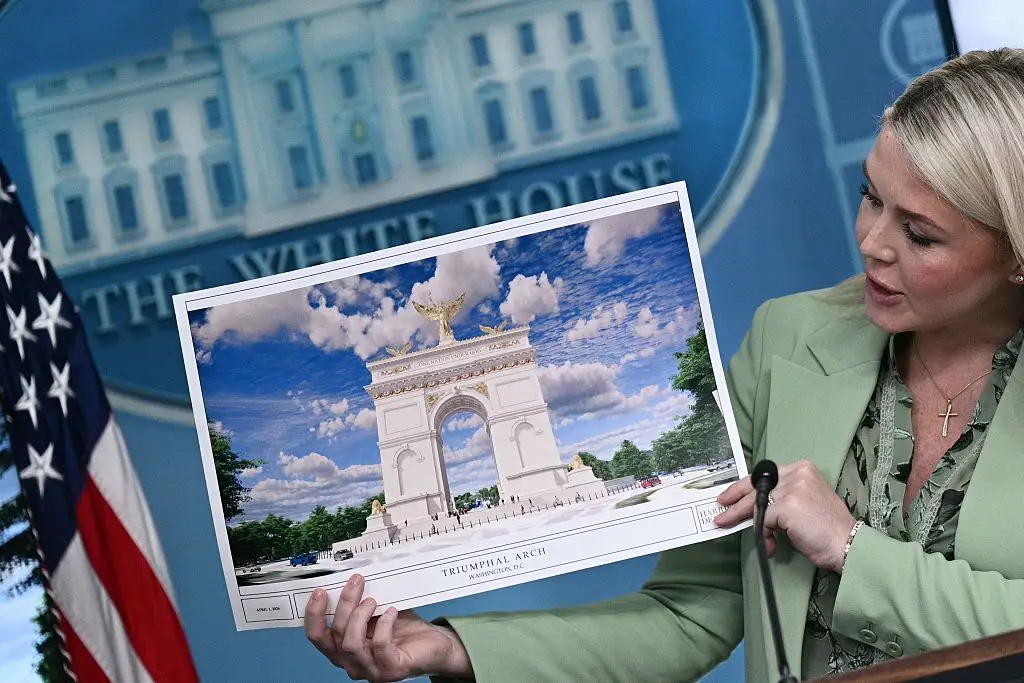
The announcement arrives as the project faces mounting legal and regulatory obstacles. The proposed arch would stand between Arlington National Cemetery and the Lincoln Memorial, rising to twice the height of the memorial itself. More than 100,000 people submitted comments to the National Park Service during the review process, the majority in opposition.
A group of Vietnam War veterans and an architectural historian have filed a lawsuit arguing the arch would desecrate Arlington National Cemetery grounds. The suit additionally challenges Trump’s authority to proceed without congressional approval.
U.S. District Court Judge Tanya Chutkin tightened the legal vise earlier this month, ordering the government to give 48 hours’ notice before any work begins on Memorial Circle. Her order specified that construction or demolition before the National Park Service grants final authorization would breach the court’s ruling.
That judicial intervention came just one day after Interior Secretary Doug Burgum posted on X that the administration intended to break ground within two weeks. Burgum’s timeline ignored the project’s pending status before the National Capital Planning Commission and other federal reviewers.
Trump used his Truth Social post to frame the arch as filling an embarrassing gap among global capitals. “Out of 59 major cities, Washington, D.C. Is the only one without a triumphal arch,” he wrote, adding that condition “won’t be the case for long.” He predicted the finished structure would be “by far, the greatest of them all!”
The military installation concept marks a significant evolution from Trump’s earlier presentations of the project, which focused primarily on aesthetic and symbolic dimensions. The former president has previously touted the arch’s design in public remarks, though he has not detailed specific architectural features or named a selected designer.
Federal reviewers have not yet granted final authorization for construction to proceed. The National Capital Planning Commission remains among the agencies with pending review authority over the site, which sits within a heavily protected corridor of national monuments and memorials.
The sniper and drone storage functions would transform what was initially promoted as a ceremonial structure into a hardened military facility. Trump’s description of “rapid ability to use” drones and the placement of armed personnel on “both the roof and plaza areas” suggests operational readiness rather than static display.
Veterans involved in the lawsuit have not publicly responded to the military installation announcement. Their original filing emphasized the sanctity of the Arlington grounds and the irreversible nature of altering the cemetery’s historic setting.
The project’s fate now depends on parallel tracks: the outcome of Chutkin’s oversight, completion of federal regulatory review, and any congressional response to the challenged authority question. Trump has not indicated whether he would seek legislative approval if courts rule it required.
The arch would become the tallest triumphal structure in the nation’s capital and, by Trump’s account, the first purpose-built military complex of its kind integrated into a ceremonial monument design in modern American history.