

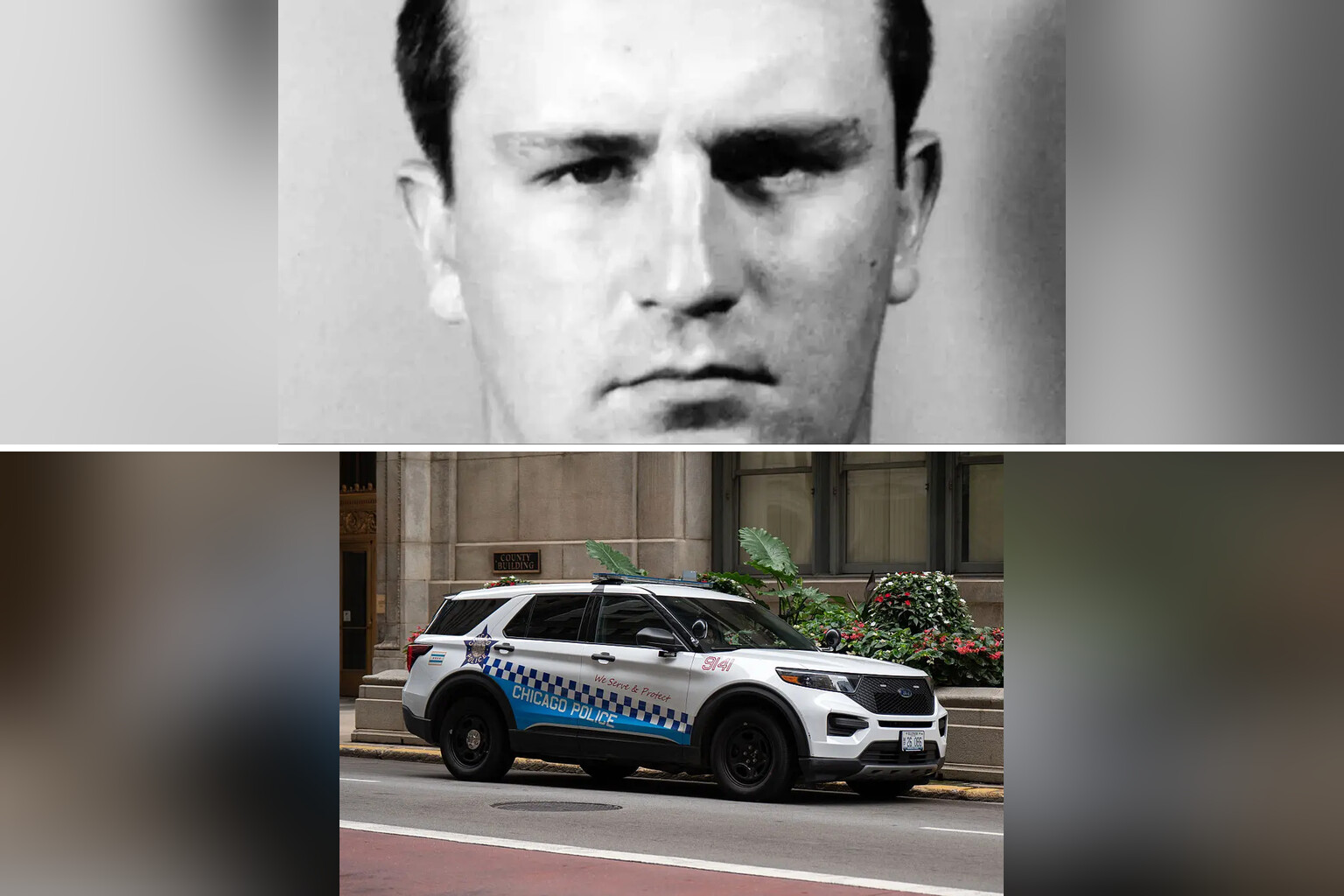
Chicago police have identified a former homicide detective as the killer of an 8-year-old girl whose 1960 murder went unsolved for 65 years.
Chief of Detectives Kevin Bruno, speaking to the Chicago Tribune, addressed the stunning revelation that Thomas Francis McInerney, who spent 28 years on the very force investigating the crime, was responsible for the death of Gloria Kowalewicz. McInerney was 24 at the time of the murder and lived just around the corner from the girl’s family in West Englewood. He died in 2006, meaning he never faced criminal charges for the killing.
“The fact that he was a police officer is deeply troubling to all of us that have made a career out of this most noble profession,” Bruno said. “But at the same time, it’s not something we’re going to minimize or shy away from.”
Bruno also praised the generations of investigators who refused to let the case go cold, pointing to the outcome as proof that “we don’t forget.”
Gloria disappeared on November 12, 1960, after leaving her family’s West Englewood home for a nearby church to receive communion. Her body was later found in a ravine several miles away, shot twice in the head. Investigators determined she had been taken to nearby woods before being killed, and eyewitnesses reported seeing a young girl with a man. Despite an extensive search involving local and state police, firefighters, Boy Scouts and veterans, no suspect was identified at the time.
The breakthrough came earlier this year when the FBI used DNA connected to a genetic genealogy website to link McInerney to the crime scene. Chicago police then confirmed the match through further analysis of DNA, fingerprints and ballistic evidence.
McInerney’s background as both neighbor and police officer added layers of betrayal to the case. An Army veteran, he served with the Chicago Police Department for nearly three decades before moving to the Federal Public Defender’s Office. He later worked as an investigator in Las Vegas and Reno, retiring in 2004. In 2003, he was named Outstanding Federal Defender Investigator. He was a father of five, including three daughters, and a grandfather.
For Gloria’s surviving family, the identification brought mixed emotions. Her brother, Adam Kowalewicz, told the Chicago Tribune that he hoped naming the killer would allow their deceased parents to “rest.” Yet he also voiced anger that McInerney escaped legal consequences.
“He never paid his dues,” Kowalewicz said. “You hope he’s going to pay his dues with the good lord.”
The case now stands as one of the oldest solved through genetic genealogy, a technology that has increasingly allowed investigators to crack decades-old crimes by tracing family trees through consumer DNA databases. The method has raised privacy concerns but has also provided answers to families who waited generations for them.
Gloria’s killing had remained one of Chicago’s most notorious cold cases, with each passing decade dimming hopes of resolution. The 1960 investigation, despite its scale and community involvement, foundered without a named suspect. McInerney’s position as a young officer on the rise may have helped him avoid scrutiny at a time when forensic science offered limited tools for narrowing suspects.
Chicago police have not announced any further developments in the case, given McInerney’s death, but the identification closes a chapter that began when Dwight D. Eisenhower was president and the city was a different world.