


Quinton Baker’s girlfriend is weighing legal action against Las Vegas police after the department admitted it cannot determine whether officers or Baker himself fired the fatal shot that killed the couple’s 3-year-old son during a deadly February standoff.
Raneka Pate, the boy’s mother, has disputed the police account of the incident and is considering a wrongful-death lawsuit, according to reports. Her position gained weight after authorities walked back their initial claim that Baker had shot his own son while using the toddler as a human shield.
Baker, 28, a former running back at Portland State and Western Kentucky universities, died in the shootout with officers. The Kentucky native had fled his apartment with son Kentre in his arms after allegedly attacking Pate and another woman, pointing a gun at the toddler’s chest as police closed in.
Bodycam footage released last week captured the final moments of the confrontation. Officers can be heard ordering Baker to drop his weapon as he advances toward them screaming, “Imma shoot myself!”

Baker managed to fire four shots between the time police opened fire and his falling to the ground, according to the department’s account. When the gunfire ended, both father and son were dead. The medical examiner has not been able to establish which weapon killed Kentre.
The incident began when police were called to Baker’s apartment following reports that he had attacked Pate and another woman. The violence erupted after Baker revealed his sexuality to his girlfriend, according to FOX5 Vegas.
Before his death, Baker had been a standout football prospect. He averaged 165 yards per game and ranked among the top five players in his state during his college career, according to a 2016 bio. The three-star prospect was once rated the No. 21 all-purpose running back nationally by 247Sports, and he earned Conference USA All-Freshman honors in his first collegiate season.
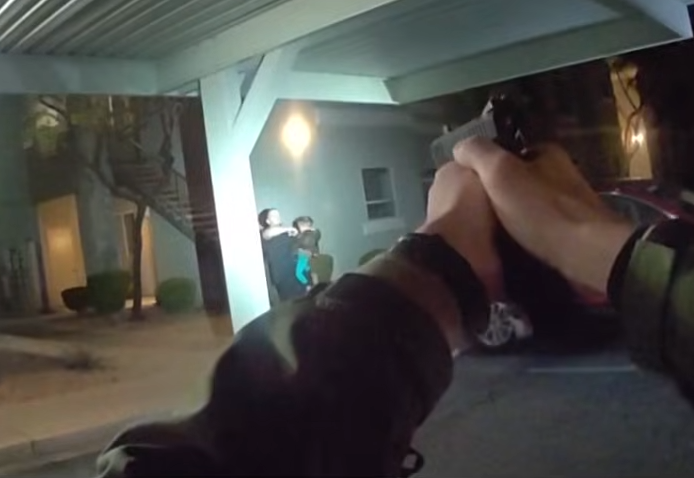
The case has drawn renewed scrutiny following the release of the bodycam footage and the police department’s revised stance on the boy’s cause of death. What began as a domestic disturbance call escalated into a fatal encounter that left both a father and his young son dead, with lingering questions about police use of force in a situation involving a child hostage.
Pate’s potential lawsuit would challenge the official narrative that Baker alone was responsible for his son’s death, a narrative police themselves can no longer fully support.
Baker’s football career had once shown significant promise. His college statistics and recruiting rankings positioned him as a notable talent, though his path ultimately led away from the sport and toward the tragic February confrontation.
The department’s inability to determine the source of the fatal shot that killed Kentre leaves a critical gap in the official record of the incident. That uncertainty now forms the basis of Pate’s dispute with police and her exploration of legal remedies.

Baker’s final words to officers, captured on bodycam, underscored the volatile nature of the standoff. His threat of self-harm came as he advanced on police while holding his son and a firearm, creating the split-second decisions that ended both their lives.
Pate has not publicly commented beyond her disputed account through representatives.