

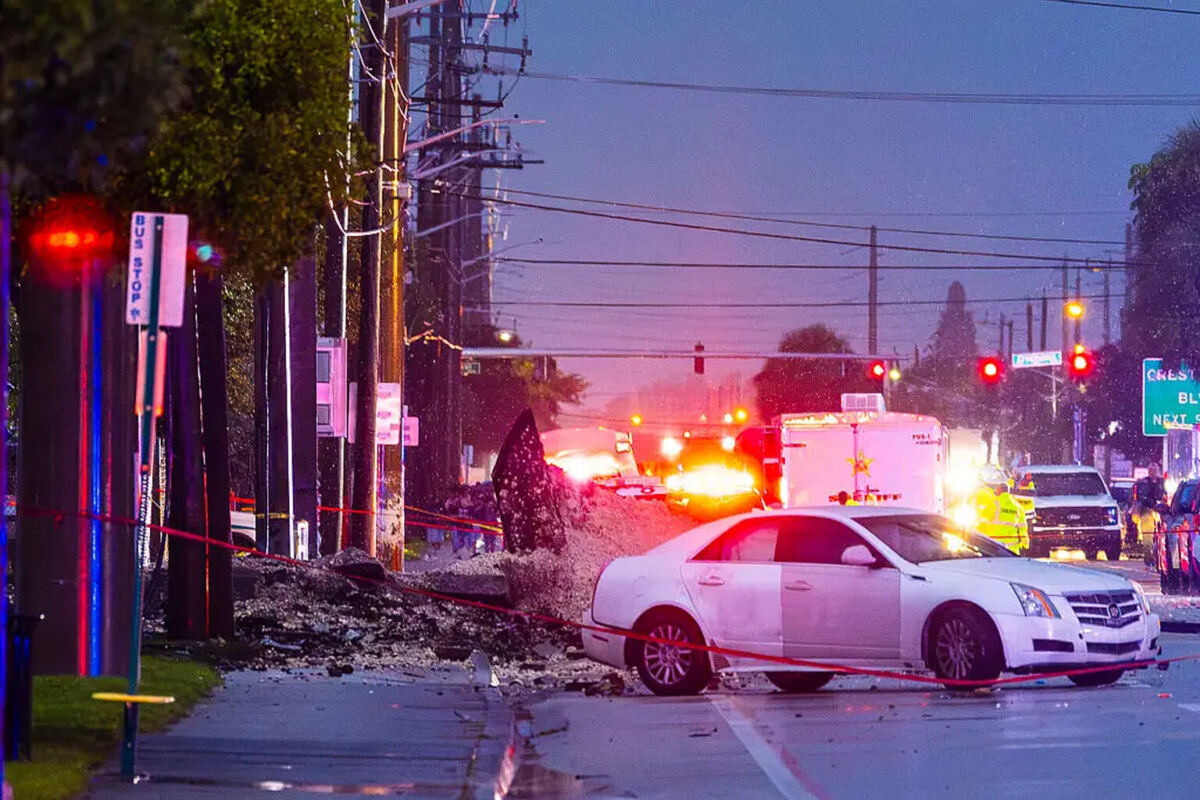
Aviation experts are explaining why a Learjet 60 that crashed in West Palm Beach, Florida, last Friday left almost no recognizable wreckage behind.
The aircraft, which was carrying nine people bound for the Bahamas, slammed into a road near a mobile home park at roughly 340 mph after descending at 20,000 feet per minute, according to released cockpit audio. US Transportation Secretary Sean Duffy confirmed all nine passengers and crew died in the impact and subsequent fireball. The Federal Aviation Administration and National Transportation Safety Board have launched a joint investigation into the cause.
The extreme velocity of the crash essentially pulverized the aircraft on contact with the ground, leaving investigators with what one expert described as a crater-like impact point rather than scattered debris.
“A high-energy impact like that can break an aircraft into very small pieces, with much of the wreckage concentrated around the impact point rather than scattered over a large area,” Justin Crabbe, commercial pilot and founder of private aviation platform Jettly, explained. He added that the amount of visible debris depends heavily on the “speed, angle of impact, the surface it strikes and whether there was a post-impact fire.”
Crabbe noted that the concentrated, crater-like nature of the impact zone indicated the jet struck “at a relatively steep angle with considerable energy.” The only components likely to survive such force, according to DeWitt Ingram, a Learjet type-rated captain and founder of Par-Avion Group Aviation Consulting, would be heavy structural elements like landing gear or engine parts.
“The energy transfer breaks apart the aircraft fuselage,” Ingram told CBS 12 News.
Aviation attorney Zachary Gorwitz offered a similar assessment to the Miami Herald, saying the “incredible force of the impact” made the lack of debris “really not surprising.”
The crew’s final transmissions, shared online shortly after the crash, revealed the terrifying speed of the aircraft’s final descent. A female crew member can be heard issuing a mayday call to Air Traffic Control.
“We’re descending 8,000. Mayday, mayday! We’re descending 10,000 feet per minute. Declaring emergency 722 Bravo Delta. We are in an overspeed condition, descending 20,000 feet per minute,” she said. “We’re going to crash into the ground.”
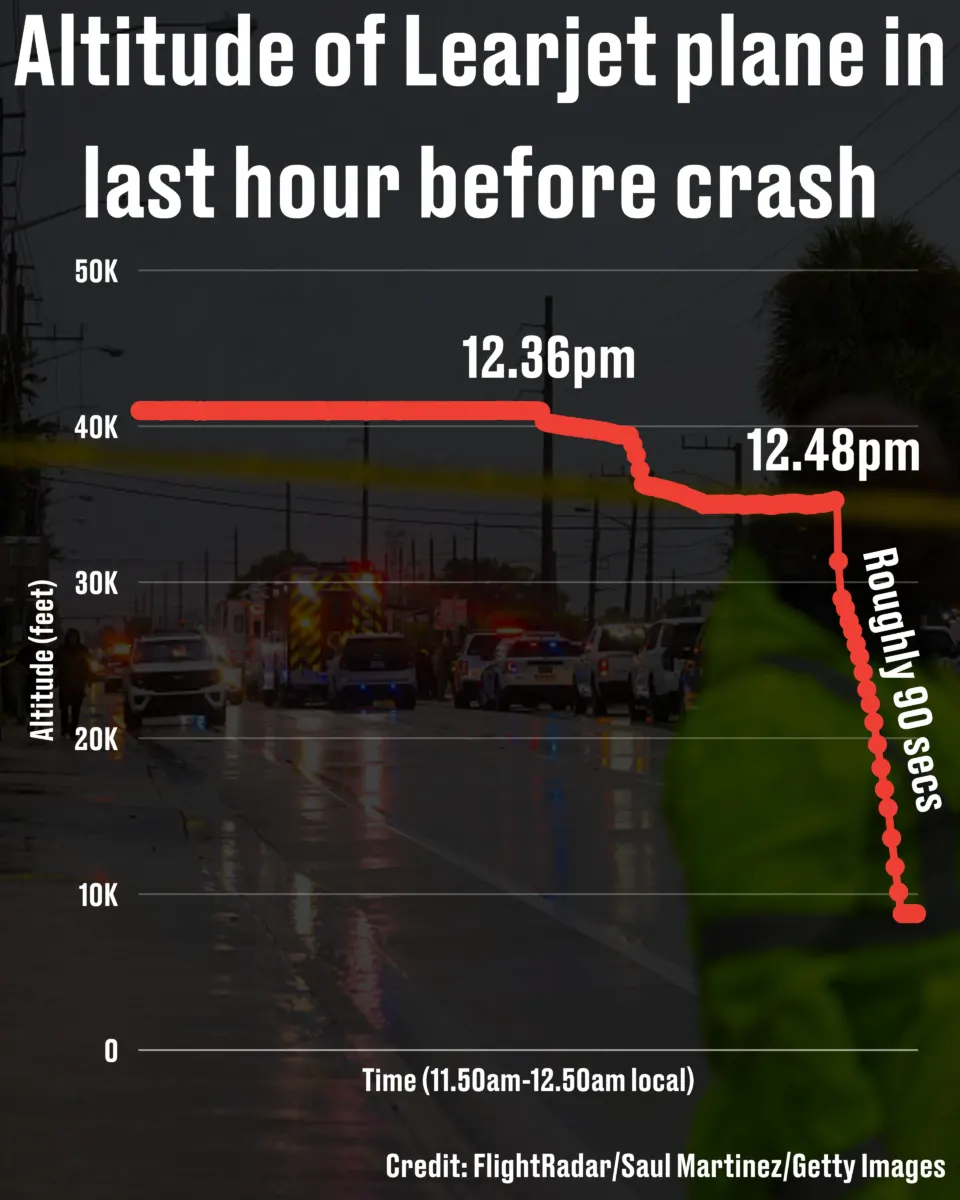
She continued: “We are descending 22,000 feet, and we are banking 60 degrees… Look outside. Holy f–k, we’re out of time.”
The same crew member also reported “severe icing” during the aircraft’s final moments, prompting speculation about whether ice accumulation contributed to the loss of control.
“When an aircraft flies through clouds containing supercooled water droplets, those droplets can freeze on contact with the aircraft,” Crabbe said in a second interview. “Even a relatively small amount of ice can significantly affect how an aircraft flies and how turbulence can also impact an aircraft.”
He added: “Severe icing means ice is accumulating at a rate that the aircraft’s anti-icing or de-icing systems may not be able to adequately manage.”
The physical effects of such icing, Crabbe explained, are devastating to flight performance: “Ice changes the shape of the wings, reduces lift, increases drag and can make the aircraft much more difficult to control.”
The Learjet 60 had departed from Palm Beach International Airport and was headed to the Bahamas when it went down around 6:15 p.m. On November 1. Witnesses described seeing the aircraft plunge nose-first into the ground like a missile, with the impact triggering a massive fireball that consumed what little remained of the airframe. The crash occurred on a busy roadway near a residential area, though no ground injuries were reported.
The aircraft was registered to an address shared with businesses linked to former presidents Donald Trump and Bill Clinton, according to public records, though neither was connected to the flight. The identities of those killed have not been officially released by authorities, though some families have begun sharing tributes. Liam Fitzgerald’s family described him in a statement as a “shining light.”
Weather conditions at the time of the crash remain a central focus of the ongoing NTSB investigation.