

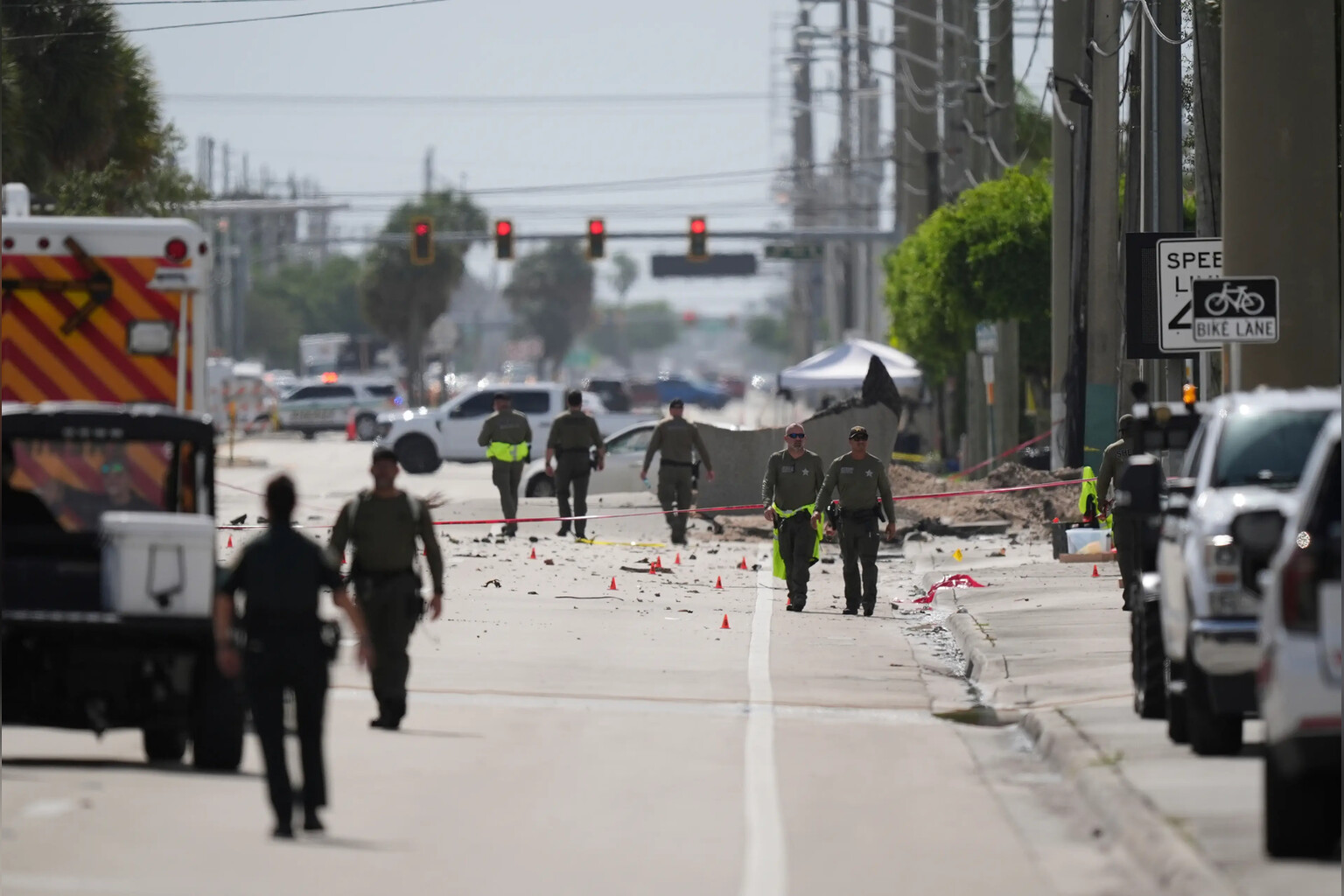
A retired pilot has floated the “coffin corner” theory to explain why a Learjet 60 plunged into a Florida neighborhood, killing everyone on board.
The crash occurred on November 1 in Palm Beach County, Florida, at approximately 12:50 p.m. EST. The private jet, which had departed Austin-Bergstrom International Airport in Texas and was bound for North Eleuthera Airport in the Bahamas, erupted into flames upon impact. All nine people aboard died in the disaster.
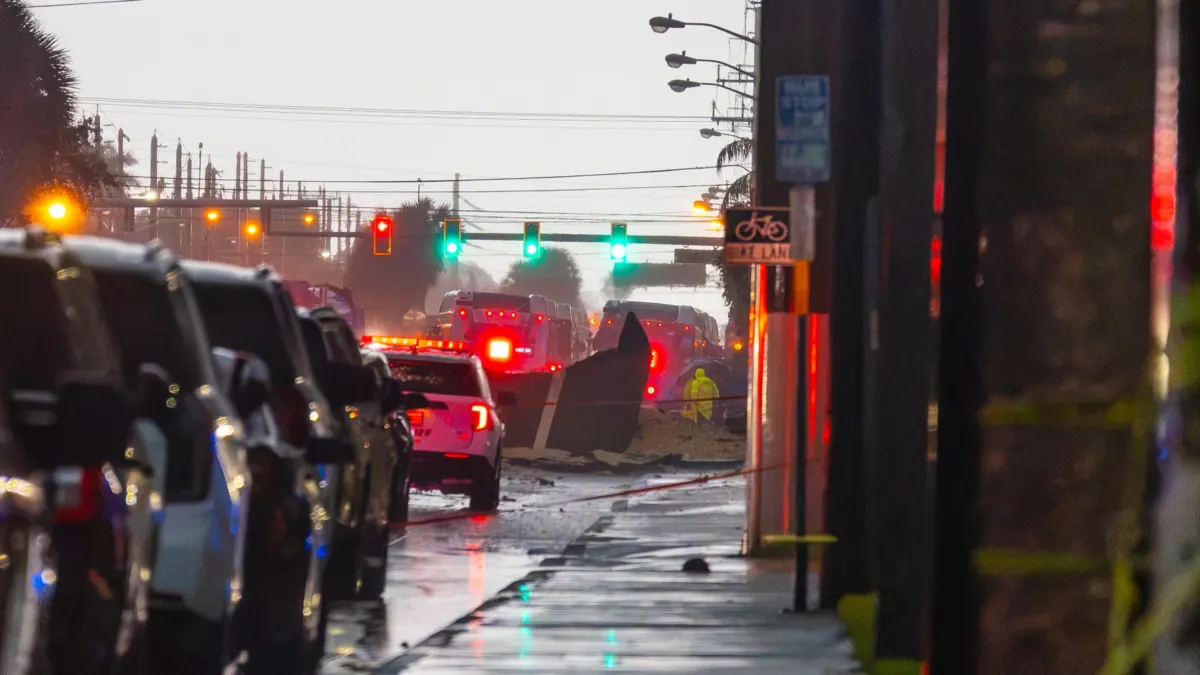
Investigators revealed in a November 2 update that they had found evidence the aircraft began breaking apart before it hit the ground. Weather conditions that day are expected to become a central focus of the ongoing probe by the National Transportation Safety Board.
The victims have been identified as Adam Robinson, his wife Helen Sharp, their two young children, and the family’s nanny Anita Maria Cetina. The crew members who died were co-pilot Nathalia Gadelha Filgueiras, 20, flight attendant Rachael Reed, and Charmi Fehr. The identity of the other pilot has not yet been released.
Aviation experts have begun weighing in as officials search for answers, and one concept drawing particular attention is coffin corner. The aviation safety database SKYbrary defines it as the point where “the Flight Envelope boundary defined by a high incidence stall intersects with that defined by the critical Mach number.” The database elaborates: “As an aircraft climbs towards the altitude that defines its coffin corner, the margin between stall speed and critical Mach number becomes smaller and smaller until the Flight Envelope boundaries intersect. At this point, any change in speed would result in exceeding one or the other of the limits.”
In practical terms, coffin corner creates a perilously narrow gap between the minimum and maximum safe speeds at high altitude. Pilots who slow down too much risk a stall; those who speed up risk losing control entirely.
Martin Varsavsky, a former pilot, took to social media to connect the phenomenon to the Florida crash and the weather conditions that day. He wrote: “What storms do by changing the outside temperature is that airplanes can no longer stay aloft at the same speed. It’s called the coffin corner. Or they become very difficult to keep under control.”

The coffin corner scenario represents one of several theories circulating as investigators examine why the Learjet descended so catastrophically. The NTSB’s finding that the plane broke up before ground impact suggests structural failure played a role, though whether that failure stemmed from aerodynamic stress, weather, mechanical defect, or some combination remains undetermined.
The crash drew immediate attention for its devastating human toll and its dramatic final moments, with audio from the flight’s last transmissions including the words “We’re gonna crash.” The aircraft came down in a residential area, though no ground casualties were reported. The investigation continues as experts parse whether high-altitude aerodynamic limits, storm-related temperature shifts, or other factors converged to doom the flight.