

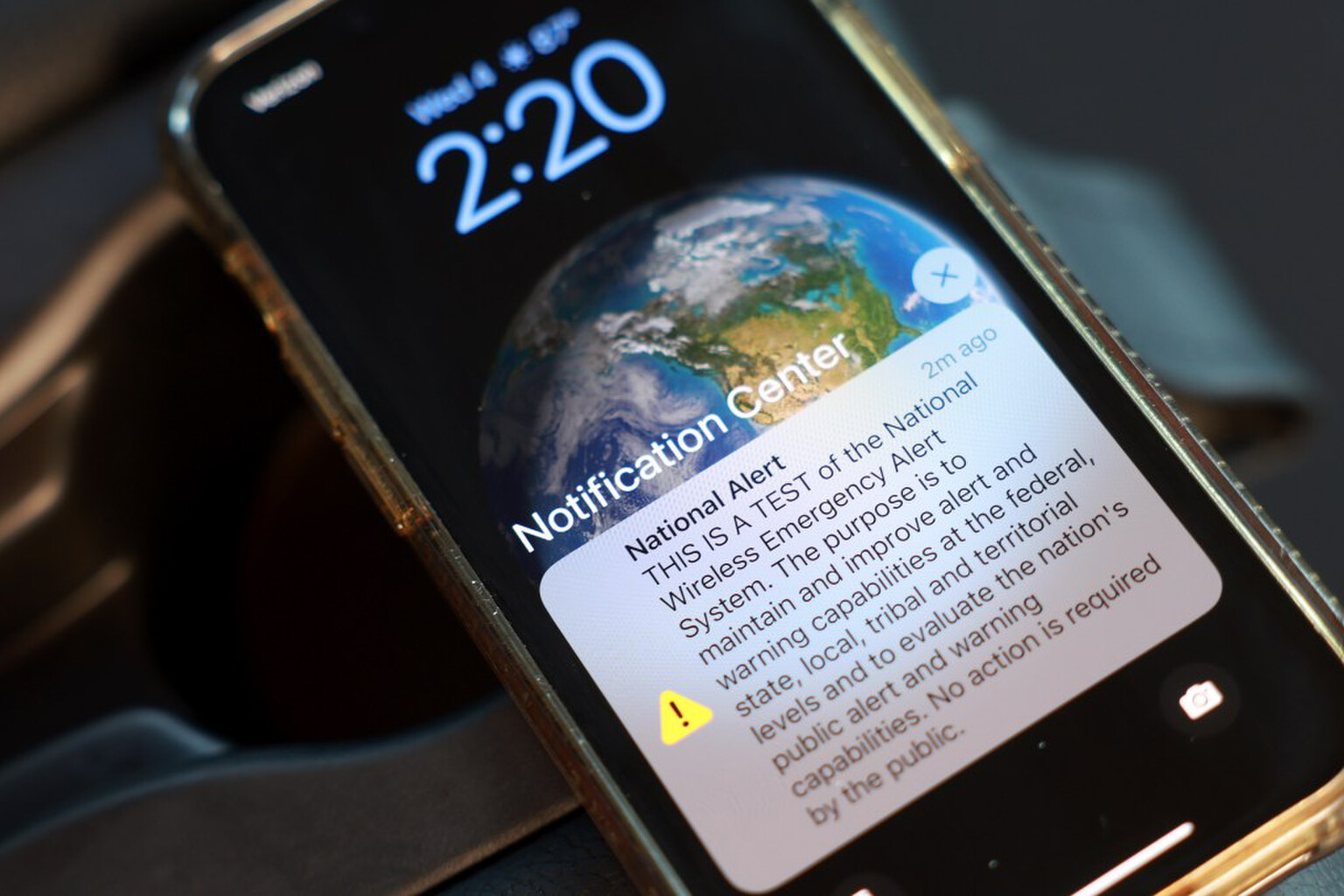
The federal government went ahead with its nationwide Emergency Alert System test Tuesday afternoon despite a week of cascading tech failures that left some Americans on edge.
FEMA triggered the drill at 2:20 p.m. ET, forcing televisions and radios across the country to blare a one-minute warning tone and message. The agency announced the Nov. 17 date back in September, long before Microsoft Outlook crashed across roughly 70 countries, the FAA ordered a rare nationwide ground stop, and major banks reported widespread outages.
The test message was blunt: “This is a nationwide test of the Emergency Alert System, issued by the Federal Emergency Management Agency. This is only a test. No action is required by the public.” FEMA posted that exact wording on X alongside a video clarifying the exercise, adding in the post: “We’ve heard a lot of rumors about tomorrow’s EAS test. Let’s clear things up. It lasts 1 minute, and no action is required. No blackouts, no secret emergencies. Just our legally mandated, routine test on TV and radio at approximately 2:20 PM ET.”
That legal mandate requires regular testing so the president can “share life-saving information with the public during a national emergency,” according to system guidelines. Officials stressed the drill had no connection to the recent outages or any hidden crisis.
Not everyone got the memo. California tourist Mohamad Bitar, visiting Times Square, predicted confusion among the unprepared. “I bet you like 30% of the people don’t even know it’s gonna happen,” he told The Post. “People might just go crazy and psych out.”
Turtle Bay resident Jerry Vitale admitted he was among the uninformed, saying he hadn’t spotted any online warnings. “I mean I’m a pretty calm person. I wouldn’t have overreacted,” he told The Post. “But it would have certainly got me to raise my eyebrows.” Vitale questioned why officials didn’t delay the timing, asking, “is there a reason that they can’t postpone it for a week or something?”
The skepticism fed on a brutal stretch of infrastructure failures. Microsoft Outlook went dark for nearly two full days starting last Thursday, with the company blaming an internal technical glitch after a network upgrade. On Friday, the FAA called for a nationwide ground stop, a measure not fully implemented since Sept. 11. Then Monday brought fresh trouble: Chase, Bank of America, Capital One and Wells Fargo all reported outages, with Downdetector.com logging almost 5,000 complaints at Chase and about 1,400 combined at BofA and Wells Fargo.
Homeland Security Secretary Markwayne Mullin moved Tuesday to shut down speculation. “I can tell you with complete certainty that we are not under attack — there’s no cyber threat that’s taken place,” he told CNBC. Mullin also swatted away conspiracy theories linking the failures, saying, “If we had somebody to blame, it’d be great because we’d be able to punch them back,” He added that American technological superiority meant the country could strike back if genuinely threatened: “The United States has the greatest ability to reach in. We have the most advanced technology than any other country out there. Full stop. We choose to use it if we need to if we’re being attacked.”
The FCC’s September announcement of Tuesday’s test date made clear it was routine, but the week’s chaos gave fresh ammunition to online alarmists. One viral post captured the mood with a meme format: “are we being cyber attacked?” paired with “the U.S government:” and a clip of officials appearing nonchalant. Another commenter posted: “You may want to hedge your bets on the no blackouts, emergencies, and outages bit… The track record the past few days isn’t reassuring.”
FEMA’s system is built to interrupt normal programming precisely because emergencies don’t wait for convenient moments. The test completed without reported technical issues.
The next nationwide test of the Integrated Public Alert and Warning System is scheduled for 2025.