

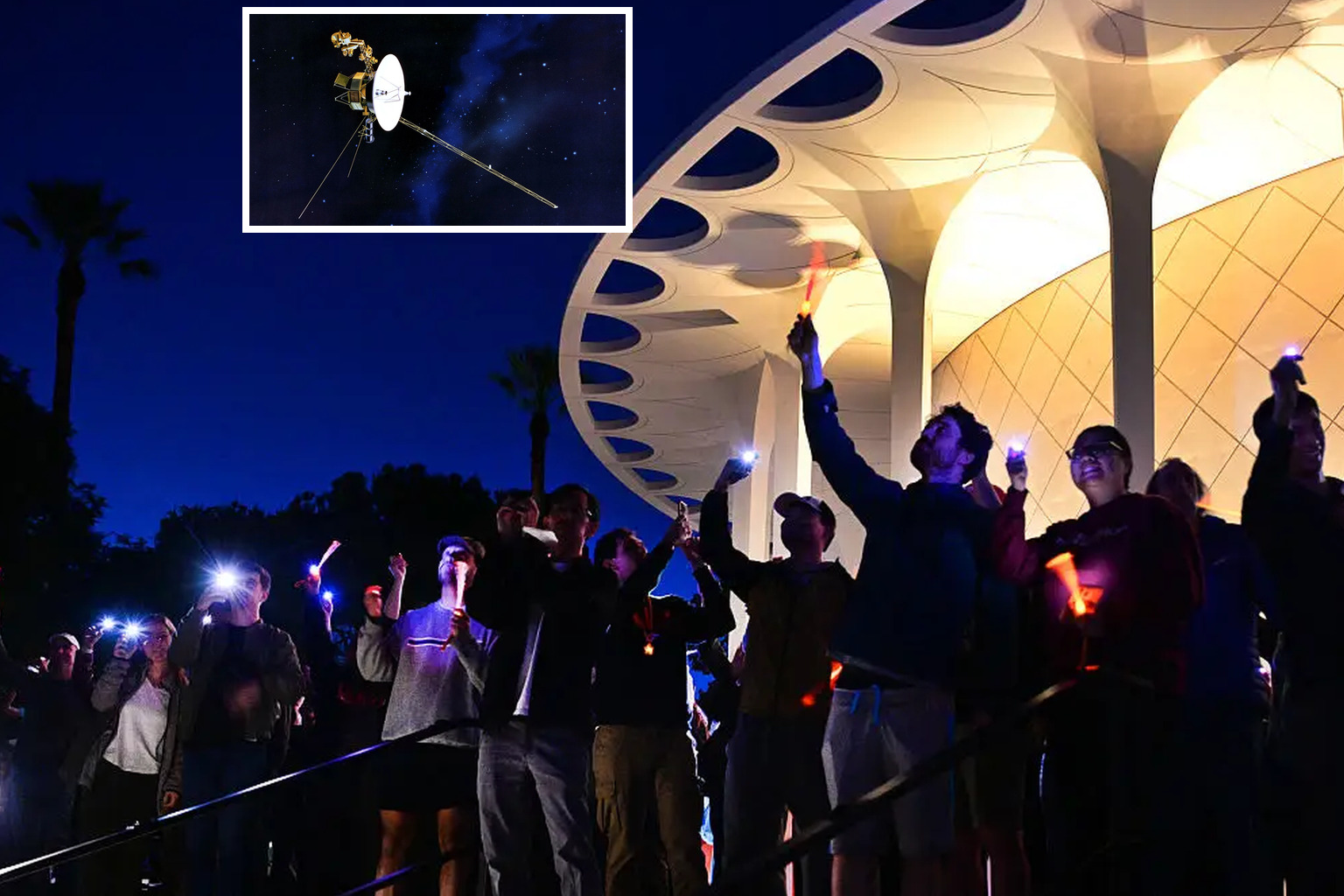
NASA’s Voyager 1 has become the first human-made object to travel one full light-day from Earth.
The milestone was reached at 5:16:07 a.m. EST on Tuesday, with the 47-year-old spacecraft now sitting roughly 16 billion miles from our planet. A light-day marks the distance light itself covers in 24 hours — meaning any command sent from mission controllers now requires a full day just to arrive, plus another day for any response to crawl back.
Launched in 1977, Voyager 1 was originally tasked with reconnaissance of the outer solar system, particularly Jupiter and Saturn. After completing those flybys, NASA extended its mission to probe the outer boundaries of the Sun’s influence and the interstellar space beyond. The probe now barrels through the cosmos at nearly 38,000 mph, a pace that dwarfs any earthly velocity yet remains sluggish against the speed of light.
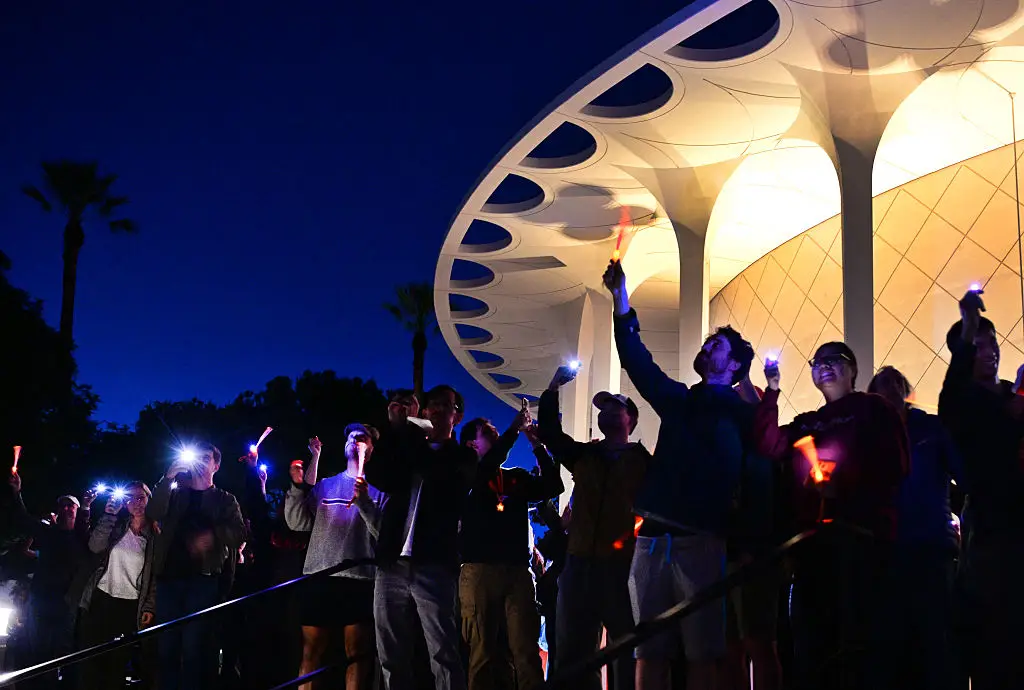
To mark the occasion, the space agency staged a global participatory event on Monday evening, inviting people worldwide to contribute to a symbolic wave of golden light. Participants were asked to shine phone flashlights, torches, and even building-mounted beams skyward after sunset on November 17, creating a collective gesture directed toward the distant traveler.
The probe’s ultimate destination, insofar as one exists, is not the star it happens to be approaching. Gliese 445, located in the constellation Ursa Minor some 17 light-years from Earth, will see Voyager 1 pass within approximately 1.7 light-years of it — in roughly 40,000 years. NASA emphasizes that this stellar encounter is incidental rather than intentional; the spacecraft was never aimed at Gliese 445 for exploration purposes.
The extreme distance has introduced operational constraints that define daily life for the mission team. With round-trip signal latency now stretching to 48 hours, real-time control is impossible. NASA has developed an interactive visualization tool called NASA’s Eyes to help the public grasp these communication delays, modeling how even light-speed transmissions lag across the expanding gulf.
Power aboard the aging probe continues to dwindle as its radioisotope thermoelectric generators decay. Recent technical challenges have required workarounds, with some fixes demanding the full two-day communication cycle simply to verify commands took hold. Engineers have spent years coaxing functionality from increasingly limited systems, including a 2023 memory corruption issue that temporarily garbled telemetry.
The spacecraft’s current trajectory carries it deeper into interstellar space, the region beyond the Sun’s protective heliosphere where it has operated since 2012. That boundary crossing itself marked another historic first, confirming humanity’s capability to build machines capable of surviving the transition to true interstellar travel.
NASA continues to monitor Voyager 1’s dwindling instruments, prioritizing those yielding the most valuable data about the environment between stars. The agency has not announced a specific end date for communications, though projections suggest the final instruments may be powered down within years rather than decades as electrical output keeps falling.
Voyager 1 carries the famous Golden Record, a time capsule of Earth sounds and images intended for any civilization that might someday intercept the craft — though at its current pace, that prospect remains firmly in the realm of speculation across timescales measured in tens of thousands of years.
The Golden Record initiative, launched with Voyager 1’s twin Voyager 2 in 1977, represented Carl Sagan’s vision of cosmic diplomacy. That second probe, traveling on a slower trajectory and in a different direction, remains in contact as well, though it has not yet reached the one light-day threshold.
NASA’s Eyes visualization platform remains available for public use, allowing anyone to track the spacecraft’s position and simulate the signal delays that now define mission operations.
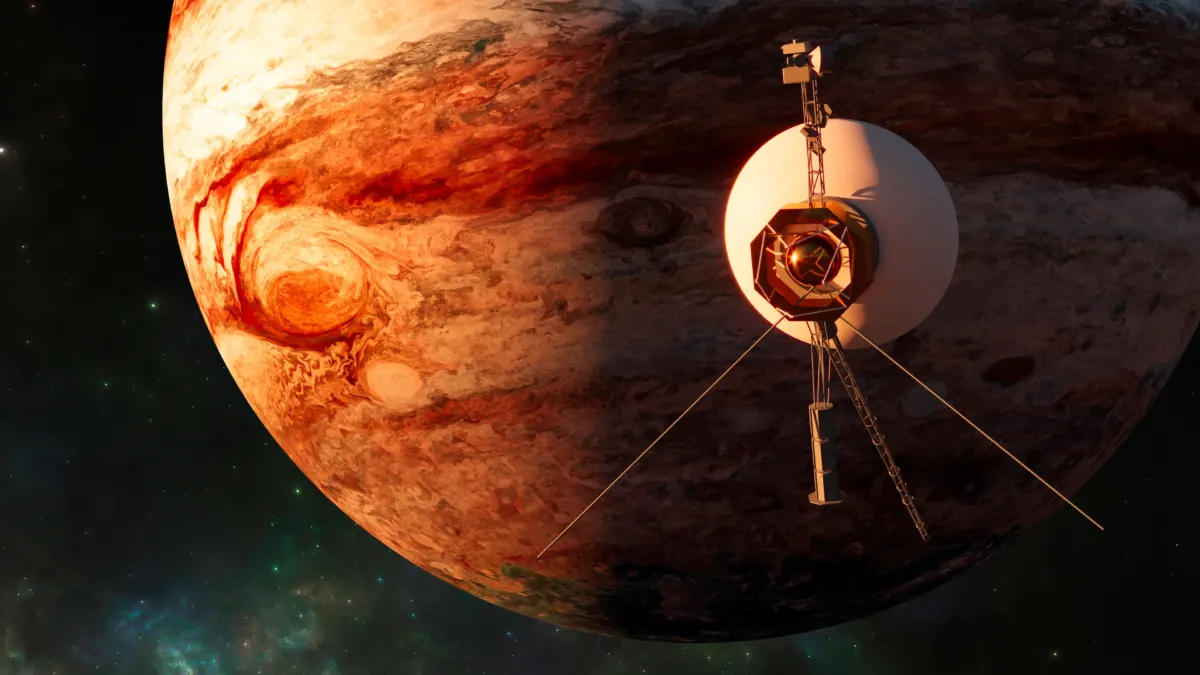
The Voyager program’s extended longevity has repeatedly defied expectations, with original mission planners anticipating only four years of operational life during the outer planet encounters. Instead, both probes have transmitted data across nearly five decades, outlasting multiple generations of ground equipment and several waves of mission personnel.
Voyager 2, which explored Uranus and Neptune in addition to Jupiter and Saturn, trails its twin and maintains its own unique scientific contributions from the heliosphere’s flank rather than its nose. Together the pair provide humanity’s only direct sampling of interstellar space from multiple vantage points.
NASA will continue receiving whatever data Voyager 1 can still transmit as power permits, with no further major milestones of comparable symbolic weight on the near horizon.