

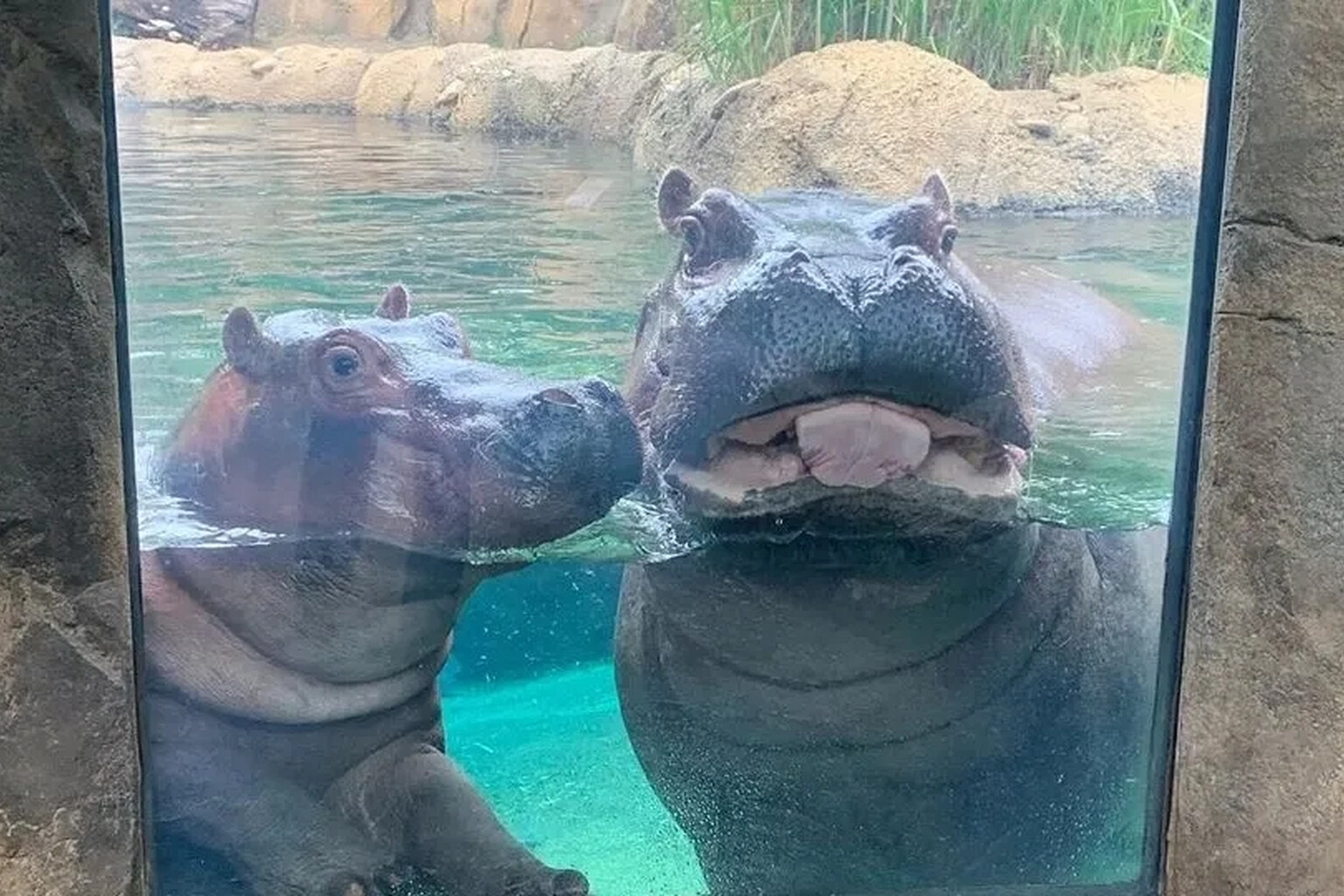
Cincinnati Zoo announced that Fiona the Hippo has died following a medical emergency after swallowing a hat thrown into her enclosure.
Fiona, 9, passed away on November 19 despite repeated veterinary interventions after she ingested a hat that landed in her habitat by accident the previous week, the zoo confirmed in a statement shared across its social media channels. The premature-born hippo had become a global sensation after surviving against remarkable odds, entering the world six weeks early in January 2017 at just 29 pounds.
“It is with extreme sadness that we share with you the devastating news that Fiona did not make it after multiple attempts from our amazing vets and keeper team to help her through what ended up being a medical emergency,” the zoo’s keepers wrote in their announcement.

“The vet staff tried everything they could to help her after she ingested a hat that ended up in her habitat by accident last week. Despite multiple attempts to move the hat out of her system, it was ultimately too much to overcome. The team performed necessary supportive care today in an attempt to save her, but it was not successful and she did not recover,” the statement continued.
Earlier in the week, the zoo had disclosed that Fiona had been sedated twice but that surgical intervention remained impossible. The revelation prompted wildlife experts to address why operating on hippopotamuses presents such extraordinary difficulties.
Chris Walzer, of the Research Institute of Wildlife Ecology, explained in a statement that hippos possess distinctive physiological traits complicating anesthesia. “The reaction of hippopotamuses to anesthesia suggests that they do not switch to anaerobic metabolism when they dive but possibly have other mechanisms to help them use the oxygen in their blood more efficiently,” he said.
Walzer’s observation highlights how hippo biology diverges from assumptions drawn from other large mammals. Their thick, oily skin and dense tissue layers beneath create additional barriers, making precise medication delivery to targeted body areas extraordinarily challenging for veterinary teams.
While surgical procedures on hippos are not entirely without precedent, the specific abdominal operation Fiona would have required represented a markedly different frontier. Dublin Zoo previously documented the first recorded cataract operation on a hippo, demonstrating that certain localized interventions can succeed under controlled circumstances.
The zoo’s statement concluded with an appeal to the community that had followed Fiona’s journey since her precarious birth. “We know everyone in the community will be crushed by this news, as we all are,” the keepers wrote.
“Please keep her keepers and everyone who tried to help her in your thoughts as they try to navigate and come to terms with this shocking news. They are also, understandably, asking for space at this time,” the statement added.
Fiona’s survival story had captivated audiences worldwide after her premature arrival in January 2017, transforming her into one of the most recognized animal personalities in modern zoo history.