

Spanish scientists say new bloodstain simulations and 3D scans strengthen a possible link between the Sudarium of Oviedo and the Shroud of Turin.
The University of Oviedo team, led by Pedro Peinado, published its findings in the Journal of Cultural Heritage after recreating how a bloodied, linen-wrapped model head would stain a burial cloth. They warmed fake blood to body temperature, applied dressings, and shifted the head’s position to see how fluids would accumulate. The resulting patterns resembled those on the Sudarium, the 33×21-inch cloth traditionally tied to the separate head covering mentioned in Gospel accounts of Jesus’ tomb.
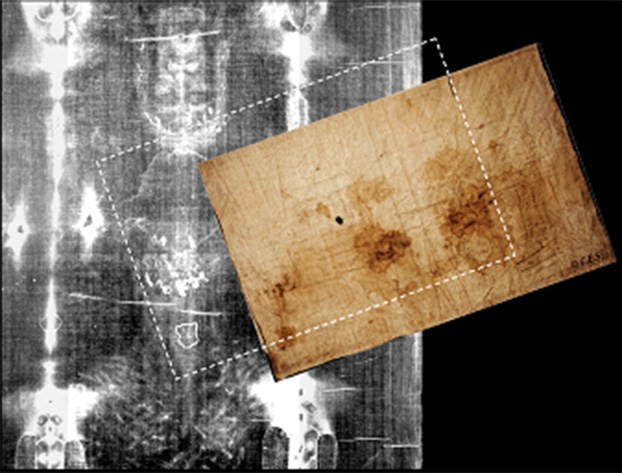
A direct examination of the original Sudarium on July 2 added further support. That nine-hour session employed 3D scanning, X-rays and other advanced techniques. “The morphology of the wrinkles, in the areas we had predicted, was fully consistent with the hypothesis that the Sudarium was secured to the executed man’s head by external pressure: bandages, cords or something similar,” Peinado said.
The study carries notable limitations. The model head lacked hair, and the replica linen differed from the ancient cloth. The bloodstain analysis also stopped short of proving the original stains formed in this specific manner.
Peinado is now running a computer comparison between Sudarium marks and the wounds visible on the Shroud of Turin, the roughly 14.44-by-3.61-foot linen bearing front and back images of a man. His unpublished preliminary work indicates stains on the Sudarium align with forehead and rear-head wounds on the shroud. Under his reconstruction, the deceased was propped upright and inclined during Sudarium bandaging, then laid face-up beneath the larger shroud, with shifting body position accounting for pattern differences between the two cloths.
“If it is confirmed — and we are very close to publishing it — the hypothesis of the same face will be greatly strengthened,” Peinado said. “Taken individually, each correspondence could be debated. Taken together, they are very difficult to attribute to chance.”
Radiocarbon dating poses the most stubborn obstacle. A 1988 test placed the Shroud of Turin between 1260 and 1390 AD, while evidence cited for the Sudarium dates it no earlier than the 8th century — both well after the crucifixion.
Earlier research had already noted limestone deposits on the Sudarium resembling those on the Shroud, with a chemical profile similar to Jerusalem stone. That 2015 study could not confirm the dust’s origin or establish that both garments touched the same body.
Even matching the two cloths to one individual would not automatically identify that person as Jesus. Peinado nonetheless argues that Jesus emerges as the strongest candidate when combining the apparent injuries, parallels with first-century Jewish burial customs and Gospel accounts.
“That this body was that of Jesus of Nazareth is a conclusion science cannot sign off on by itself,” he said.
Bible scholar Jeremiah Johnston, unaffiliated with the research, advanced a separate claim about the Shroud’s blood evidence. He contended that intact, undisturbed blood clots indicate Jesus’ body vanished without the cloth being physically removed.
“This is where it gets hard for the skeptic,” Johnston said while defending his Resurrection theory. “Pull a cloth off a wounded body and you tear and smear them. That did not happen here.”
The Sudarium has been venerated in Oviedo, Spain since at least the 8th century and is displayed in the city’s Cathedral of San Salvador. The Shroud of Turin resides in a climate-controlled case in Turin Cathedral, rarely shown to the public. Both artifacts have survived centuries of debate, scientific testing and devotional pilgrimage despite repeated challenges to their authenticity.
Peinado’s full computer analysis comparing both artifacts is expected to be published in the near future.