

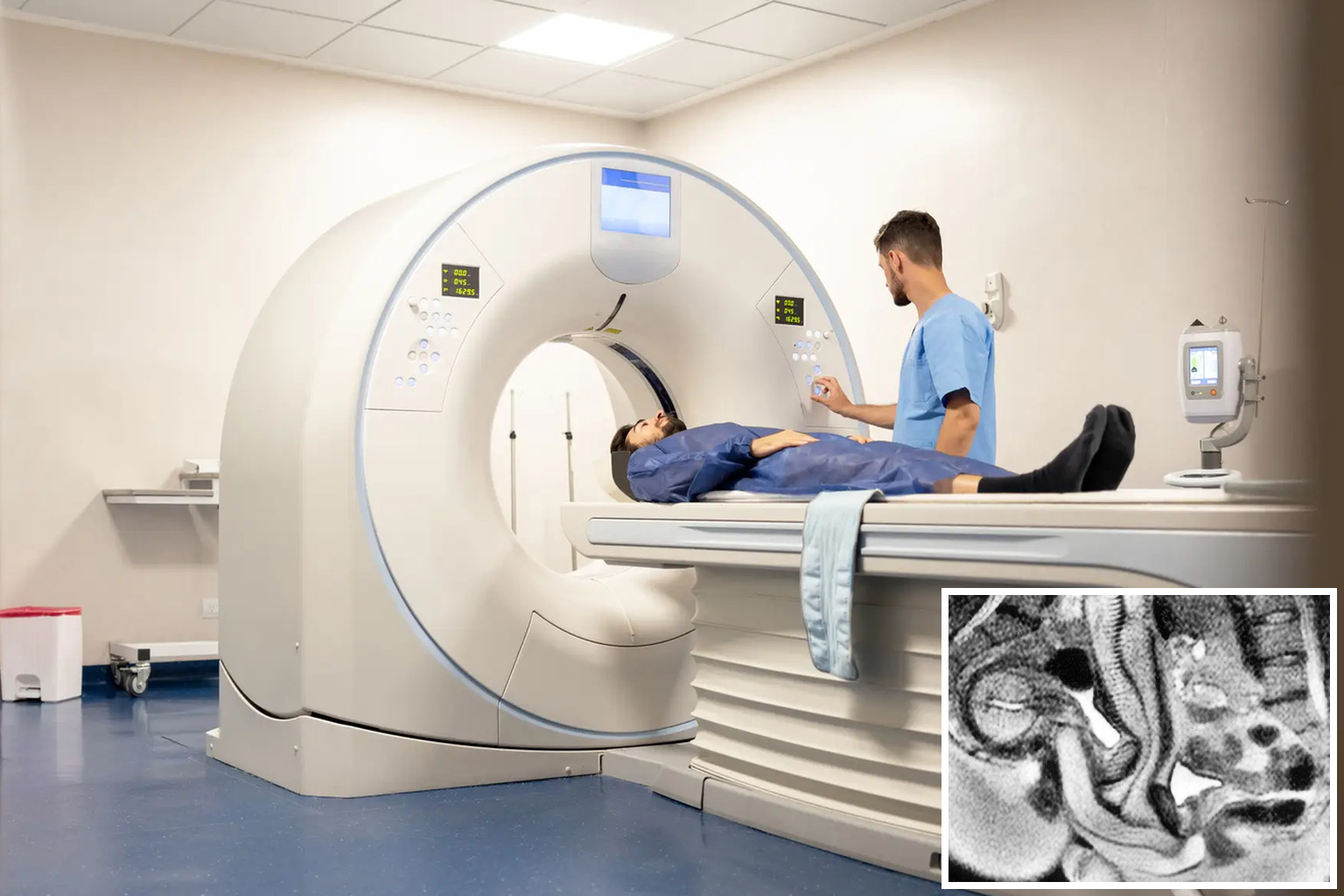
Ida Sabelis has spoken out about the 1991 experiment that put her and her boyfriend inside an MRI scanner during sex.
Sabelis, who took part in the study with her partner Jupp at a hospital in the Netherlands, admitted on a podcast last year that she never anticipated how much impact the research would carry. The couple were among the volunteers recruited by researcher Pek van Andel, who sought to capture live internal imaging of human anatomy during intercourse rather than rely on textbook diagrams.
“This was one of the first MRI machines ever, so taking the photos took some time,” Sabelis told the What Was It Like podcast in April 2024. “There was a command from the control room to keep in position for, I don’t know, a minute.”
The mechanical whirs and cramped, polo mint-shaped scanner made romance impossible, so the couple adopted a spooning position to complete the task. Sabelis described the experience as more performance than passion, noting that neither she nor Jupp suffered claustrophobia despite the tight quarters. “Jupp and I wriggled into that machine and started doing our thing,” she shared on the podcast. “It wasn’t romantic, it was more like an act of love and a performance. Thankfully, we didn’t get claustrophobic.”
The resulting images, published in the British Medical Journal in 1999 under the title “Magnetic resonance imaging of male and female genitals during coitus and female sexual arousal,” became one of the most widely circulated papers in the journal’s history. The study’s explicit aim was twofold: to establish whether such imaging was technically possible, and to test whether established anatomical assumptions about intercourse held up under direct observation.
What the scans revealed upended a misconception that had persisted for over five centuries. Leonardo da Vinci’s anatomical drawings had depicted the vaginal canal as essentially a straight cylinder, and that understanding had gone largely unchallenged since the Renaissance. The MRI images showed instead that the canal curves during intercourse, and that the penis bends to conform to that shape rather than maintaining a straight trajectory.
Sabelis and Jupp, who remain together, found themselves focused on how well they “fit together” during the experiment. The research ultimately involved eight couples and three single women as van Andel built his dataset. Investigators concluded that the MRI work did “contribute to the understanding of anatomy,” a dry understatement given how dramatically it revised long-held beliefs.
The timing proved fortunate for safety. Metallic and magnetic sex toys were far less common in 1991 than they are today, eliminating the risk of dangerous projectile accidents or heating injuries that such objects can cause inside powerful magnetic fields. Both participants emerged physically unharmed, if somewhat compressed by the experience.
Van Andel’s full study pool allowed researchers to compare multiple subjects and confirm that the anatomical findings were consistent rather than unique to any single couple. The spooning position, chosen for practical constraints, nonetheless produced data that applied broadly enough to reshape medical understanding.
The podcast interview marked a rare public reflection by Sabelis on an experiment she undertook with no inkling of its eventual scientific significance. “I had no idea of the impact that the experiment would have,” she acknowledged, looking back more than three decades after she and Jupp first climbed into the scanner.