

A 2018 study of a French orca mimicking human speech has resurfaced online, leaving new listeners both astonished and deeply unsettled by recordings of the whale’s attempts at words like “hello.”
The research centered on Wikie, a 14-year-old captive orca at Marineland d’Antibes in southern France. Scientists led by Josep Call, a co-author of the study published in the journal Proceedings of the Royal Society B, trained her to copy sounds she had never heard before. The team first had Wikie reproduce three familiar orca sounds made by her three-year-old calf, then introduced five novel orca sounds. Finally, a human produced three orca sounds and six human sounds — “hello,” “Amy,” “ah ha,” “one, two,” and “bye bye” — for Wikie to imitate.
Call, speaking to The Guardian about the study’s aims, said the researchers wanted to test “how flexible a killer whale can be” in copying unfamiliar sounds. “We thought what would be really convincing is to present them with something that is not in their repertoire – and in this case ‘hello’ [is] not what a killer whale would say,” he explained.
The results exceeded expectations. Wikie quickly copied the new sounds, successfully reproducing two of the human utterances on her very first attempt. While only “hello” was correctly produced more than 50 percent of the time in subsequent trials, the findings marked the first evidence that orcas may learn sounds through vocal imitation.
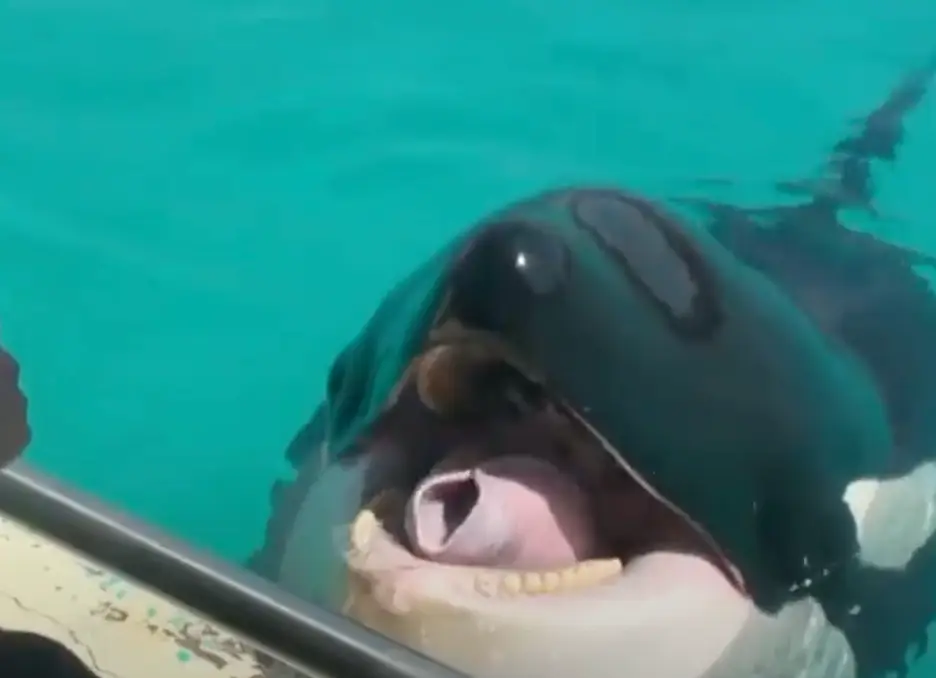
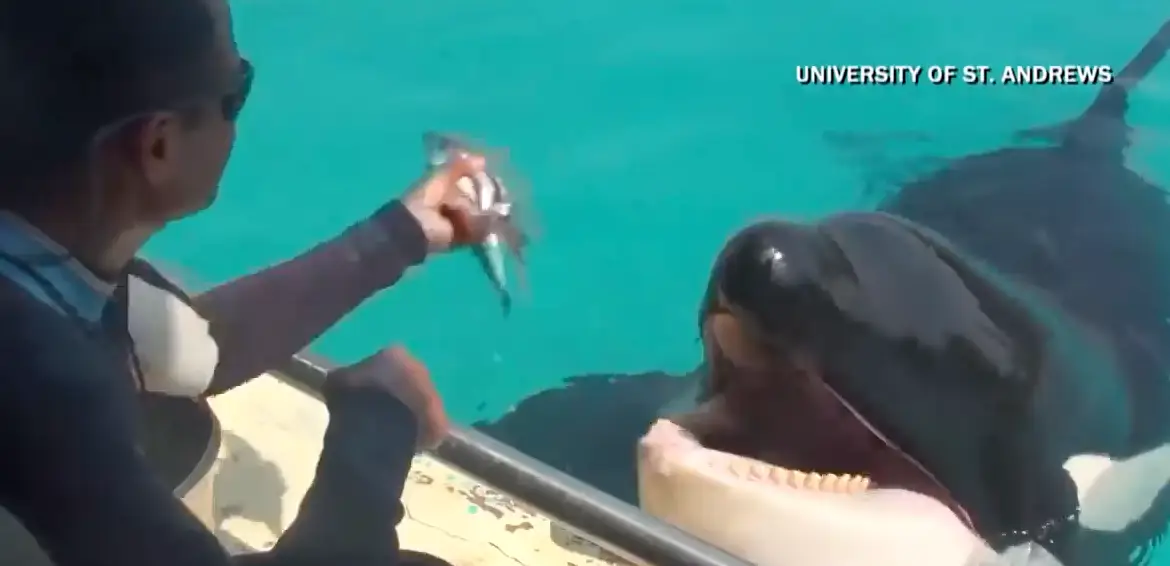
Listeners encountering the recordings online have reacted with a mixture of awe and horror. “The hello sounded demonic,” one viewer commented. Another wrote: “OK, that second hello was a little demonic. Was that really an orca, or the Devil speaking through a ghost box LOL The funniest and scariest thing EVER! That’s my day, can’t stop laughing my head off lol.”
Others emphasized the wonder of the discovery. “This makes me tear up, the fact that we live in a such a beautiful world filled with wonderful creatures,” one person shared.
The recordings sound particularly strange because Wikie’s vocal apparatus differs so dramatically from human anatomy. “Even though the morphology [of orcas] is so different, they can still produce a sound that comes close to what another species, in this case us, can produce,” Call noted. Yet he added a crucial caveat: “We have no evidence that they understand what their ‘hello’ stands for.”
The study’s broader significance lies in what it suggests about wild orca behavior. The dialects observed among different killer whale populations in the ocean may originate from this capacity for vocal imitation. “This is something that could be the basis of the dialects we observe in the wild – it is plausible,” Call said. He emphasized, however, that further trials with wild orcas would be necessary to understand how they naturally acquire sounds.